What Makes Diamond a Mineral?
Finding the perfect diamond can feel overwhelming. You want something beautiful and genuine, but with so many options and details to consider, it’s easy to get lost. You’re not alone—many people struggle to understand what truly makes a diamond special and worth the investment.
You recognize a diamond as a mineral because it forms naturally as an inorganic solid with a definite chemical composition—pure carbon arranged in a rigid, repeating crystal structure deep in the Earth’s mantle. Its unique tetrahedral atomic bonds give it exceptional hardness and stability.
Diamonds form under extreme heat and pressure over millions of years, distinguishing them from rocks or synthetic gems.
Keep exploring to understand what truly makes diamonds extraordinary and how they differ from common misconceptions.
Key Takeaways
- Diamonds are naturally occurring, inorganic solids with a definite chemical composition of pure carbon (C).
- They have an ordered atomic structure forming crystals with a consistent tetrahedral lattice.
- Diamonds exhibit specific physical properties such as extreme hardness and cleavage because of strong covalent bonds.
- Their formation deep in Earth’s mantle under high pressure and temperature confirms their natural mineral origin.
- Diamonds possess well-defined crystal symmetry and stability. This means they meet all criteria that classify them as minerals.
What Is a Mineral in Geology?
Minerals are the building blocks of the Earth’s crust, and understanding what makes a substance a mineral is key to studying geology. When you look at the mineral definition, you’ll find that minerals are naturally occurring, inorganic solids with a definite chemical composition and an ordered atomic structure.
These mineral characteristics distinguish them from other substances. For example, you’ll notice that minerals form crystals due to their internal structure, and they have specific physical properties like hardness, color, and cleavage. When you identify a mineral, you rely on these traits to determine what it is.
Why Are Diamonds Classified as Minerals, Not Rocks?
Although both diamonds and rocks come from the Earth, diamonds are classified as minerals because they have a specific chemical composition and a well-defined crystal structure. When you examine diamond properties, you’ll find they consist purely of carbon atoms arranged in a rigid lattice.
This precise organization fits the criteria for mineral classification, which requires a consistent chemical formula and an orderly atomic structure. Rocks, on the other hand, are made up of multiple minerals or mineral-like substances without a fixed composition.
How Do Diamonds Form Deep Inside the Earth?
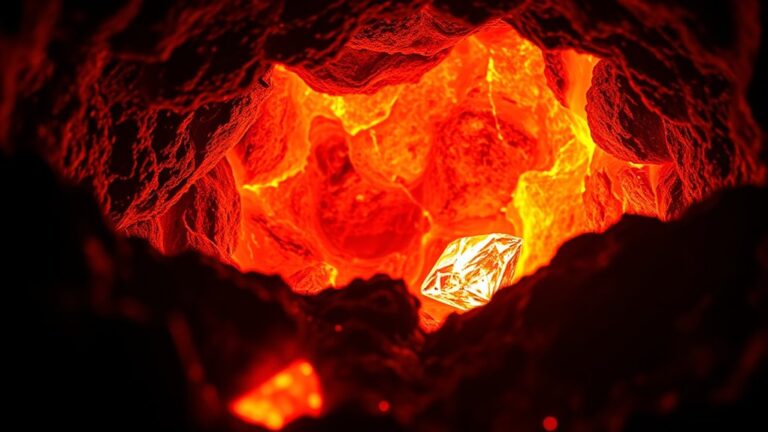
When carbon atoms experience extreme heat and pressure deep within the Earth’s mantle, they begin to bond tightly, forming the crystal structure that defines diamonds. This process marks the start of diamond genesis, where carbon transforms into a unique mineral with remarkable hardness and brilliance.
As you learn about diamond genesis, you’ll see why diamonds fall under mineral classification. They have a consistent chemical composition and crystalline structure. These diamonds form at depths of about 140 to 190 kilometers, where conditions are just right for carbon atoms to rearrange.
Volcanic eruptions then transport these diamonds closer to the surface, allowing you to find them in kimberlite pipes. Understanding this natural formation helps clarify why diamonds are distinct minerals, not just any ordinary rocks.
How Heat and Pressure Form Diamonds
You’ll see how carbon atoms change their structure under intense heat and pressure deep in the Earth. Basically, these extreme conditions force carbon to form a tight crystal lattice, which is what makes diamonds so strong. And remember, this whole transformation doesn’t happen overnight—it takes millions of years to complete.
Carbon Transformation Process
Because carbon atoms need extreme conditions to rearrange into diamonds, they undergo a transformation deep within the Earth’s mantle. This process is part of the carbon cycle, where carbon shifts between different forms.
In this intense environment, carbon atoms bond tightly, creating diamond allotropes, which are unique crystal structures that distinguish diamonds from other minerals.
Here’s a quick look at the carbon transformation process:
| Stage | Carbon Form | Description |
|---|---|---|
| 1. Carbon Source | Organic Carbon | Carbon from dead plants and animals |
| 2. Burial | Graphite | Carbon atoms arrange in layers |
| 3. Heat & Pressure | Diamond Allotropes | Atoms form a rigid 3D lattice |
| 4. Uplift | Kimberlite | Volcanic rock brings diamonds closer to surface |
| 5. Mining | Gem-Quality Diamond | Extracted for use in jewelry and industry |
Role of Extreme Conditions
The intense heat and pressure deep within the Earth’s mantle force carbon atoms to rearrange into the rigid lattice structure that defines diamonds. You’ll find that these extreme environments are essential for diamond formation, as they trigger unique geological processes that transform carbon.
Without such conditions, carbon remains graphite or other forms. Here’s what you should know about this role of heat and pressure:
- Temperatures around 1,000 to 1,300 degrees Celsius
- Pressures exceeding 45,000 times atmospheric pressure
- Depths between 140 to 190 kilometers beneath the surface
- The mantle’s chemical environment aiding carbon stability
- Rapid cooling and transport to the surface through volcanic eruptions
Geological Time Requirements
Although heat and pressure create the perfect conditions for diamond formation, this transformation doesn’t happen overnight. It takes millions to billions of years, spanning several geological eras, for carbon atoms to rearrange into the crystal structure that defines diamond.
As you study mineral classification, you’ll see that diamonds are unique because their formation requires not just specific conditions but also vast amounts of time deep within the Earth’s mantle. These prolonged periods allow the carbon to bond tightly, giving diamonds their hardness and clarity.
Without such extended geological time requirements, diamonds wouldn’t develop their characteristic properties that qualify them as minerals. So, when you hold a diamond, you’re literally holding a piece of Earth’s ancient history shaped by time, heat, and pressure.
Chemical Composition of Diamond Minerals
When you examine diamonds closely, you’ll find they’re composed almost entirely of carbon atoms arranged in a crystal lattice. This simple yet unique diamond chemistry plays an essential role in its mineral classification.
Unlike other minerals, diamonds consist of a single element, carbon, making them pure and distinct. Understanding this chemical composition helps you appreciate why diamonds fit firmly into the mineral category.
Here are key points about diamond’s chemical composition:
- Made exclusively of carbon atoms
- Carbon atoms bonded in a tetrahedral structure
- Pure elemental composition distinguishes it from compounds
- Consistent chemical formula: C
- Chemical stability under high pressure and temperature conditions
Knowing this helps you grasp the fundamental reasons diamonds qualify as minerals.
How Diamond’s Crystal Structure Creates Hardness
You’ll notice that diamond’s hardness comes from how its atoms are arranged in a strong, repeating pattern. The covalent bonds between carbon atoms hold everything tightly together. Because of this stable crystal lattice, diamond is incredibly tough and durable.
Atomic Arrangement Patterns
Because diamond’s atoms connect in a tightly bonded, three-dimensional lattice, the mineral achieves unmatched hardness. This arrangement relies heavily on crystal symmetry, which organizes atoms into a repeating pattern that maximizes stability.
You’ll notice that each carbon atom forms atomic bonds with four neighbors, creating a rigid framework. This uniform pattern distributes force evenly, preventing fractures. When you examine diamond’s atomic arrangement, you’ll see:
- A cubic crystal symmetry pattern
- Each atom tetrahedrally bonded to four others
- A continuous network without gaps
- Strong directional atomic bonds
- A stable, repeating lattice structure
This precise atomic arrangement is what makes diamond incredibly durable and resistant to scratching or breaking. Understanding these patterns helps you appreciate why diamond stands out as a mineral.
Covalent Bond Strength
The tightly bonded atomic lattice of diamond sets the stage for the incredible strength you experience at the macroscopic level. Each carbon atom forms a strong covalent bond with four neighboring atoms, creating an interconnected three-dimensional network.
This covalent bond is one of the strongest chemical bonds, giving diamond its remarkable hardness, a defining mineral characteristic. When you try to scratch or break diamond, you’re actually working against this robust bonding system, which resists deformation.
Unlike minerals held together by weaker forces, diamond’s hardness directly results from these strong covalent bonds holding its crystal structure tightly together. This explains why diamond stands out among minerals, combining a natural crystalline form with extraordinary durability thanks to the power of covalent bonding.
Crystal Lattice Stability
While strong covalent bonds form the foundation of diamond’s hardness, its crystal lattice stability plays an equally important role. You see, the unique arrangement of carbon atoms in a rigid, repeating three-dimensional network gives diamond exceptional crystal stability. This stability resists deformation and contributes directly to diamond’s place in mineral classification as one of the hardest minerals.
Here’s why crystal lattice stability matters:
- Each carbon atom bonds with four others in a tetrahedral shape
- The lattice remains intact under extreme pressure
- Defects in the lattice are rare, preserving strength
- The stable structure disperses stress evenly
- This orderliness guarantees consistent hardness throughout
Understanding crystal stability helps you appreciate why diamond isn’t just hard because of bonds, but because of its flawless internal framework.
Unique Physical Properties of Diamonds
When you hold a diamond, you quickly notice its unmatched hardness and brilliance, making it stand out among other minerals. This incredible hardness, rated 10 on the Mohs scale, allows diamonds to resist scratching and maintain their sharp facets.
Beyond toughness, the diamond brilliance enchants you instantly; it’s the result of its exceptional optical properties. The way diamonds bend and reflect light creates that fiery sparkle, or “fire,” which you won’t find in most other minerals.
These optical properties include a high refractive index and strong dispersion, causing light to separate into vibrant colors. Together, these unique physical traits don’t just make diamonds beautiful, they’re also essential in defining why diamonds qualify as minerals with extraordinary qualities.
How Natural Diamonds Differ From Synthetic Gems
You’ll notice natural diamonds form deep within the Earth under intense heat and pressure over millions of years. On the other hand, synthetic gems are created in labs much faster. Even though they share similar chemical structures, there are subtle physical and chemical differences that set them apart. Knowing these distinctions helps you appreciate what makes natural diamonds truly unique.
Formation Processes Compared
Because natural diamonds form deep within the Earth’s mantle over billions of years, their creation process contrasts sharply with synthetic gems produced in laboratories. When you investigate diamond genesis, you’ll see natural diamonds emerge under intense pressure and temperature, fitting their mineral classification as naturally occurring crystalline carbon.
Synthetic diamonds, however, grow through controlled processes like High Pressure High Temperature (HPHT) or Chemical Vapor Deposition (CVD), which mimic nature but in much shorter timescales.
Key differences in formation include:
- Natural diamonds require geological timescales
- Synthetics form in weeks or months
- Natural diamonds reflect Earth’s mantle environment
- Lab diamonds grow in engineered settings
- Mineral classification recognizes natural origin as key
Understanding these formation processes helps you appreciate what sets natural diamonds apart.
Physical and Chemical Differences
Although natural and synthetic diamonds share the same basic chemical composition, pure carbon arranged in a crystal lattice, they differ noticeably in physical and chemical characteristics. You’ll find natural diamonds often exhibit unique color variations and inclusions that affect gemstone clarity, while synthetic ones tend to be more uniform and flawless.
On hardness scales, both score comparably, but subtle differences arise from growth conditions. Natural diamonds carry historical significance and cultural symbolism tied to their origin, boosting their market value.
Synthetic diamonds, favored for ethical sourcing, are widely used in industrial applications due to consistent quality and lower cost. Understanding these distinctions helps you appreciate why natural diamonds remain prized despite the rise of lab-grown alternatives, each offering distinct benefits depending on your needs and values.
Common Misconceptions About Diamonds as Minerals
Misunderstandings about diamonds often arise from their glamorous reputation rather than their scientific nature. You might encounter diamond myths that blur the line between popular belief and mineral education. It’s easy to forget that diamonds are minerals formed through natural geological processes, not just luxury items.
Here are some common misconceptions you should be aware of:
- Diamonds are rare; in reality, they’re relatively abundant in Earth’s mantle.
- All diamonds are flawless and colorless.
- Diamonds form from coal.
- Diamonds aren’t minerals because they’re man-made or synthetic.
- The value of a diamond reflects its scientific significance.
Knowing these myths helps you appreciate diamonds for their true mineralogical identity, not just their sparkle.
Why Understanding Diamonds as Minerals Matters for Science
When you recognize diamonds as minerals formed deep within the Earth, you reveal valuable insights into our planet’s geology and the conditions that create extreme pressure and temperature. Understanding diamond classification helps you appreciate how these minerals differ from others based on their crystal structure and chemical composition.
This perspective highlights the mineral significance of diamonds beyond their beauty or economic value. By studying diamonds as minerals, you gain clues about Earth’s mantle and tectonic processes. This knowledge aids scientists in unraveling Earth’s history and the dynamic forces shaping it.
Frequently Asked Questions
How Are Diamonds Mined and Extracted From the Earth?
You mine diamonds by locating kimberlite pipes where diamond formation occurred deep underground. Extraction techniques include open-pit mining for shallow deposits and underground mining for deeper ones.
After blasting or digging, you crush the ore and use heavy machinery to separate diamonds from other materials. Sometimes, alluvial mining collects diamonds from riverbeds.
These methods let you efficiently retrieve diamonds formed under extreme pressure millions of years ago.
What Industries Use Diamonds Besides Jewelry?
Ever wonder how diamonds cut through more than just hearts? You’ll find them shining in industrial applications, like cutting, grinding, and drilling tools, thanks to their unmatched hardness.
Synthetic diamonds, in particular, play a huge role here, offering consistent quality for precision work in electronics and manufacturing.
Can Diamonds Be Recycled or Reused?
Yes, you can recycle or reuse diamonds thanks to their incredible durability. Because diamonds are so tough, they maintain their brilliance even after being reset or repurposed.
When you choose to recycle diamonds, you also support ethical sourcing by reducing demand for new mining. So, by reusing diamonds, you not only preserve their beauty but also contribute to more responsible and sustainable jewelry practices.
How Do Diamonds Affect the Environment During Mining?
You should know that diamonds impact the environment considerably during mining. Mining practices often lead to habitat destruction, soil erosion, and water pollution, increasing the environmental impact.
If you care about sustainability, you’ll want to look for diamonds sourced through responsible mining practices that minimize harm. By choosing recycled or ethically mined diamonds, you can reduce your contribution to these negative effects and support better environmental stewardship in the industry.
What Are the Most Famous Diamonds in History?
Imagine holding the Hope Diamond, famed for its deep blue hue and mysterious curse, reflecting how famous diamonds carry stories beyond their sparkle. You’ll find that diamonds like the Koh-i-Noor and the Cullinan also boast incredible historical significance, symbolizing power and legacy across centuries.
These gems aren’t just beautiful; they’re storytellers, connecting you to royal histories and legendary tales etched in time, shining far brighter than their physical brilliance alone.
Conclusion
You might not realize it, but the diamond you admire as a gem is also a mineral formed deep within Earth’s mantle. Isn’t it fascinating that something so precious and beautiful owes its existence to intense heat and pressure, just like many other minerals?
Understanding diamonds as minerals not only deepens your appreciation but also connects you to the planet’s powerful natural processes. It shows how beauty and science often coincide in the most unexpected ways, making diamonds truly remarkable minerals.