What Is Diamond and Is It an Element?
Trying to find the perfect gemstone that combines beauty, durability, and timeless appeal can be overwhelming. You’re not alone if you’ve struggled to understand what makes diamonds so special or why they stand out from other stones.
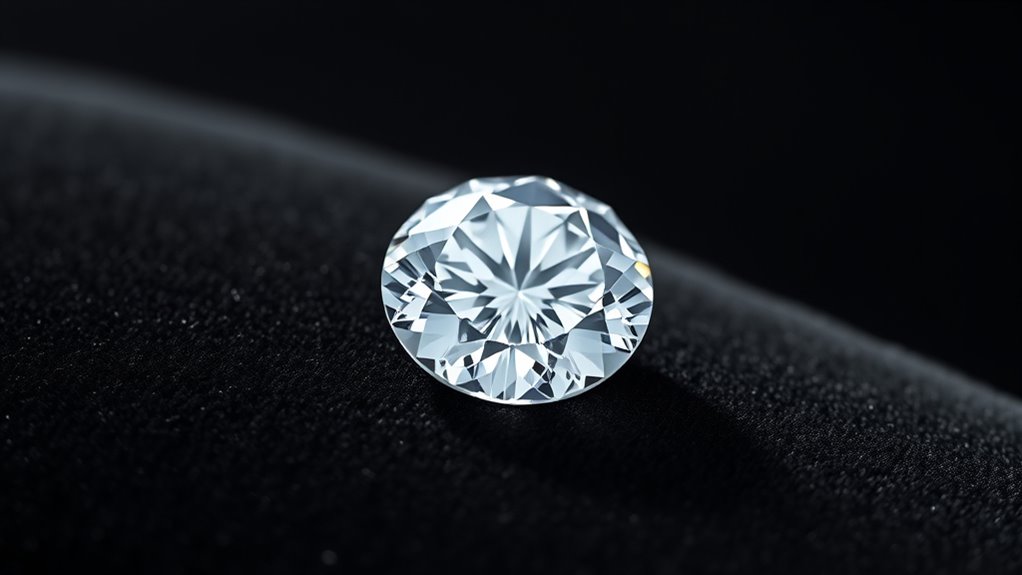
A diamond is made entirely of carbon atoms arranged in a unique, rigid crystal structure that gives it unmatched hardness and brilliance. It’s not an element itself, but an allotrope of carbon meaning it has the same atoms as graphite or graphene, just bonded differently.
This special arrangement creates strong covalent bonds that make diamond incredibly durable and sparkly.
If you want to understand what sets diamonds apart and how they’re made, there’s plenty more to investigate.
Key Takeaways
- Diamond is a carbon allotrope composed entirely of carbon atoms arranged in a strong, three-dimensional crystal lattice.
- It is not an element but a form of carbon with unique atomic bonding and structure.
- Each carbon atom in diamond bonds tetrahedrally to four others, creating extreme hardness and stability.
- Diamond differs from other carbon allotropes like graphite and fullerenes due to its distinct atomic arrangement.
- Its properties arise from bonding and structure, not from being a unique atomic species on the periodic table.
What Is a Diamond Made Of?
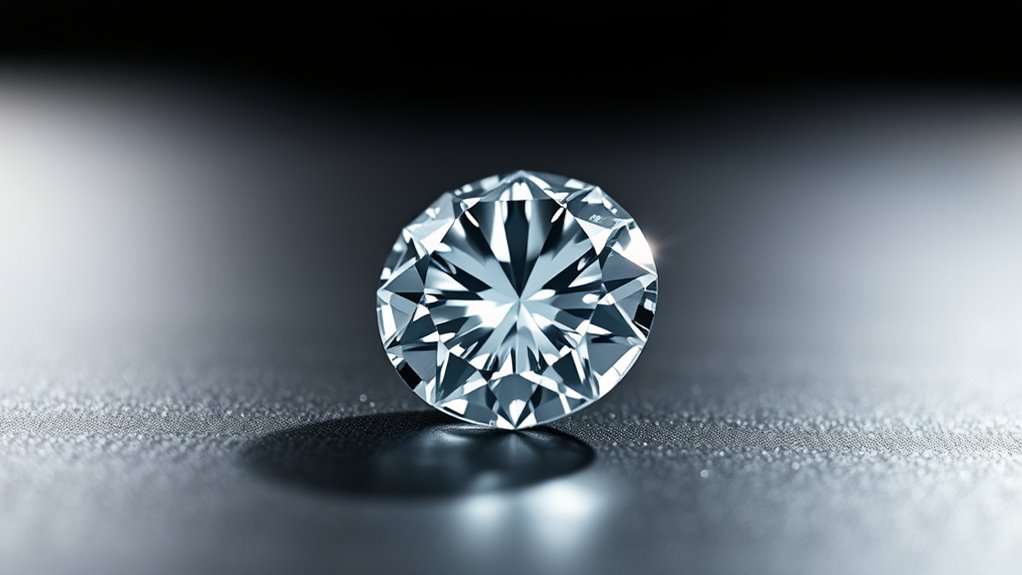
A diamond is made entirely of carbon atoms arranged in a crystal lattice. When you look closely at diamond properties, you’ll see that this unique atomic structure gives it remarkable hardness and brilliance.
Diamonds are one of several carbon allotropes, meaning they are different structural forms of the same element, carbon. Unlike graphite or graphene, diamonds have each carbon atom bonded to four others in a rigid, three-dimensional network.
This arrangement explains why diamonds are so tough and why they refract light so beautifully. Understanding that diamonds are a carbon allotrope helps you appreciate their distinct qualities compared to other forms of carbon.
Why Isn’t Diamond Classified as an Element?
Despite diamond’s unique structure and impressive properties, you won’t find it listed as an element on the periodic table. The reason lies in the element definition and diamond classification. An element consists of only one type of atom. Diamond, however, is a form of carbon atoms arranged in a specific way, not a separate element itself.
Here’s why diamond isn’t classified as an element:
- It’s made entirely of carbon atoms, not a unique atomic species
- Its structure is a variation, called an allotrope, of the element carbon
- The element definition focuses on atomic identity, not molecular arrangement
- Diamond’s properties stem from bonding and structure, not elemental composition
How Do Carbon Atoms Form Diamond’s Structure?
When carbon atoms bond in a specific way, they create the incredibly strong and rigid structure that defines diamond. You’ll find that in diamond, each carbon atom forms four strong covalent bonds with neighboring carbon atoms, arranging themselves in a precise, repeating pattern.
This atomic arrangement results in a three-dimensional network where every atom connects uniformly, maximizing strength and stability. This carbon bonding is what sets diamond apart from other forms of carbon, like graphite, where atoms bond differently.
What Makes Diamond’s Crystal Structure So Unique?
Although many materials form crystals, diamond’s crystal structure stands out because of its perfect symmetry and incredible strength. You’ll find that the atomic arrangement in diamonds is highly ordered, with each carbon atom covalently bonded to four others in a tetrahedral shape.
This creates an exceptionally stable and rigid 3D network. The crystal symmetry of diamond is cubic, which contributes to its uniformity and unique physical properties. Here’s what makes it so unique:
- Each carbon atom forms strong covalent bonds in a precise pattern
- The tetrahedral atomic arrangement maximizes structural integrity
- Its cubic crystal symmetry guarantees uniformity in all directions
- The tightly packed structure results in minimal atomic movement
This atomic arrangement and symmetry make diamond’s crystal truly one of a kind.
How Does Diamond’s Structure Affect Hardness and Brilliance?
Diamond’s perfectly ordered atomic structure doesn’t just make it strong; it directly influences its unmatched hardness and sparkling brilliance. When you look at diamond hardness, it’s the rigid lattice of carbon atoms bonded tightly in a tetrahedral arrangement that gives it incredible structural integrity.
This makes diamond the hardest natural material, resisting scratches and abrasions that would damage other substances. Beyond toughness, the same structure affects brilliance factors by guiding how light interacts with the stone.
Its optical properties, including high refractive index and dispersion, cause light to bend and reflect internally, creating that dazzling sparkle you see. So, the atomic arrangement isn’t just about strength. It’s key to diamond’s signature shine and durability you admire.
What Other Forms of Carbon Exist Besides Diamond?
How many different forms of carbon can you name besides diamond? Carbon exists in several allotropes, each with unique properties due to differences in atomic arrangement. These carbon allotropes vary widely in structure and use.
For example, the graphite structure is made of layers of carbon atoms arranged in hexagonal patterns, allowing it to conduct electricity. Here are four common carbon allotropes you should know:
- Graphite: Soft, layered, conducts electricity
- Fullerenes: Spherical molecules, useful in nanotechnology
- Carbon nanotubes: Cylindrical, extremely strong and light
- Amorphous carbon: Lacks a defined structure, found in soot and charcoal
Understanding these forms helps you appreciate carbon’s versatility beyond just diamonds.
How Does Diamond Compare to Graphite and Other Allotropes?
You’ll notice that diamond’s structure makes it incredibly hard. On the other hand, graphite’s layered form lets it slide easily. These differences affect their physical properties and how we use them in everyday life. So, let’s compare these allotropes to see why each one fits unique roles.
Structural Differences Explained
Although both diamond and graphite are made entirely of carbon atoms, their structures differ dramatically. This explains their contrasting properties. These carbon allotropes form distinct crystal lattices that affect their behavior.
Diamond features a rigid three-dimensional crystal lattice where each carbon atom bonds tetrahedrally to four others. This creates unparalleled hardness. Graphite, on the other hand, has layers of carbon atoms arranged in hexagonal sheets. These layers are held together loosely by van der Waals forces, allowing them to slide easily.
Other carbon allotropes like graphene and fullerenes exhibit distinctive lattice structures too. Here’s what sets diamond apart structurally:
- Strong covalent bonds in a 3D network
- Tetrahedral crystal lattice arrangement
- No free electrons within the lattice
- Extremely stable and rigid framework
Understanding these differences helps you grasp why diamond behaves so exceptionally among carbon allotropes.
Physical Properties Comparison
Diamond stands out among carbon allotropes because of its remarkable physical properties that contrast sharply with those of graphite and others. You’ll notice diamond durability far exceeds that of graphite, thanks to its strong tetrahedral bonding, making it the hardest natural material.
While graphite is soft and opaque, diamond’s brilliance and clarity define its unique diamond aesthetics, contributing to its timeless diamond symbolism as a symbol of strength and love. Diamond rarity and diamond sourcing also set it apart; diamonds form deep within the Earth over billions of years, a process rooted in diamond history that adds to their mystique.
Unlike graphite’s layered structure, diamond’s compact network gives it exceptional thermal conductivity and electrical insulation, enhancing its distinctive physical profile among carbon allotropes.
Uses and Applications
In relation to uses and applications, diamond’s unmatched hardness and thermal conductivity make it invaluable in cutting, grinding, and drilling tools where durability matters most. Unlike graphite, which is soft and slippery, diamond withstands extreme conditions, making it the preferred choice for many industrial applications.
You’ll find diamonds used not only in the gemstone market but also in sectors requiring precision and endurance. Here’s how diamond stands out:
- Cutting tools for metal and stone
- High-performance drill bits
- Heat sinks in electronics
- Jewelry and luxury goods
While graphite excels as a lubricant and in batteries, diamond’s unique properties give it a distinct edge in both industrial and aesthetic fields. Understanding these differences helps you appreciate why diamond remains irreplaceable despite other carbon allotropes.
Can Diamonds Be Created Artificially? How?
You might be curious if diamonds can actually be made in a lab instead of being mined from the earth. Well, the answer is yes! There are a couple of methods, like High Pressure High Temperature (HPHT) and Chemical Vapor Deposition (CVD), that make this possible. These techniques allow scientists to create synthetic diamonds that have qualities very similar to natural ones. It’s pretty fascinating how technology can replicate something so precious, right?
Methods Of Synthetic Creation
Although natural diamonds form over millions of years deep within the Earth, scientists have developed ways to create them in laboratories much faster. Synthetic diamonds are produced using advanced production techniques that mimic natural processes or use entirely different methods. These methods allow you to obtain diamonds with similar physical and chemical properties as natural ones.
Key production techniques for synthetic diamonds include:
- Chemical Vapor Deposition (CVD), which grows diamonds from carbon-rich gas.
- Detonation Synthesis, using controlled explosions to form nanodiamonds.
- High-Pressure High-Temperature (HPHT), simulating Earth’s conditions (discussed later).
- Plasma Arc techniques, employing plasma to convert carbon into diamond.
High Pressure High Temperature
Among the various synthetic diamond production methods, High Pressure High Temperature (HPHT) stands out for its ability to closely replicate the natural formation conditions of diamonds deep within the Earth. You create diamonds by subjecting carbon sources to high pressure environments, around 5 GPa, and temperatures exceeding 1,300°C.
These intense temperature effects cause the carbon atoms to rearrange into the diamond’s crystal structure. By carefully controlling pressure and temperature, you can produce gem-quality synthetic diamonds in a lab setting.
This method mimics how diamonds form in the mantle, compressing graphite or other carbon materials until they transform into diamond. HPHT is widely used because it yields diamonds with properties nearly identical to natural ones, making it a reliable technique for artificial diamond creation without relying on mining.
Chemical Vapor Deposition
Harnessing advanced technology, Chemical Vapor Deposition (CVD) allows you to create diamonds by depositing carbon atoms onto a substrate in a controlled gas environment. The CVD process involves breaking down gas molecules, usually methane and hydrogen, under low pressure and high heat. This method produces high-quality diamonds with fewer impurities than traditional techniques.
You’ll find CVD diamonds used in various diamond applications such as:
- Jewelry, offering affordable alternatives to natural stones
- Electronics, for heat sinks and semiconductors
- Cutting tools, providing exceptional hardness
- Optical devices, thanks to their transparency and durability
Why Have Diamonds Fascinated Humans for Centuries?
Because diamonds combine extraordinary beauty with remarkable rarity, they’ve enchanted human fascination for centuries. You can’t help but notice their diamond allure, which draws attention through sparkling brilliance and timeless elegance.
Their historical significance runs deep, symbolizing power and status across cultures, while cultural symbolism ties them to love, commitment, and eternity. You appreciate their rarity appeal, knowing each diamond’s uniqueness adds to its value.
Beyond emotional connections, diamonds serve as a smart investment, retaining worth over time. Their scientific intrigue also fascinates you, as you consider their formation under extreme conditions.
Artists find inspiration in diamonds’ clarity and form, fueling creativity worldwide. Together, these factors explain why diamonds continue to enchant your imagination and admiration.
How Does Knowing Diamond’s Composition Change Our View of Gems?
When you understand diamond’s unique carbon structure, it’s easier to see why it’s so incredibly hard and brilliant. And once you know that, it changes the way you value gems. It’s not just about how beautiful a stone looks—there’s a whole chemistry side to it. Knowing what makes diamonds special can really shift how you appreciate all kinds of gems.
Chemical Makeup Insights
Understanding diamond’s chemical makeup reveals why it stands apart from other gems, and it changes how you appreciate its value and uniqueness. Diamonds are pure carbon, arranged in a crystal lattice that makes them the hardest natural material.
This structure, a key carbon allotrope, sets diamonds apart from graphite and other forms of carbon. Knowing this, you realize diamond properties aren’t just about sparkle but atomic structure.
This insight helps you see gems differently:
- Diamonds’ hardness stems from strong carbon bonds.
- The crystal structure influences their brilliance.
- Carbon allotropes explain diverse physical traits.
- Pure composition means consistent chemical behavior.
Gem Value Perception
Although many admire diamonds for their sparkle alone, knowing their chemical composition changes how you value them. Understanding that diamonds are pure carbon arranged in a crystal lattice highlights the scientific marvel behind their gem aesthetics.
This knowledge can deepen your appreciation beyond just their brilliance, revealing why their hardness and light refraction are unmatched. You start to see diamonds not just as pretty stones but as natural wonders shaped by nature’s forces over millions of years.
This insight also elevates their cultural significance, as you realize the rarity and complexity behind what many cultures prize as symbols of love and status. Ultimately, knowing what diamonds are made of transforms your perception, making their value more than skin-deep and blending science with tradition.
Frequently Asked Questions
How Are Diamonds Used in Modern Technology Beyond Jewelry?
You’ll find diamond applications far beyond jewelry. In modern technology, diamonds’ hardness and thermal conductivity make them perfect for cutting, grinding, and drilling tools.
You’ll also see diamonds in heat sinks for electronics, improving performance by efficiently dissipating heat. Their industrial uses extend to high-precision optics and semiconductors, where diamonds help boost durability and efficiency.
What Environmental Impacts Result From Diamond Mining?
You’ll find that diamond mining causes significant environmental impacts like water pollution and habitat destruction. When mining disrupts ecosystems, it often contaminates nearby water sources with chemicals and sediment, harming aquatic life.
Plus, clearing land for mining operations destroys habitats, threatening wildlife. If you care about the environment, it’s important to reflect on these effects and support more sustainable practices or alternatives to reduce the damage caused by traditional diamond mining.
How Can You Tell the Difference Between Real and Fake Diamonds?
You can tell the difference between real and fake diamonds by using a few tests. Real diamonds, including lab-created diamonds, have unique hardness and sparkle that diamond simulants often lack.
Try the fog test. Breathe on the stone. Real diamonds disperse heat quickly and won’t stay fogged.
You can also check for imperfections under a magnifier. Lab-created diamonds may look flawless, while simulants usually have visible flaws or different refractive qualities.
What Is the Significance of Diamond Grading and Certification?
Diamond grading and certification matter because they help you understand diamond quality clearly. Grading standards evaluate cut, color, clarity, and carat weight, ensuring you know exactly what you’re buying.
Certification from a trusted lab guarantees the diamond’s authenticity and value, protecting you from scams or overpaying. When you rely on these standards, you can confidently compare diamonds and make smarter, informed choices.
Are There Ethical Concerns Related to Diamond Sourcing?
Yes, you should be aware of ethical concerns related to diamond sourcing. Conflict diamonds, also known as blood diamonds, fund violence and human rights abuses in some regions.
To avoid supporting these issues, you can look for diamonds with ethical sourcing certifications like the Kimberley Process, which aims to prevent conflict diamonds from entering the market. By choosing certified diamonds, you help promote responsible practices and guarantee your purchase doesn’t contribute to harm.
Conclusion
Now that you know diamonds are pure carbon, not elements themselves, you see them as nature’s dazzling puzzle. Their unique crystal structure is like a tightly woven tapestry, giving them unmatched hardness and sparkle.
Whether natural or lab-made, diamonds show how carbon can transform into something extraordinary. So next time you admire a diamond, remember it’s not just a gem; it’s carbon’s brilliant masterpiece shining through time. Diamonds truly reveal the incredible potential of carbon.