
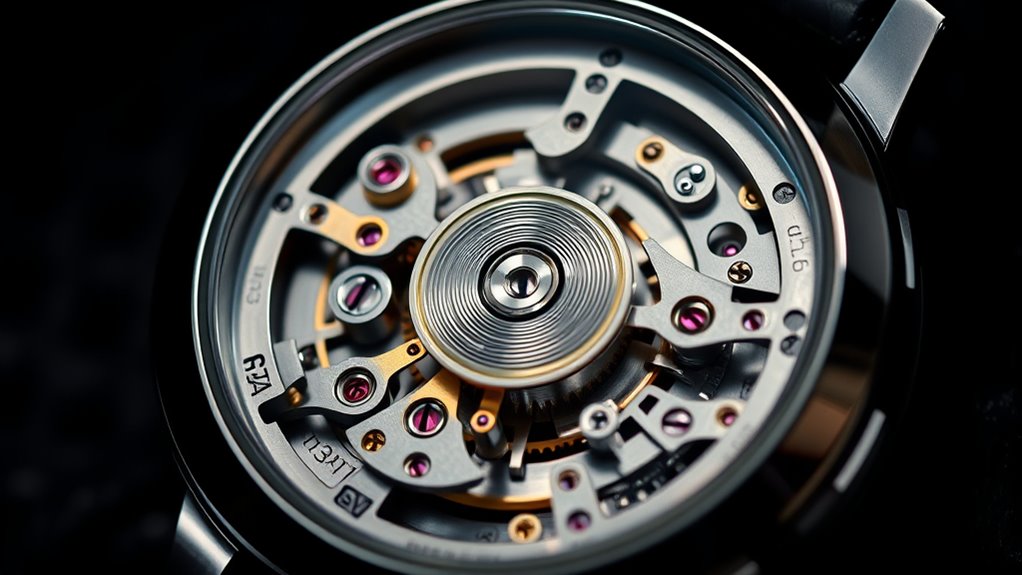
How Do Self-Winding Watches Work Step by Step
Struggling to keep your watch running without the hassle of constant winding? You’re not alone. Many people find it frustrating to remember to wind their watch regularly or deal with stopping timepieces.
That’s why self-winding watches have become so popular—they offer a hands-free way to keep your watch powered and accurate.
You keep your self-winding watch powered by moving your wrist naturally, which spins a rotor inside the case. This rotor captures kinetic energy and transfers it through a gear train to wind the mainspring.
The escapement then regulates this stored energy, ensuring accurate timekeeping by controlling energy release.
Wearing your watch daily maintains its power reserve, avoiding manual winding. If you’re curious about its efficiency and care tips, there’s more to investigate here.
Key Takeaways
- Wrist movement causes the rotor inside the watch to pivot and spin, capturing kinetic energy.
- The rotor’s rotation transfers energy through a gear train to wind the mainspring.
- The mainspring stores energy, powering the watch’s movement steadily over time.
- The escapement regulates energy release, ensuring accurate timekeeping by controlling the balance wheel.
- Regular wrist motion keeps the rotor active, maintaining the power reserve without manual winding.
What Is a Self-Winding Watch? How Does It Differ From Manual Watches?

Although both self-winding and manual watches rely on mechanical movements, a self-winding watch automatically winds itself using the motion of your wrist. A manual watch, on the other hand, requires you to wind it by hand regularly.
You’ll appreciate the benefits of a self-winding watch, especially the convenience of not having to remember daily winding. These watches keep running as long as you wear them, reducing the risk of stopping unexpectedly.
Manual winding demands regular attention to maintain power. Some find this process rewarding, while others might see it as a hassle.
If you prefer a watch that keeps going without extra effort, a self-winding model suits you better. But if you enjoy the ritual of winding your watch, manual winding offers that connection.
How Wrist Movement Powers a Self-Winding Watch
When you move your wrist, a rotor inside the watch spins freely. This spinning rotor transfers energy to wind the mainspring automatically. So, every little movement you make actually helps keep your watch running.
Let’s take a closer look at how this simple motion powers your watch all day long. It’s pretty cool how something as natural as moving your arm can keep the time ticking without any extra effort from you.
Rotor Movement Mechanism
Since your wrist is constantly in motion throughout the day, the rotor inside a self-winding watch spins freely with each movement you make. This spinning rotor is an essential part of the winding system, designed to convert your natural wrist motions into energy.
The rotor design typically features a semicircular shape that pivots around a central axis, allowing it to swing smoothly in either direction. As you move, gravity causes the rotor to rotate, harnessing kinetic energy without requiring any manual winding.
This clever mechanism guarantees that the watch remains powered as long as you wear it regularly. The rotor’s efficient design maximizes energy capture from even subtle wrist movements, keeping your watch running accurately and reliably day after day.
Energy Transfer Process
Three key components work together to transfer the energy generated by your wrist’s movement into the watch’s mainspring. First, the rotor spins with your wrist motion, converting kinetic energy. Then, a series of gears and a winding mechanism channel this energy effectively.
Finally, the mainspring stores the energy, powering the watch. This process relies heavily on energy conservation and mechanical efficiency to guarantee your watch stays wound without excess wear.
Here’s how the energy transfer maintains peak function:
- Rotor captures motion energy
- Gear train amplifies and directs power
- Winding mechanism engages the mainspring
- Energy conservation minimizes losses
- Mechanical efficiency maximizes power storage
Step 1: How Wrist Motion Starts the Winding Process
A subtle movement of your wrist sets the entire winding process in motion. Your wrist mechanics play an essential role here, as even small, natural motions trigger the watch’s self-winding mechanism.
When you move, your wrist causes internal components to respond without any extra effort from you. This seamless connection between your movements and the watch’s mechanism guarantees winding efficiency, allowing the watch to maintain power consistently throughout the day.
The design cleverly harnesses your everyday gestures, turning motion into energy. By relying on your wrist’s natural activity, the watch stays wound without manual intervention, making it both convenient and reliable.
Understanding this first step highlights how your body’s motion directly influences the watch’s ability to keep ticking accurately.
Step 2: How the Rotor Spins Inside the Case
As your wrist moves, it sets a small, weighted component called the rotor into motion inside the watch case. The rotor’s design is essential. It’s mounted on a central pivot, allowing it to spin freely with your natural movements.
This spinning mechanics harness kinetic energy efficiently, regardless of your wrist’s direction. Here’s what makes the rotor spin smoothly:
- Balanced weight distribution for consistent rotation
- Low-friction pivots to reduce resistance
- Free-spinning 360-degree movement
- Durable materials to withstand constant motion
- Compact size to fit seamlessly inside the case
This smart rotor design guarantees your watch continually winds itself without you even noticing. It converts your everyday wrist movements into energy that powers the watch.
Step 3: How the Gear Train Transfers Energy
Once the rotor spins, it transfers energy through a series of interconnected gears called the gear train. This gear train acts like a mechanical highway, efficiently moving the rotor’s kinetic energy deeper into the watch’s mechanism.
Each gear in the train meshes precisely with the next, ensuring smooth energy transfer without loss. As you wear the watch, the gear train continuously channels energy from the rotor’s motion, maintaining the watch’s operation.
The design of the gear train is vital. It balances durability with minimal friction to keep the energy flowing steadily. By understanding how the gear train transfers energy, you see how every movement of your wrist powers the watch’s intricate inner workings, keeping time accurate and reliable.
Step 4: How the Mainspring Stores Power
The gear train channels energy from the rotor directly into the mainspring, which acts as the watch’s power reservoir. As you wear the watch, the mainspring tightens, storing energy through increased mainspring tension.
This tension is essential because it guarantees steady power distribution to keep the watch running smoothly. The mainspring coils tighter with each movement, ready to release its energy gradually.
Here’s what happens inside the mainspring barrel:
- The mainspring winds tighter with rotor motion
- Stored energy accumulates as tension increases
- Power is held securely until released
- Controlled unwinding enables consistent power delivery
- Tension prevents sudden energy spikes or drops
Step 5: How the Escapement Regulates Timekeeping
Now that the mainspring stores power, let’s see how the escapement controls its release to keep time steady. The escapement mechanism lets energy escape in precise bursts, which regulates the watch’s ticking. By understanding this process, you’ll get a clearer picture of how your watch maintains accurate time.
Escapement Mechanism Function
Precision lies at the heart of a self-winding watch, and the escapement mechanism plays an essential role in maintaining it. The escapement controls energy release from the mainspring, ensuring consistent movement. Understanding escapement types and escapement history helps you appreciate its function, from early verge escapements to modern anchor designs.
The escapement mechanism functions by receiving energy in controlled bursts. It transfers impulses to the balance wheel and allows the gear train to advance step-by-step. It also prevents the mainspring from unwinding too quickly while maintaining the rhythm necessary for accurate timekeeping.
Time Regulation Process
Although you may not notice it, the escapement constantly regulates your watch’s timekeeping by controlling the release of energy in precise intervals. This mechanism guarantees your watch maintains time accuracy by dividing the energy from the mainspring into consistent beats.
Each tick you hear is the escapement allowing a small, measured amount of energy to pass, keeping the gears moving steadily. Without this regulation, the watch would either run too fast or stop altogether.
The escapement also impacts winding efficiency by preventing excess energy from overwhelming the gear train. By balancing energy release and maintaining steady motion, it preserves the watch’s performance and longevity.
Understanding this time regulation process helps you appreciate the delicate engineering behind your self-winding watch’s reliable accuracy.
How Your Watch Maintains Power Reserve Throughout the Day
Because your self-winding watch depends on your movements to stay powered, it continuously converts kinetic energy into stored energy throughout the day. This process guarantees your watch maintains its power reserve without manual winding, supporting its daily maintenance effortlessly.
A self-winding watch harnesses your movements to effortlessly keep its power reserve charged throughout the day.
As you go about your routine, the rotor spins, winding the mainspring and keeping the watch ready to run even when not worn.
To help your watch maintain its power reserve:
- Wear it regularly to keep the rotor active
- Avoid letting it sit unused for long periods
- Store it in a watch winder if not worn daily
- Keep it clean to prevent mechanical resistance
- Have it serviced periodically to guarantee smooth winding
Key Features That Boost Self-Winding Efficiency
Keeping your watch powered throughout the day relies heavily on more than just regular movement. Specific design elements play a big role in maximizing winding efficiency.
For instance, the rotor’s weight and shape are essential. They’re engineered to capture even subtle wrist motions, converting them into consistent winding action. Some watches also feature bi-directional winding rotors, which boost energy optimization by winding the mainspring regardless of rotation direction.
Moreover, advanced gear trains minimize friction, ensuring more energy transfers efficiently without loss. The use of high-quality lubricants further reduces resistance, helping maintain smooth operation.
How to Care for and Troubleshoot Your Self-Winding Watch
Proper care and timely troubleshooting can extend the life of your self-winding watch and keep it running smoothly. To guarantee peak performance, focus on regular watch maintenance and be proactive with troubleshooting tips. Here’s what you should do:
Wear your watch daily or wind it manually if unused for days. Avoid exposing it to extreme temperatures and strong magnetic fields. Clean the case and strap gently with a soft cloth regularly.
Have your watch serviced by a professional every 3-5 years. If it stops or runs inaccurately, check for low power reserve or mechanical issues.
Frequently Asked Questions
Can Self-Winding Watches Be Manually Wound if Not Worn?
Yes, you can manually wind a self-winding watch if you haven’t worn it for a while. Manual winding helps restore the energy storage in the mainspring, keeping the watch running accurately.
Just turn the crown gently to build up power. This will keep your watch ticking until you wear it again. It’s a simple way to maintain your watch’s performance even when it’s off your wrist.
What Materials Are Commonly Used in Self-Winding Watch Rotors?
You’ll find that self-winding watch rotors commonly use materials like tungsten, gold, or brass because these offer excellent material durability and weight for efficient rotor design. Tungsten’s heaviness helps the rotor spin smoothly with your wrist movement, while gold adds luxury and corrosion resistance.
Some rotors also incorporate ceramic or titanium to balance durability and lightweight. Choosing the right material guarantees your watch winds effectively and lasts long.
How Accurate Are Self-Winding Watches Compared to Quartz Watches?
You’ll find self-winding watches generally less accurate than quartz watches due to their mechanical movement. Quartz watches offer superior accuracy, often deviating only a few seconds per month, while self-winding watches might vary by several seconds daily.
However, self-winding watches excel in movement reliability and craftsmanship. If you value precision, quartz wins. But if you appreciate intricate mechanics and steady movement reliability, self-winding watches still hold strong appeal.
Are Self-Winding Watches Water-Resistant by Default?
Imagine your watch diving into a pool. Self-winding watches aren’t water-resistant by default, so don’t take that plunge without checking. You’ll need to look for specific water resistance ratings, usually marked on the back or dial.
Keeping up with watch maintenance guarantees seals stay intact, protecting against moisture. So, before you swim or shower, confirm your watch’s water resistance to avoid costly damage and keep it ticking smoothly.
Can a Self-Winding Watch Be Over-Wound or Damaged by Motion?
You don’t have to worry about over winding concerns with a self-winding watch because they’re designed to prevent that. The mechanism stops winding once it’s fully powered.
However, excessive or harsh motion can cause motion damage to the delicate internal parts. So, while normal daily activities won’t harm your watch, avoiding intense impacts or extreme vibrations will help keep it running smoothly and extend its lifespan.
Conclusion
Now that you know how your self-winding watch works, you’ll never look at it the same way again. It’s like having a tiny, magical engine on your wrist that’s powered by your every move.
Just keep wearing it, and it’ll keep ticking flawlessly, no winding marathons needed! With a bit of care, your watch will stay as reliable as the sunrise, keeping you perfectly on time every single day.
Understanding how self-winding watches work helps you appreciate the craftsmanship and technology behind them even more.