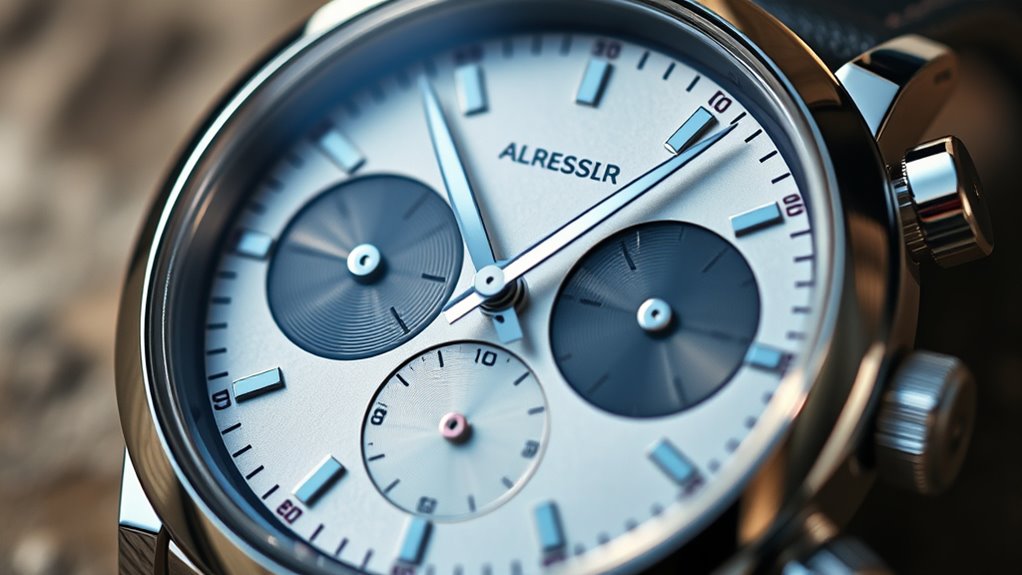
How Do Chronograph Watches Work Step by Step
If you’ve ever struggled to understand how a chronograph watch works or felt overwhelmed by its functions, you’re not alone. Many people want to make the most of these stylish timepieces but find the mechanics confusing.
Luckily, learning how chronograph watches operate step by step can make using one much more enjoyable and precise.
You operate a chronograph watch by pressing its pushers to start, stop, and reset the timer. Inside, precise gears and levers engage to move the central hand and subdials that track seconds, minutes, and hours.
This mechanism guarantees smooth, accurate timing with minimal wear.
To get the best results, you should handle it carefully and avoid harsh conditions.
Keep exploring, and you’ll uncover how to maximize its precision and maintain its performance over time.
Key Takeaways
- Chronograph watches combine a stopwatch function with a regular watch to measure elapsed time accurately.
- Start the timer by pressing the top pusher, stop it again with the same pusher, and reset with the bottom pusher.
- Internal gears and the column wheel engage or disengage the chronograph mechanism for precise, smooth timing.
- Subdials track elapsed minutes and hours while the central hand measures seconds during chronograph operation.
- Regular calibration and careful handling maintain timing accuracy and ensure the chronograph functions properly over time.
What Is a Chronograph Watch and How Is It Different?
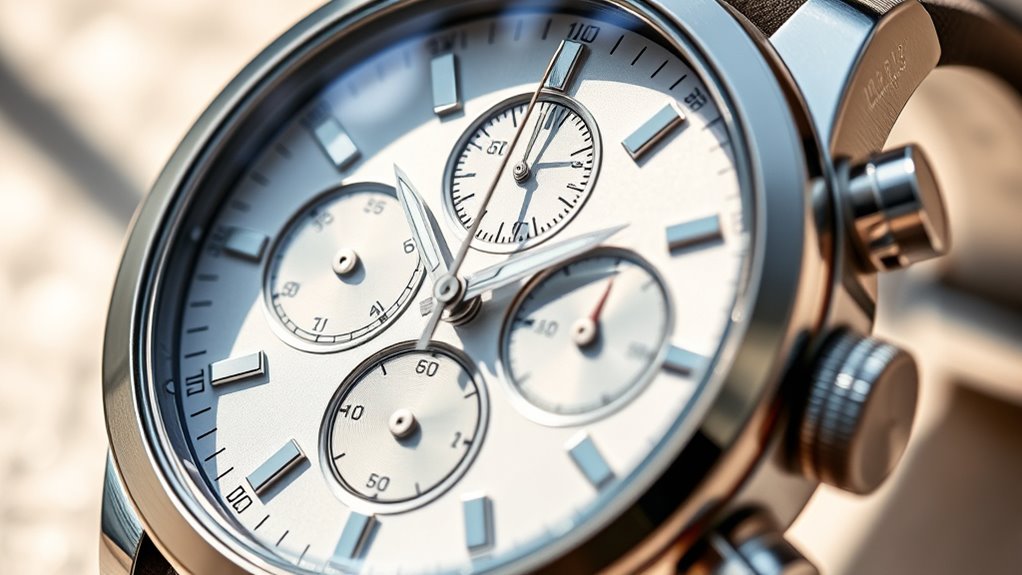
A chronograph watch is more than just a timekeeper; it’s a stopwatch combined with a regular watch. You get the ability to measure elapsed time while still seeing the current time.
The chronograph history dates back to the early 19th century when Nicolas Rieussec invented the first model to time horse races. Since then, notable brands like Omega, TAG Heuer, and Breitling have refined the design, making it a symbol of precision and style.
Unlike regular watches, chronographs feature extra dials and buttons to start, stop, and reset the timer. When you wear one, you’re not just telling time, you’re capturing moments with accuracy that standard watches simply can’t match.
Key Components That Drive Chronograph Function
Understanding how a chronograph works means getting to know its essential parts. These components have evolved throughout chronograph history, powering famous chronographs you might recognize. Each part plays a critical role in the watch’s ability to measure elapsed time accurately.
| Component | Function |
|---|---|
| Chronograph Pushers | Start, stop, and reset the timer |
| Central Chronograph Hand | Measures elapsed seconds |
| Subdials | Track minutes and hours passed |
| Column Wheel | Controls the engagement and release of the chronograph |
How Chronograph Gears and Levers Work Together
The intricate dance between chronograph gears and levers powers the precise timing functions you rely on. When you activate the chronograph, gear interaction guarantees the timing wheels mesh seamlessly, transmitting motion with flawless precision.
Meanwhile, lever mechanics control the engagement and disengagement of these gears, coordinating the start, pause, and measurement of elapsed time.
This synergy creates a smooth, reliable experience you can trust because:
- Precision: Each gear and lever moves with exact timing, avoiding slips or delays.
- Responsiveness: Lever mechanics instantly engage the gears, giving you immediate feedback.
- Durability: The careful gear interaction reduces wear, guaranteeing long-lasting accuracy.
Understanding this teamwork helps you appreciate the mechanical mastery behind every chronograph tick.
How to Start, Stop, and Reset a Chronograph
Starting, stopping, and resetting your chronograph is straightforward once you know which buttons to press and when. Typically, you’ll find two pushers on the side of the watch case. Press the top pusher to start the timer. This action engages the chronograph’s intricate gears, a design rooted in chronograph history aimed at precise time measurement.
When you want to stop the timer, simply press the same top button again. To reset the chronograph hands back to zero, press the bottom pusher. This sequence allows you to measure elapsed time easily, which is why chronographs have long been favored for timer applications like sports and aviation.
Mastering these controls lets you use your chronograph watch efficiently and appreciate its mechanical complexity.
How Subdials Show Elapsed Seconds, Minutes, and Hours
When you look at a chronograph watch, each subdial tracks a specific unit of time—seconds, minutes, or hours. So, you’ll use these to read the total elapsed time after starting the chronograph. It’s pretty handy once you get the hang of it.
Understanding what each subdial does helps you quickly see how much time has passed. That way, you don’t have to guess or do any math in your head. It just becomes second nature.
Functions of Each Subdial
Chronograph subdials provide a clear and organized way to track elapsed time in seconds, minutes, and hours. Understanding the subdial functions and subdial types helps you fully appreciate your watch’s capabilities. Each subdial serves a specific purpose:
- Seconds Subdial: This subdial continuously counts seconds, letting you monitor precise short intervals with ease.
- Minutes Subdial: It records elapsed minutes, usually up to 30 or 60, so you can time events longer than a minute without losing track.
- Hours Subdial: This tracks the total hours elapsed, perfect for timing extended activities or workouts.
Reading Elapsed Time
How do you quickly read the elapsed time on your watch? Start by focusing on the subdials, each designed for specific elapsed timekeeping techniques. The seconds subdial shows the running seconds, while the minutes subdial tracks up to 30 or 60 minutes, depending on your watch.
The hours subdial records elapsed hours, perfect for longer timing event strategies. To read the total elapsed time, combine the readings from all active subdials. For example, if the minutes subdial points to 12 and the hours subdial reads 1, you’ve timed 1 hour and 12 minutes.
Mastering these subdials lets you measure events precisely and efficiently. Using these elapsed timekeeping techniques improves your ability to monitor durations in everyday or professional timing event strategies.
Mechanical vs. Quartz Chronographs: Movement Differences
Although both mechanical and quartz chronographs serve the same purpose of measuring elapsed time, they operate using fundamentally different movements. Mechanical chronographs rely on intricate gears and springs, with choices between automatic vs. manual winding. These are often found in vintage models that evoke timeless craftsmanship.
Quartz chronographs use a battery and electronic oscillator, making them more precise and low-maintenance.
Here’s what sets them apart:
- Mechanical watches offer a tactile, emotional connection through their complex, hand-assembled movements.
- Quartz chronographs provide reliable accuracy and convenience with less upkeep.
- Vintage mechanical models carry a nostalgic charm you won’t get from the more modern quartz technology.
Choosing between them depends on whether you value tradition and artistry or practicality and precision.
What Makes a Chronograph Accurate and Precise
When you rely on your watch to measure elapsed time, its accuracy and precision become essential. Chronograph history shows a continuous pursuit of improved timing, from early mechanical designs to today’s advanced quartz movements.
What makes a chronograph accurate is the quality of its movement and the strict adherence to accuracy standards set by watchmakers. Precision depends on how finely the watch can measure intervals, often down to fractions of a second.
High-grade materials, stable oscillators, and careful assembly reduce errors and improve reliability. You’ll find that certified chronographs undergo rigorous testing to meet these standards, ensuring consistent performance.
Understanding these factors helps you appreciate the engineering behind a chronograph’s ability to deliver both accuracy and precision every time you use it.
Tips for Using Your Chronograph Watch Effectively
To get the most accurate readings, try to start and stop your chronograph smoothly without hitting the reset button unnecessarily. It really helps keep things precise. Also, don’t forget to keep your watch clean and have it serviced regularly. That way, it’ll keep performing at its best. Following these simple tips will make sure your chronograph stays reliable and precise for a long time.
Maximizing Chronograph Accuracy
Since precision matters most in timing, you’ll want to guarantee your chronograph watch operates at its best by following a few simple practices. First, regular chronograph calibration guarantees your watch measures intervals accurately; don’t skip this step if you want reliable results.
Second, master timing techniques like starting and stopping the chronograph smoothly to avoid lag or overshoot. Third, use your watch in stable conditions. Extreme temperatures or strong magnetic fields can affect its accuracy.
Here’s how to maximize your chronograph’s precision:
- Schedule routine calibration checks with a professional.
- Practice starting and stopping the chronograph steadily for consistent measurements.
- Avoid exposing your watch to environmental factors that can disrupt timing.
Maintaining Watch Performance
Although chronograph watches are designed for durability, you’ll want to handle yours with care to maintain peak performance. Proper watch care guarantees your timepiece stays accurate and reliable over time.
Avoid exposing your watch to extreme temperatures, strong magnetic fields, or harsh chemicals, as these can affect its delicate mechanisms. Regularly clean your watch with a soft cloth to remove dirt and sweat, which can degrade components.
Follow performance tips like winding your mechanical chronograph regularly and avoiding overuse of the stopwatch function to prevent unnecessary wear. If your watch is water-resistant, check seals periodically to maintain protection.
Finally, schedule professional servicing every few years to keep your chronograph running smoothly and extend its lifespan.
How to Maintain Your Chronograph for Long-Term Use
Keeping your chronograph in top shape requires regular care and attention. By following a few essential steps, you can guarantee it runs smoothly and lasts for years.
- Regular Cleaning and Strap Care: Use gentle cleaning techniques to remove dirt and sweat from the case and strap. For leather straps, avoid water exposure; for metal, dry thoroughly to prevent corrosion.
- Battery Replacement and Lubrication Intervals: Replace the battery promptly to avoid leakage, and schedule lubrication every few years to keep gears moving without friction.
- Protect from Impact, Temperature, and Water: Store your watch in proper storage solutions, avoid extreme temperatures, and respect its water resistance limits to prevent damage.
With this care, your chronograph stays reliable and looks great over time.
Common Issues and How to Troubleshoot Your Chronograph
Anyone who owns a chronograph watch may encounter issues like inaccurate timing, stuck buttons, or a non-responsive stopwatch function. Often, these problems stem from chronograph misuse, such as pressing buttons underwater or neglecting battery replacement.
If your stopwatch isn’t working, first check if the battery needs changing. This is one of the most common repairs. Also, verify that water resistance hasn’t been compromised; moisture inside the watch can cause malfunction.
Stuck buttons can sometimes be freed by gently cleaning around the crown and pushers, but avoid forcing them to prevent damage. If problems persist, it’s best to consult a professional watchmaker to avoid worsening the issue.
Regular care and proper use will keep your chronograph functioning smoothly.
Frequently Asked Questions
Can Chronograph Watches Be Waterproof?
Yes, chronograph watches can be waterproof, but it depends on their water resistance features. You should check the watch’s rating, like 50m or 100m, to know how much water exposure it can handle.
To keep your watch in top shape, follow maintenance tips like avoiding pressing buttons underwater and regularly checking seals. This way, you’ll enjoy your chronograph’s functionality without risking water damage.
Are Chronograph Watches Suitable for Diving?
Chronograph watches aren’t always suitable for exploration because not all models have the necessary exploration features or sufficient water resistance.
If you want to explore with a chronograph, you’ll need one specifically designed for underwater use, typically offering at least 200 meters of water resistance and features like a unidirectional bezel.
Otherwise, regular chronographs might not handle the pressure and can let water in, risking damage during explorations.
What Is the History of Chronograph Watches?
You’d think chronographs popped out of nowhere, but their evolution spans centuries! Starting in 1816, Louis Moinet created one to time celestial events, sparking the chronograph evolution.
Vintage models from the early 1900s became iconic, combining style and function for pilots and racers. Over time, these watches transformed from bulky tools to sleek timepieces you’d proudly wear today.
They blend history with modern precision in every tick.
How Much Do Chronograph Watches Typically Cost?
Chronograph watches typically cost anywhere from $100 to several thousand dollars. If you’re looking at budget options, you can find reliable chronographs around $100 to $500, perfect for everyday use.
However, if you want something from luxury brands like Rolex or Omega, expect to pay $3,000 or more. These high-end models offer superior craftsmanship and prestige. So, your budget really determines the quality and brand you can choose.
Can I Customize the Look of My Chronograph Watch?
Absolutely, you can customize your chronograph watch! From choosing custom straps to selecting dial colors, you have plenty of playful possibilities.
Whether you prefer a sleek leather band or a sporty silicone strap, swapping it out is simple and stylish. Dial colors can often be tailored to match your mood or wardrobe, making your watch distinctly yours.
Immerse yourself in customization and create a timepiece that truly tells your story.
Conclusion
Mastering your chronograph watch is like conducting a finely tuned orchestra. Each gear and lever plays its vital part in measuring time’s fleeting moments.
By understanding its intricate dance, you’ll not only track seconds with precision but also appreciate the timeless craftsmanship ticking beneath your wrist.
Treat it well, and your chronograph watch will be a steadfast companion. It will capture life’s pulses with elegance and reliability for years to come.