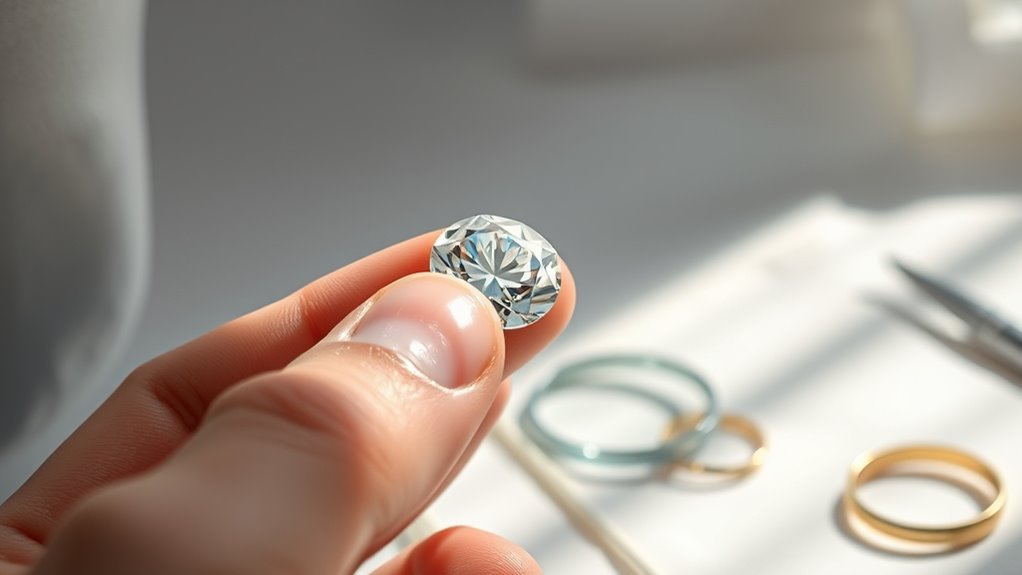
7 Easy Tips to Tell a Real Diamond by Eye
Trying to tell if a diamond is real can feel overwhelming, and you’re not alone. Many people struggle with spotting the difference between genuine diamonds and imitations.
Whether you’re buying a ring or just curious, knowing how to identify a real diamond by eye can save you time and money.
You can spot a real diamond by checking its sparkle and vibrant fire, which show colorful flashes as it moves. Look closely at sharp edges and precise facets. Real diamonds have crisp, even cuts.
Use a magnifier to find tiny natural imperfections inside.
Try reading text through it; if letters blur, it’s likely genuine. The fog test helps too. Real diamonds clear fog quickly.
Also, compare its weight and size for consistency. Keep exploring to uncover more ways to verify authenticity.
Key Takeaways
- Observe the diamond’s sparkle and fire; real diamonds show intense brilliance and colorful light flashes when moved.
- Check the edges and facets; authentic diamonds have sharp, well-defined cuts with consistent reflections.
- Perform the fog test; real diamonds disperse heat quickly, causing fog to vanish almost instantly.
- Look for inclusions using a magnifier; natural diamonds often have tiny imperfections, unlike flawless fakes.
- Assess size and weight consistency; real diamonds’ dimensions align with expected carat weight on reliable charts.
Check a Diamond’s Sparkle and Fire
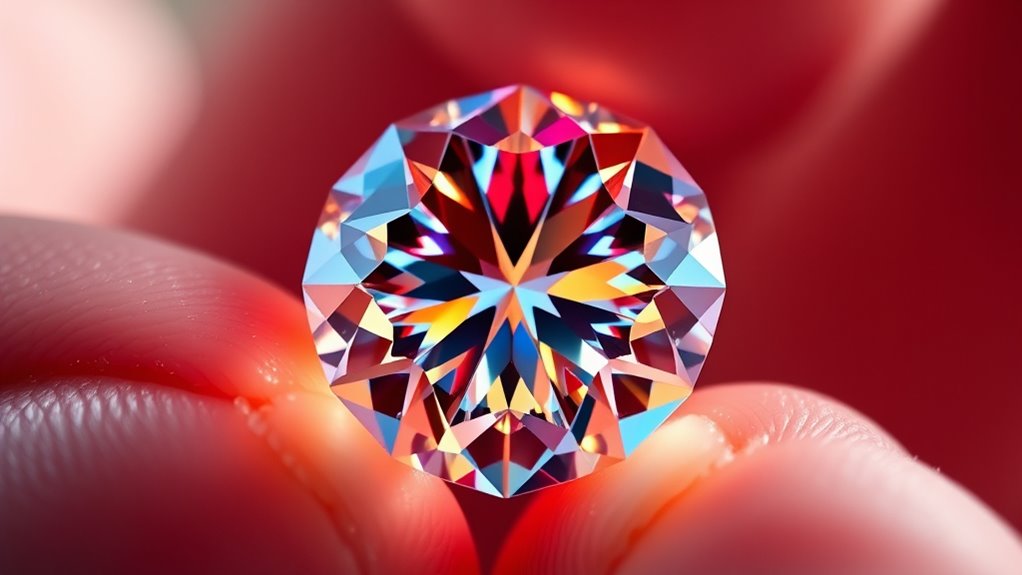
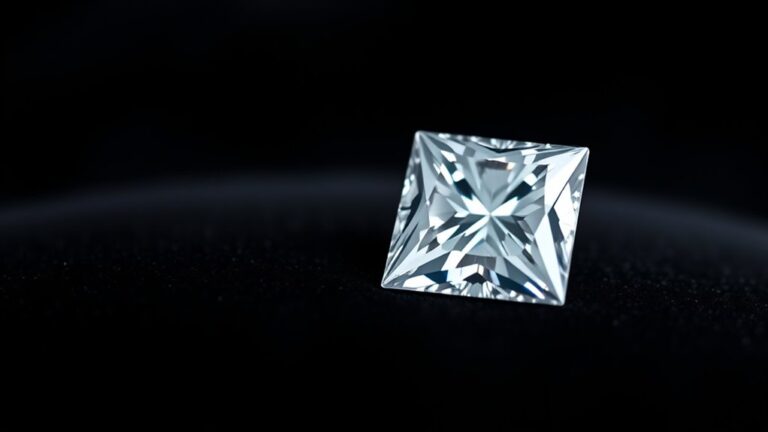
One of the easiest ways to tell if a diamond is real is by checking its sparkle and fire. When you hold a genuine diamond under light, you’ll notice a remarkable sparkle intensity that makes it stand out. The diamond’s facets catch and reflect light brilliantly, creating a dynamic shimmer.
Alongside the sparkle, pay attention to the fire display, the colorful flashes of light that appear as you move the stone. Real diamonds show a vibrant mix of rainbow hues, while fakes often lack this vivid fire or produce dull, muted colors. By focusing on how intensely it sparkles and the quality of the fire display, you can quickly assess whether a diamond is authentic without needing special tools or expertise.
Examine Diamond Edges and Facets Closely
Take a close look at the diamond’s edges to see if they’re sharp and well-defined. You’ll want to check the symmetry of its facets, too, because real diamonds have precise, even cuts. Also, notice how the light reflects—if you see uneven patterns, that could be a sign it’s a fake.
Sharpness of Diamond Edges
Sharp diamond edges reveal a lot about a stone’s authenticity. When you look closely, real diamonds have crisp, well-defined edges that contribute to their overall edge brilliance. These sharp edges result from precise cutting and polishing, reflecting light cleanly.
If the edges appear rounded or worn, the stone might be a fake or heavily treated. Also, diamond clarity plays a role here. Flaws or inclusions near the edges can dull their sharpness, so pay attention to how clean and clear the edges look.
Facet Symmetry Check
Facet symmetry plays an essential role in a diamond’s brilliance and overall appearance, so you’ll want to examine the edges and facets closely. Start by observing the facet alignment. Each facet should match its opposite, creating a balanced, mirror-like effect.
Misaligned facets can indicate a lower-quality stone or even a fake. Next, check the facet proportions. Uneven sizes or shapes disrupt the diamond’s harmony and reduce its sparkle.
Use a magnifying glass or jeweler’s loupe to spot inconsistencies. Real diamonds typically have precise, symmetrical facets, while imitations often show irregularities.
Light Reflection Patterns
Although diamonds are known for their sparkle, the way light reflects off their edges and facets can reveal whether you’re looking at a real stone. Real diamonds have unique light behavior due to their optical properties, creating brilliant reflections and sharp contrasts.
When examining a diamond, pay close attention to these clues:
Facets should produce crisp, well-defined flashes of light, not dull or blurry ones. Look for a mix of bright white light (brilliance) and colorful light (fire) as the stone moves. The edges of a real diamond reflect light sharply, without soft or rounded glows.
Check for consistent light patterns across all facets, indicating precise cutting and quality.
Spot Diamond Inclusions With a Magnifier
You can spot a real diamond by looking for common inclusions, like tiny crystals or feathers inside the stone. Just grab a magnifier and take a close look. Focus on the center and edges to catch these natural imperfections.
With a bit of practice, you’ll quickly get the hang of using your magnifier to tell what’s genuine. It’s pretty satisfying once you start noticing those little details!
Identifying Common Inclusions
When you examine a diamond closely with a magnifier, you’ll often spot tiny imperfections called inclusions. These are natural marks inside the stone that affect clarity grades and help you tell a real diamond from a fake.
Understanding common inclusion types is key to quick identification. Look out for:
- Feather inclusions: small cracks that resemble feathers
- Crystal inclusions: tiny mineral spots trapped inside
- Pinpoint inclusions: tiny dots scattered throughout
- Cloud inclusions: clusters of pinpoints creating a hazy area
Each inclusion type impacts the diamond’s clarity grade differently. Real diamonds usually have some inclusions, while synthetic or fake stones may appear flawless or show unnatural patterns.
Using Magnifier Techniques
Since spotting inclusions requires careful observation, using a magnifier correctly is essential for examining a diamond’s internal features. You’ll want to pick the right lens type. Typically, a jeweler’s loupe with 10x magnification works best.
This magnification method lets you see tiny imperfections that reveal if a diamond is real. Hold the magnifier close to your eye and position the diamond under good lighting. Move the stone slowly to catch all angles.
Different lens types can offer varied clarity, but a standard loupe is usually sufficient for spotting inclusions. Avoid lower magnification methods, as they might miss subtle flaws. Mastering these magnifier techniques helps you confidently distinguish real diamonds by eye without expensive tools.
See If You Can Read Text Through the Diamond
How clearly can you see text through a diamond? Real diamonds tend to distort text because of their unique cut and high refractive index. When you place a diamond over printed text, pay attention to these signs:
Blurry or warped letters: Real diamonds refract light, causing text to appear distorted or doubled.
Sharp, clear text: If you can read the text easily with minimal distortion, it’s likely not a real diamond.
Color rainbow effects: Notice if the text looks fractured with rainbow-like light distortion, a hallmark of genuine diamonds.
Overall text clarity: Fake diamonds or glass often allow more straightforward visibility without much light distortion.
Use this quick observation to help distinguish real diamonds from imitations with just your eyes.
Use the Fog Test to Detect Fake Diamonds
Wondering if you can quickly spot a fake diamond without special tools? Try the fog test. Simply breathe on the stone to create breath condensation and watch the fog density.
Real diamonds disperse heat rapidly, so the fog disappears almost instantly. If the fog lingers for a few seconds, the stone likely isn’t genuine. Fake diamonds, like cubic zirconia, hold the heat longer, causing the breath condensation to stay dense and visible.
This simple test gives you immediate clues about the diamond’s authenticity without needing any equipment. Just remember to perform the test in a room with normal humidity to avoid skewed results.
The fog test is a quick, effective way to separate real diamonds from fakes using nothing but your breath.
Evaluate How a Diamond Reflects Light
When you look closely at a diamond, its light reflection can reveal a lot about its authenticity. Real diamonds have a unique way of interacting with light, which you can spot during a simple visual inspection. Pay attention to the light behavior. The sparkle should be bright and lively, not dull or flat.
Examining a diamond’s light reflection closely reveals its authenticity through bright, lively sparkle and unique light behavior.
Here’s what to watch for:
- Brilliant sparkle: Real diamonds reflect light in sharp flashes.
- Fire: Look for colorful light dispersion, like tiny rainbows.
- Scintillation: Notice the dynamic patterns of light and dark as you move the stone.
- No rainbow effect: If you see a rainbow of colors inside, it might be glass or cubic zirconia.
Compare Diamond Weight and Size for Authenticity
Although diamonds come in various shapes and sizes, their weight always corresponds closely to their dimensions. When you hold a diamond, you can perform a simple carat comparison by estimating its size and feeling its heft.
If a stone looks larger than its weight suggests, it might be a fake or a simulant. Your size perception plays an essential role here. Real diamonds have a specific density, so a diamond that appears big but feels light could be glass or cubic zirconia.
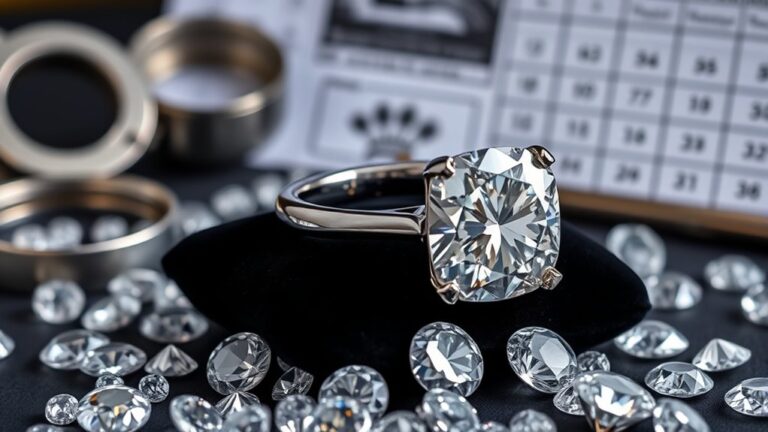
To verify authenticity, compare the diamond’s dimensions with a reliable carat chart or use a scale to measure weight precisely. This combination of size perception and carat comparison helps you spot inconsistencies and identify real diamonds effectively.
Frequently Asked Questions
How Does the Price of a Diamond Affect Its Authenticity?
You shouldn’t rely solely on diamond pricing to judge authenticity because high prices don’t always guarantee a real diamond. Authenticity factors like cut, clarity, color, and carat weight play bigger roles in value.
Sometimes, synthetic or treated diamonds can be priced comparably. So, while price gives you a hint, you need to check other authenticity factors or get a professional appraisal to be sure you’re buying a genuine diamond.
Can Synthetic Diamonds Pass All Visual Authenticity Tests?
No, synthetic diamonds can’t pass all visual authenticity tests. While you might not spot synthetic characteristics easily during a casual visual inspection, experts use specialized tools to detect subtle differences.
These lab-grown stones often have distinct growth patterns and inclusions that differ from natural diamonds. So, if you rely solely on your eyes, synthetic diamonds can fool you, but a thorough inspection reveals the truth.
What Tools Besides a Magnifier Help Identify Real Diamonds?
You can use a thermal conductivity tester to check if a stone disperses heat like a real diamond. A light performance scope helps you see how the diamond reflects and refracts light, revealing its brilliance and fire.
Measuring the refractive index with specialized tools confirms authenticity. Also, inspect surface scratches under a loupe; real diamonds resist scratching better than simulants. These tools together give you a clearer picture beyond just a magnifier.
How Does Diamond Certification Impact Buying Confidence?
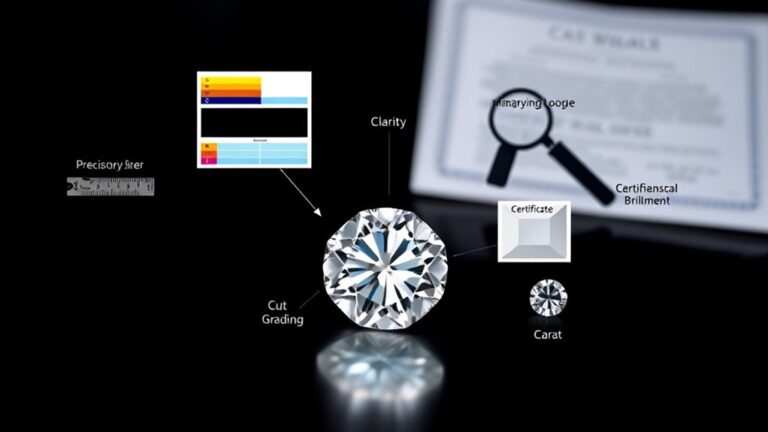
Diamond certification boosts your buying confidence by providing proof of authenticity and quality. Certification benefits include detailed grading standards that assess the diamond’s cut, color, clarity, and carat weight.
This transparent information helps you make informed decisions and avoid scams. When you choose certified diamonds, you’re assured of consistent quality and value, making your purchase safer and more satisfying. Certification acts as a trustworthy guide in the diamond market.
Are There Quick Tests to Differentiate Diamonds From Moissanite?
You don’t need Sherlock’s magnifying glass to spot differences between diamonds and moissanite. Yes, quick tests like the fire test, where you observe the sparkle under light, can help. Diamonds show sharper, more colorful flashes.
The water test is simple: drop the stone in water. A real diamond sinks due to its density, while moissanite might float or sink slower. These tricks give you clues but aren’t foolproof without professional tools.
Conclusion
You might think only experts can spot a real diamond, but these simple tips prove otherwise. By checking sparkle, edges, and reflections, you’ll quickly tell genuine stones from fakes.
Even without fancy tools, the fog test and reading text through the diamond give you powerful clues. Trust your eyes and these easy methods. You’ll confidently choose real diamonds and avoid costly mistakes every time when you know how to tell a real diamond by eye.