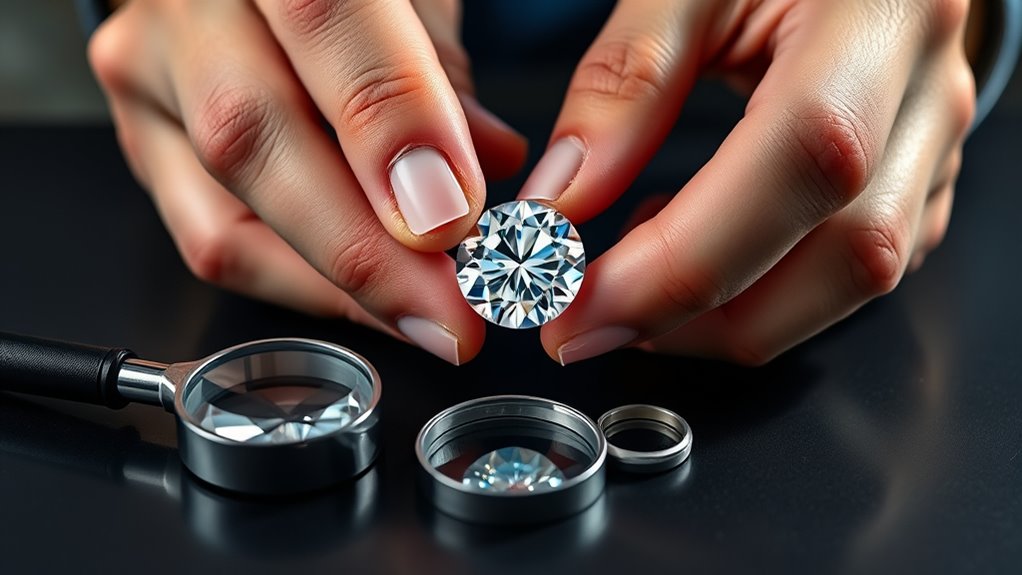
How to Test Real Diamond in 10 Easy Steps
If you’ve ever wondered whether the diamond you’re holding is real, you’re not alone. Many people struggle with identifying genuine diamonds from imitations, especially when shopping or inheriting jewelry.
It can feel overwhelming trying to figure out which tests actually work and which don’t.
You can test a real diamond quickly by checking for natural imperfections and sharp facets, then doing the fog test to see how fast moisture clears. Real diamonds clear in seconds.
Drop it in water to see if it sinks due to its density, use a loupe to find tiny inclusions, and shine UV light to spot blue fluorescence.
Heat tests can confirm fast heat dispersion too. If you want reliable results, keep exploring these easy ways to confirm authenticity.
Key Takeaways
- Perform the fog test by breathing on the diamond and checking if the fog clears within 1-2 seconds. This quick clearing indicates real diamond heat dispersion.
- Drop the stone in water to see if it sinks quickly. Real diamonds have high density, so they do not float.
- Inspect the diamond under a loupe for natural inclusions or tiny imperfections. Authentic diamonds typically have these.
- Shine UV light on the diamond in a dark room to observe blue fluorescence. This is common in many real diamonds.
- Compare the diamond’s sparkle and facet sharpness against a known fake. Look for bright white flashes and well-defined edges.
Quick Visual Signs To Identify A Real Diamond
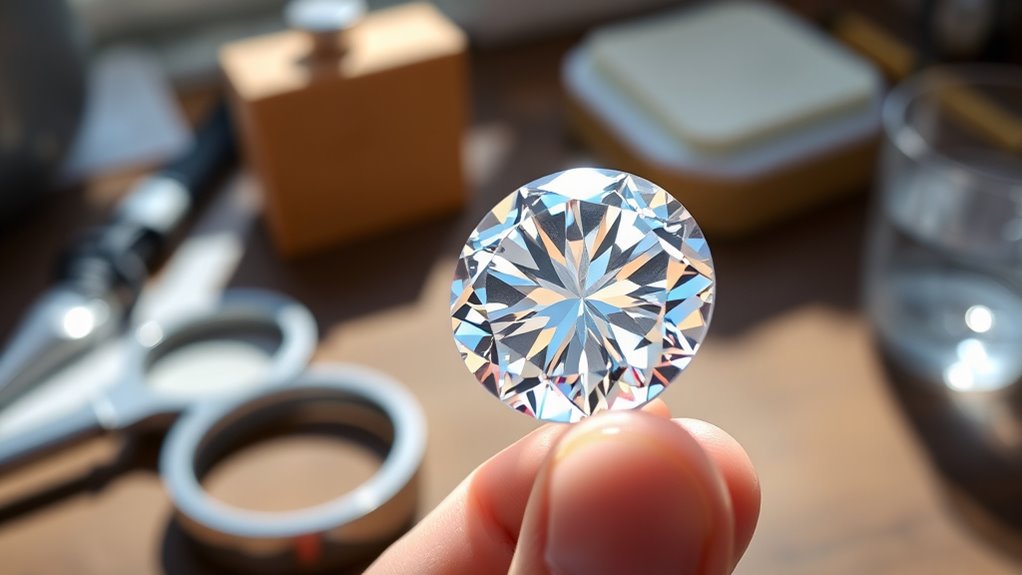
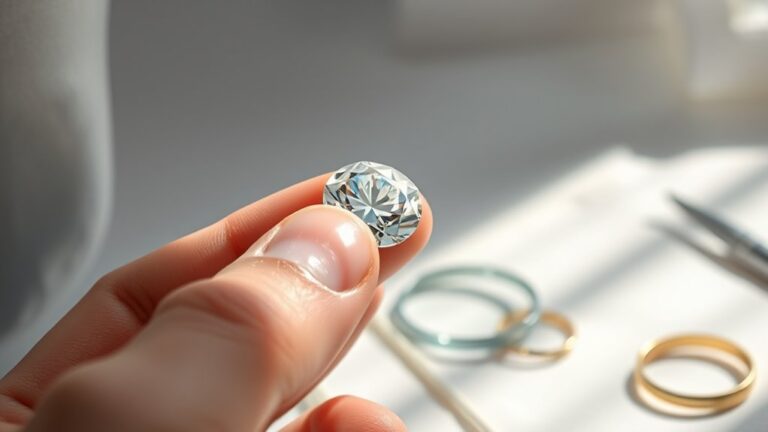
Although professional testing often provides the most reliable results, you can quickly spot signs of a real diamond by examining its appearance closely. Start by looking at the diamond clarity; genuine diamonds usually have tiny natural imperfections called inclusions, while fake ones tend to be flawless or overly perfect.
Next, perform a sparkle comparison between your diamond and a known fake or simulated stone. Real diamonds reflect light distinctly, displaying bright white flashes alongside colorful sparkle, known as fire. If your stone lacks this brilliance or appears dull, it might not be authentic.
Also, observe the edges. Real diamonds have sharp, well-defined facets, unlike the rounded edges often found on imitations. These quick visual checks can help you identify a real diamond before moving on to more advanced tests.
Using The Fog Test To Check Diamond Authenticity
When you breathe on a diamond to create fog, you can quickly tell if it’s real by how fast the fog clears. The fog test is a simple way to check diamond authenticity based on moisture retention. Real diamonds disperse heat rapidly, so the fog from your breath evaporates almost instantly.
Here’s how to do the fog test:
- Hold the diamond close to your mouth and breathe steadily on its surface.
- Watch closely for how long the fog stays.
- If the fog clears within 1-2 seconds, it’s likely a genuine diamond.
- If the fog lingers for several seconds, the stone may be a fake, as it retains moisture longer.
This quick test can help you easily distinguish real diamonds from imitations.
How The Water Test Reveals Real Diamonds
You can use the water test to see if your diamond is real by checking its density. Just drop the stone into a glass of water and watch what happens.
If it sinks quickly and stays at the bottom, that’s a good sign it might be a genuine diamond. But if it floats or sinks slowly, it could be a fake.
Diamond Density Explained
Density plays a key role in identifying real diamonds, and the water test uses this property to reveal their authenticity. Real diamonds have a high density, meaning their diamond weight is concentrated in a small volume. This density affects how they interact with water, unlike glass or cubic zirconia.
When you understand diamond density, you can appreciate why the water test works.
Consider these points:
- Diamonds have a density around 3.5 g/cm³, much higher than most imitations.
- This density relates directly to diamond clarity and cut, influencing weight.
- When placed in water, real diamonds sink quickly due to their weight.
- Fake stones often float or sink slowly, showing less density.
Knowing this helps you judge diamond authenticity confidently.
Performing The Water Test
Although the water test is simple, it provides a reliable way to distinguish real diamonds from fakes by leveraging their unique density. To perform the water test, fill a glass with water and carefully drop the diamond into it.
Because diamonds have a high density, a real diamond will sink quickly to the bottom. Fake diamonds, made from less dense materials like glass or cubic zirconia, tend to float or sink slowly.
This quick check helps you assess diamond authenticity without special tools. Make sure the diamond is loose or set in a way that allows it to move freely in the water for accurate results.
The water test is an easy, low-cost method you can use at home to verify diamond authenticity before seeking professional evaluation.
Interpreting Test Results
The way a diamond behaves in water reveals key clues about its authenticity. When you perform the water test, focus on interpreting the results by evaluating clarity and how the stone interacts with water. Here’s what to look for:
- Sinking Quickly: A real diamond’s density causes it to sink immediately.
- Floating or Slow Sink: Fake diamonds or simulants often float or sink slowly.
- Clarity in Water: Real diamonds maintain sharp clarity underwater; a cloudy or blurry appearance hints at a fake.
- Bubbles: If bubbles cling to the stone, it might be a fake because of surface imperfections.
Using A Loupe To Spot Diamond Flaws And Inclusions
A loupe lets you examine a diamond’s internal characteristics closely, helping you identify flaws and inclusions that reveal its authenticity. When you look through a loupe, focus on the diamond clarity by spotting tiny imperfections inside the stone.
These imperfections, known as inclusion types, can include crystals, feathers, clouds, or needles. Real diamonds usually have some natural inclusions, while synthetic or fake stones tend to be flawless or have unnatural patterns.
Inclusions like crystals or feathers reveal a diamond’s authenticity, unlike flawless or patterned fake stones.
By carefully observing these details, you’ll get a better sense of whether the diamond is genuine. Just hold the loupe close to your eye and examine the stone under good light.
This simple step is essential for confirming the diamond’s true quality and authenticity before making a purchase.
Checking Diamond Sparkle With The Light Reflection Test
When you hold a diamond up to the light, you’ll notice how it reflects and refracts that light with a brilliance unique to real stones. This sparkle intensity results from the diamond’s exceptional light dispersion, creating a mesmerizing play of colors.
To check the sparkle with the light reflection test, follow these steps:
- Position the diamond under a bright, direct light source.
- Tilt and rotate the stone slowly to observe changes in brightness.
- Look for sharp flashes of white light (brilliance) and colorful sparkles (fire).
- Compare the sparkle intensity to a known genuine diamond for accuracy.
If the diamond shows dull reflections or muted colors, it likely lacks real diamond’s superior light dispersion.
Using Weight Comparison To Spot Real Diamonds
You can spot a real diamond by comparing its weight to a fake one of the same size. Since real diamonds are denser, they actually weigh less than many imitations. So, if you have two stones that look similar in size, checking their weight can give you a clue.
It’s best to use a precision scale for this. That way, you get an accurate reading, making the test much more reliable. It’s a simple but effective trick to help tell real diamonds apart from fakes.
Diamond Vs Fake Weight
Since real diamonds have a higher density than most imitations, you can often spot a fake by comparing their weights. When you hold two stones of the same size, the real diamond will feel heavier. This weight difference becomes clearer with accurate weight measurement.
Keep in mind, diamond clarity doesn’t affect weight, but it helps identify authenticity in tandem with weight checks.
Here’s how to compare diamond vs fake weight effectively:
- Choose stones of identical size and shape.
- Use a reliable scale to weigh each stone.
- Note that fakes like cubic zirconia weigh more, while glass weighs less.
- Cross-check the weight difference with known diamond weight charts.
This quick weight test helps you rule out many counterfeit stones.
Precision Scale Importance
A precision scale plays an essential role in accurately comparing diamond weights, helping you spot real stones from imitations with greater confidence. When testing diamonds, precise diamond weight measurement is key because real diamonds have specific density and weight characteristics that fakes often don’t match.
To get reliable results, you need to verify your precision scale calibration is up to date, as even small errors can lead to incorrect outcomes. Before weighing, zero the scale and place the diamond carefully to avoid fluctuations.
How To Safely Do The Scratch Test At Home
Performing the scratch test at home requires careful preparation to avoid damaging your jewelry. Before you begin, keep in mind scratch precautions to protect both the diamond and its setting. If you’re unsure, consider alternative methods instead.
Follow these steps to safely do the scratch test:
- Clean the diamond surface thoroughly to remove any dirt or oils.
- Use a piece of glass or a mirror as your scratch target, not the diamond itself.
- Gently try to scratch the glass with the stone’s edge, applying minimal pressure.
- Observe the results: a real diamond won’t scratch easily, while glass will show marks.
Always prioritize safety and avoid aggressive testing to prevent costly damage to your jewelry.
Using UV Light To Detect Real Diamonds
You can use UV light to check if a diamond is real by looking at its fluorescence. Most natural diamonds will glow blue under UV light. On the other hand, fake ones usually don’t react the same way. That said, not all diamonds fluoresce, so this test isn’t foolproof. But it’s still a helpful indicator to keep in mind.
UV Light Reaction
How does UV light help reveal whether a diamond is real? When you expose a diamond to UV light, it can exhibit UV fluorescence, a property that causes it to glow, usually blue. This glow can help you distinguish a real diamond from many imitations, which often show no fluorescence or a different color glow.
The intensity and presence of UV fluorescence also relate to the diamond color, sometimes influencing its appearance under normal light.
Here’s what to look for during your UV light test:
- Shine a UV light onto the stone in a dark room.
- Observe whether the diamond glows and note the color.
- Check for a blue fluorescence, common in many real diamonds.
- Remember, absence of fluorescence doesn’t always mean fake.
Identifying Diamond Fluorescence
UV fluorescence offers a valuable clue when testing a diamond’s authenticity, but identifying the specific fluorescence characteristics can provide even clearer insights. When you expose a diamond to UV light, observe the fluorescence intensity carefully. It varies from none to strong.
Real diamonds often show a blue glow, but the strength can differ based on the diamond color. For example, some colorless diamonds have faint fluorescence, while others with slight tint exhibit stronger reactions.
Keep in mind that fluorescence intensity doesn’t affect value directly but helps confirm authenticity. If you see unusual colors like green or yellow, you might be looking at a synthetic or treated stone.
How The Heat Conductivity Test Reveals Genuine Diamonds
When you put a diamond to the heat conductivity test, you tap into one of the most reliable ways to confirm its authenticity. This test works because genuine diamonds exhibit unique heat transfer properties, dispersing heat much faster than imitations.
Here’s how you can visualize the process:
- Place the diamond on a cool surface to stabilize its temperature.
- Apply a heated probe gently to the stone’s surface.
- Observe how quickly the heat spreads through the gem.
- Notice that real diamonds quickly dissipate heat, preventing hot spots.
Thanks to these distinct diamond properties, a tester designed to measure heat conductivity can distinguish real diamonds from fakes like cubic zirconia, which retain heat longer. This method is fast, non-destructive, and highly effective for confirming diamond authenticity.
When To Consult A Professional For Diamond Testing
While simple tests like heat conductivity can quickly indicate if a diamond is real, there are times when you’ll want to seek expert help. If you’re unsure about your results or dealing with a high-value stone, consulting a professional guarantees accurate identification.
An expert verification can confirm authenticity and reveal treatments or improvements that simple tests miss. Also, if you’re planning to sell or insure your diamond, a formal diamond appraisal by a certified gemologist is crucial.
They provide detailed documentation of your diamond’s quality, carat, cut, and clarity, which protects your investment. Don’t hesitate to reach out to a trusted jeweler or gemological lab when in doubt. Professional testing offers peace of mind and affirms your diamond’s true value.
Frequently Asked Questions
How Do Diamond Certifications Impact Authenticity Verification?
Diamond certifications play an essential role in authenticity verification because they provide an expert evaluation of your stone’s quality. When you rely on diamond grading from trusted certification agencies, you’re getting a reliable report on the diamond’s cut, color, clarity, and carat weight.
This makes it easier for you to trust that the diamond is genuine and worth its value, reducing the risk of buying a fake or misrepresented gem.
Can Diamond Simulants Affect Jewelry Value?
Diamond simulants can definitely cast a shadow over your jewelry’s value. When you bring your piece in for a jewelry appraisal, the presence of simulants can lower its worth since they lack the rarity and brilliance of real diamonds.
You’ll want to be cautious, as simulants might glitter like the real thing but don’t hold the same investment power. Knowing this helps you protect your treasure’s true shine.
What Is the History of Synthetic Diamonds?
You’ll find that synthetic diamond origins date back to the 1950s when scientists first used high-pressure, high-temperature laboratory techniques to create diamonds mimicking natural ones. These methods evolved, allowing labs to produce gem-quality synthetic diamonds more efficiently.
As you investigate this history, you’ll see that ongoing improvements in laboratory techniques have made synthetic diamonds nearly indistinguishable from mined ones, changing the jewelry industry considerably.
How to Care for and Clean Real Diamonds Properly?
You should prioritize diamond maintenance by cleaning your diamond regularly to keep its sparkle. Use gentle cleaning techniques, like soaking it in warm water with mild dish soap and softly brushing with a soft toothbrush.
Avoid harsh chemicals and ultrasonic cleaners if your diamond has inclusions. Always rinse thoroughly and dry with a lint-free cloth.
Store your diamond jewelry separately to prevent scratches, and get professional inspections to guarantee it stays in top condition.
Are There Any Insurance Options for Diamond Jewelry?
Yes, you can get insurance coverage for your diamond jewelry to protect your investment. Start by getting a professional jewelry appraisal to determine its current value.
Then, choose a policy specifically designed for fine jewelry, which often covers loss, theft, and damage. Make sure you update the appraisal regularly and keep all documentation safe.
This way, you’ll have peace of mind knowing your diamonds are properly insured.
Conclusion
Now that you’ve uncovered these sparkling secrets, you hold the diamond’s true story in your hands. Like a skilled detective reading a shimmering map, you can spot the real from the illusion.
Trust your eyes, your touch, and these simple tests. They’re your lanterns cutting through the glittering fog. When in doubt, seek a pro’s wisdom to guarantee your gem shines with genuine fire, not just a fleeting flicker.
Remember, knowing how to test real diamond ensures your treasure is the real deal every time.