7 Easy Steps to Tell If a Diamond Is Real at Home
Wondering if your diamond is the real deal? You’re not alone. Many people struggle with telling genuine diamonds from imitations, especially when buying secondhand or receiving a surprise gift. Knowing how to verify your diamond’s authenticity can save you time, money, and stress.
You can easily check if a diamond is real by trying simple tests at home. Drop it in water; real diamonds sink without cloudiness. Breathe on it; real ones clear fog instantly. Place it on newspaper; blurry print means it’s likely real.
Inspect edges for sharpness and use a loupe to spot natural inclusions. These quick checks reveal a lot, and there are more ways to confidently verify your diamond’s authenticity.
Key Takeaways
- Drop the stone in a glass of water. Real diamonds sink because they’re very dense, while fakes might float or make the water look cloudy.
- Breathe on the diamond to fog it up. Real diamonds clear the fog instantly, but fakes hold onto the fog for 2 seconds or more.
- Place the diamond on printed paper. Real diamonds blur the print underneath, while if you can see the print clearly, it’s probably a fake.
- Inspect the edges with a magnifier. Real diamonds have sharp, well-defined edges without chips or cracks.
- Use a jeweler’s loupe to look for inclusions. Natural imperfections mean the diamond is real, but if it looks flawless or has unnatural patterns, it’s likely fake.
How to Spot a Real Diamond With the Water Test
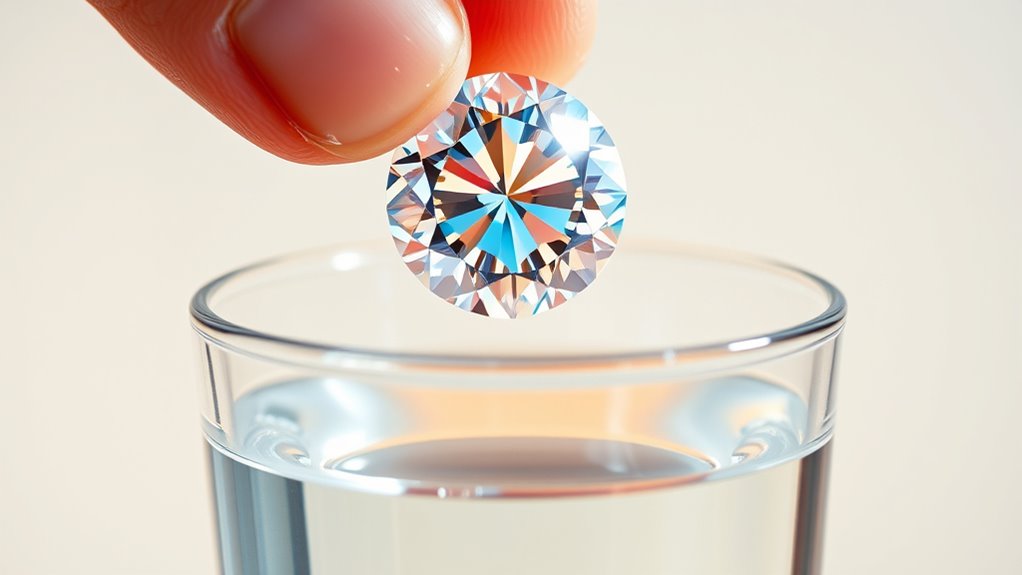
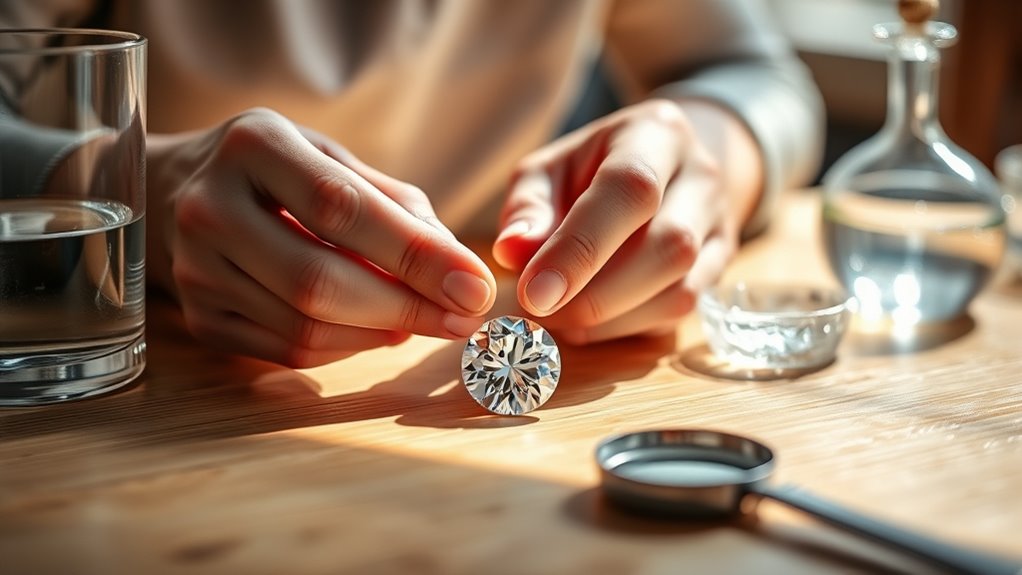
One simple way to check if a diamond is real is by using the water test. Fill a glass with water and carefully drop the stone into it. Real diamonds have high density, so they won’t float; their diamond buoyancy is low, causing them to sink quickly to the bottom.
Fake diamonds or imitations often float or hover near the surface because they’re less dense. While observing, pay close attention to the water clarity around the stone. A genuine diamond’s sharp edges and brilliance won’t distort the water’s clarity considerably.
If the water appears cloudy or the stone seems to disrupt the water’s surface unusually, it might not be a real diamond. This simple test gives you an immediate, visual clue about your stone’s authenticity.
Using the Fog Test to Check Diamond Authenticity
How can you quickly tell if a diamond is real using just your breath? Try the fog test. Simply breathe on the stone to create fog from your breath moisture. A real diamond disperses heat rapidly, so the fog density disappears almost instantly. If the fog lingers for a few seconds, it’s likely not genuine.
Here’s a quick guide:
| Test Result | Interpretation |
|---|---|
| Fog clears instantly | Real diamond |
| Fog lingers 2+ seconds | Fake or imitation stone |
| Dense fog forms | High breath moisture |
| Light fog forms | Low breath moisture |
| Fog test inconclusive | Try additional tests |
This simple method helps you quickly assess diamond authenticity at home without special tools.
How to Use the Newspaper Test on Diamonds
Wondering if a diamond can really be tested with just a newspaper? The newspaper test is simple and effective for a quick check. Place your diamond flat side down on a page with small, dense print.
Focus on the print visibility through the stone. If you can clearly read the words or see distinct letters, your diamond might be fake or a lower-quality stone because real diamonds refract light strongly, causing the print to blur or distort.
The key here is newspaper clarity. Real diamonds won’t allow clear print visibility beneath them. Remember, this isn’t a foolproof test but a handy first step.
If the print looks sharp and clear, you should consider further testing or professional appraisal to confirm authenticity.
How to Spot Real Diamonds by Inspecting Edges
If the newspaper test leaves you uncertain about your diamond’s authenticity, inspecting the edges can give you more clues. Real diamonds usually have sharp, well-defined edges. Fake ones tend to show rounded or worn edges.
When in doubt, examine your diamond’s edges—sharp and defined edges indicate authenticity, while rounded edges suggest a fake.
Pay close attention to edge clarity and facet alignment because these details reveal a lot about the stone’s authenticity. Here’s what to look for:
- Sharp edges: Real diamonds have crisp edges that catch light effectively.
- Smooth facet alignment: Facets should meet precisely without gaps or overlaps.
- No chips or cracks: Authentic diamonds resist minor edge damage better.
- Consistent edge clarity: The edges should appear clear, not cloudy or frosted.
Why Sparkle and Brilliance Matter in Diamonds
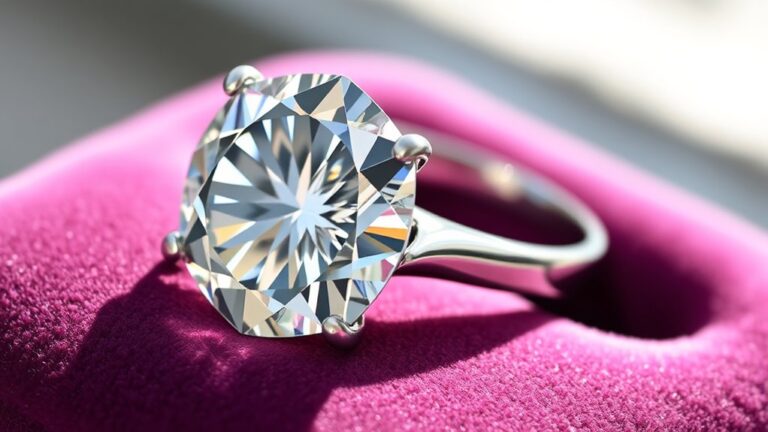
Sparkle and brilliance define the beauty and value of a diamond, capturing your attention and reflecting light in enchanting ways. When you examine a diamond, its ability to reflect light directly affects how dazzling it appears.
Diamonds with high diamond clarity allow light to pass through and bounce around inside, creating that mesmerizing sparkle you’re looking for. If the diamond has inclusions or cloudiness, its brilliance diminishes because light reflection gets obstructed.
You want to see a vibrant play of light, which signals a genuine, high-quality diamond. So, when checking your stone at home, focus on how it shines and sparkles under different lighting. This simple observation tells you a lot about its authenticity and overall value.
Using a Loupe to Inspect Diamond Inclusions and Imperfections
Although it might seem like a simple tool, a jeweler’s loupe can reveal essential details about your diamond’s authenticity. When you look through it, focus on spotting inclusion types, tiny internal flaws that affect clarity grades. Real diamonds usually have natural inclusions, while fakes often appear flawless or show bubbles.
A jeweler’s loupe reveals tiny flaws that help distinguish real diamonds from flawless or bubble-filled fakes.
Here’s what to check:
- Identify common inclusion types like feathers, crystals, or clouds.
- Assess the size and location of imperfections.
- Compare clarity grades by noting how visible inclusions are under 10x magnification.
- Look for unnatural patterns that might indicate synthetic stones.
Using a loupe helps you understand the diamond’s internal structure, giving you a better chance of distinguishing a real diamond from a fake without expensive equipment.
When to Try Heat and Scratch Tests on Diamonds
When you’re unsure about a diamond’s authenticity after inspecting it visually, you might consider heat and scratch tests to confirm your suspicions. You should only try these tests if other non-invasive methods, like using a loupe or fog test, don’t give clear results.
Diamonds are known for their exceptional heat resistance, so heating a suspected stone briefly and then dropping it into cold water can reveal flaws if it cracks. For scratch tests, remember diamonds have unmatched scratch durability, meaning they won’t get scratched by common materials.
However, avoid scratching your stone against unknown surfaces to prevent damage. Use a scratch test only on an inconspicuous area or a loose stone to protect your jewelry. These tests are last-resort checks when you need more certainty.
Frequently Asked Questions
How Can I Tell if a Diamond Is Ethically Sourced?
To tell if a diamond is ethically sourced, you’ll want to ask for certification from reputable organizations like the Kimberley Process. It helps prevent conflict diamonds from entering the market. Always request full disclosure about the diamond’s origin and check if the seller follows ethical sourcing standards.
Don’t hesitate to research the jeweler’s reputation and policies. By doing this, you can avoid supporting conflict diamonds and guarantee your diamond’s ethical background.
What Is the Difference Between a Diamond and a Moissanite?
The difference between a diamond and a moissanite lies in their properties and characteristics. Diamonds have unmatched hardness, brilliance, and fire due to their carbon crystal structure. This makes them highly durable.
Moissanite, while also sparkly, has different optical properties. It shows more colorful flashes and is slightly less hard. When you compare diamond properties to moissanite characteristics, you’ll notice moissanite is a more affordable, lab-created alternative with unique sparkle.
How Does Diamond Certification Affect Its Value?
You might think diamond certification is just extra paperwork, but it actually boosts your diamond’s value. When you get a diamond appraisal from a trusted gem grading lab, it confirms the stone’s quality and authenticity.
This official report helps you prove your diamond’s worth, making it easier to sell or insure. Without certification, buyers may doubt the diamond’s real value, so don’t skip this important step.
Can I Clean a Diamond Safely at Home?
Yes, you can clean a diamond safely at home with proper diamond care. Use warm water mixed with mild dish soap for home cleaning, soaking the diamond for about 20-30 minutes.
Gently brush it with a soft toothbrush to remove dirt and oils. Rinse thoroughly and dry with a soft cloth. Avoid harsh chemicals or abrasive materials to keep your diamond sparkling without damage during home cleaning.
What Are the Best Professional Services for Diamond Appraisal?
Looking for the best professional services for diamond appraisal? You’ll want to choose certified gemologists with expert credentials from organizations like the GIA or AGS. Their appraisal methods are precise and trusted.
These experts use advanced tools to assess your diamond’s cut, clarity, carat, and color. By trusting such professionals, you guarantee your diamond’s value is accurately determined.
This gives you confidence whether you’re buying, selling, or insuring.
Conclusion
Now that you’ve got these seven simple tests up your sleeve, spotting a real diamond at home won’t feel like searching for a needle in a haystack. Diamonds have a unique sparkle and clarity that fake stones just can’t match.
Trust your instincts and use these tricks. You’ll shine bright with confidence knowing your gem is the genuine article. Don’t let doubt cloud your sparkle; your diamond’s truth is just a test away!