Is Diamond a Compound or Element?
Trying to figure out whether diamond is a compound or an element can be confusing, and you’re not alone. Many people struggle with understanding the basics of what makes up this precious gem. If you’ve ever wondered about the true nature of diamonds, you’re in the right place.
You might wonder if diamond is a compound or an element. Diamond is actually an element made entirely of carbon atoms arranged in a crystal lattice, not a compound formed from different atoms. This pure carbon structure gives diamonds their amazing hardness and sparkle.
While trace impurities can affect color, the core material remains carbon. If you keep exploring, you’ll uncover how this atomic arrangement influences diamond’s unique properties and why understanding its chemistry matters.
Key Takeaways
- Diamonds are composed entirely of carbon atoms, making them a pure element, not a compound.
- Carbon atoms in diamonds form a rigid crystal lattice with strong covalent bonds.
- Diamonds exhibit unique properties like hardness and brilliance due to their atomic structure.
- Trace elements like nitrogen or boron may affect diamond color but do not change its elemental nature.
- Understanding that diamonds are an element helps differentiate them from synthetic or compound materials.
What Is the Difference Between an Element and a Compound?
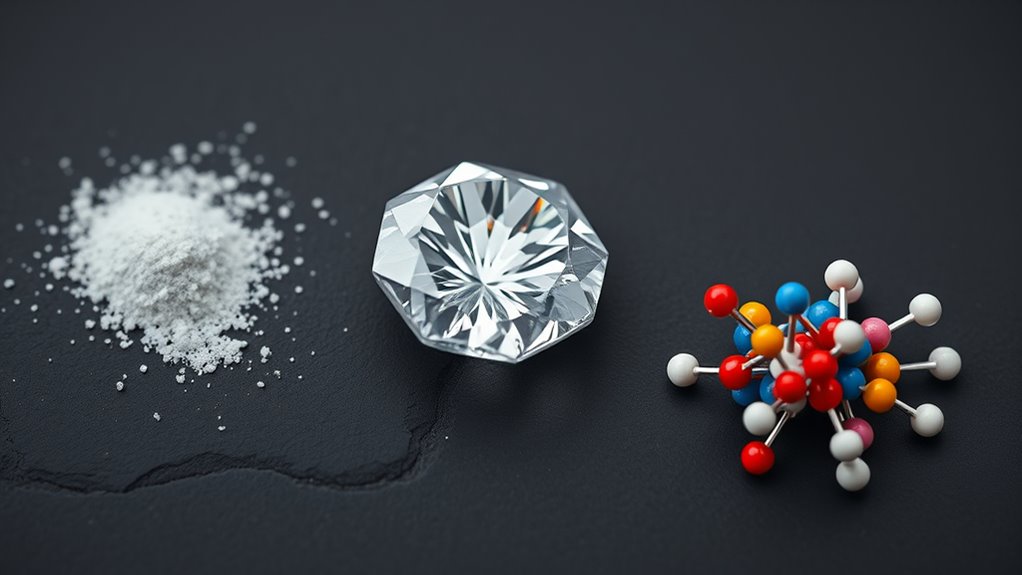
Although elements and compounds both make up the substances around you, they differ fundamentally in their composition. Elements consist of only one type of atom, which gives them unique element properties like specific melting points and densities.
You’ll find that elements can’t be broken down into simpler substances by chemical means. Compounds, however, form when two or more different atoms chemically bond, creating substances with distinct compound characteristics. These characteristics often differ from those of the individual elements forming them.
When you compare an element to a compound, you see that elements maintain consistent properties, while compounds show new properties due to their atomic combinations. Understanding these differences helps you grasp the basics of chemistry and how materials around you are structured.
What Atoms Make Up a Diamond?
Diamonds are made entirely of carbon atoms arranged in a crystal lattice. When you look at diamond formation, you’ll see that intense pressure and heat deep within the Earth cause carbon atoms to bond tightly in a specific pattern. This structure gives diamonds their remarkable hardness and brilliance.
Carbon is unique because it forms several allotropes, different structural forms of the same element. Besides diamonds, carbon allotropes include graphite and graphene. Each has distinct properties due to how their atoms connect.
So, Why Is Diamond Considered an Element?
Why do we classify diamond as an element rather than a compound? It all comes down to the diamond classification based on its atomic composition. Diamond consists purely of carbon atoms bonded together, without any other elements involved.
This uniformity means diamond isn’t a mixture of different atoms, which would make it a compound. Instead, it’s a pure form of one element, carbon. Understanding this helps you grasp the element significance when studying materials like diamond.
Recognizing diamond as an element highlights its unique properties derived from carbon alone, not from combinations of elements. So, when you think about diamond classification, keep in mind that its identity as an element reflects its consistent atomic makeup and the fundamental role carbon plays in defining its nature.
How Does Carbon’s Atomic Structure Create Diamond’s Properties?
Understanding that diamond is made entirely of carbon sets the stage for exploring how carbon’s atomic structure shapes diamond’s remarkable properties. You see, carbon atoms can arrange themselves in different ways, forming various carbon allotropes like graphite, graphene, and diamond.
Each allotrope’s unique atomic configuration determines its physical traits. In diamond, carbon atoms form a three-dimensional lattice where each atom bonds to four others in a tetrahedral arrangement. This precise atomic configuration results in a rigid, highly ordered structure that influences diamond’s thermal conductivity, transparency, and strength.
How Do Diamond’s Atomic Bonds Create Hardness and Sparkle?
You’ll notice that diamond’s incredible hardness comes from the way carbon atoms are tightly arranged and bonded. These strong covalent bonds hold the structure firmly, which makes it really tough to break. And at the same time, the way light moves through this atomic network is what gives diamond its famous sparkle.
Carbon Atom Arrangement
Although diamond looks simple on the surface, its incredible hardness and sparkle come from the unique way carbon atoms are arranged. As one of the carbon allotropes, diamond’s atomic arrangement forms a strong three-dimensional network.
Each carbon atom bonds with four others in a tetrahedral structure, creating exceptional stability and density. This layout contrasts with other allotropes like graphite, where atoms form layers. Understanding this atomic arrangement helps you see why diamond is so durable and brilliant.
| Carbon Allotrope | Atomic Arrangement | Key Feature |
|---|---|---|
| Diamond | Tetrahedral 3D network | Extreme hardness |
| Graphite | Planar layers | Conducts electricity |
| Fullerene | Spherical cages | Unique molecular shapes |
| Graphene | Single atomic layer | High strength |
Covalent Bond Strength
Because each carbon atom in a diamond shares strong covalent bonds with four neighbors, the structure forms an incredibly rigid network. You’ll notice that these covalent bond properties give diamond exceptional hardness, far surpassing most other materials.
When you compare bond strength, diamond’s carbon-carbon bonds rank among the strongest known, creating a stable, three-dimensional lattice. This bond strength comparison highlights why diamond doesn’t easily break or scratch.
The strength comes from the equal sharing of electrons in the covalent bonds, locking atoms tightly in place. So, when you hold a diamond, you’re feeling a material forged by powerful atomic connections that resist deformation, making diamond not just hard but also durable and long-lasting.
Light Reflection Mechanism
How exactly do diamond’s atomic bonds contribute to both its hardness and dazzling sparkle? The strong covalent bonds between carbon atoms create an incredibly rigid crystal lattice, giving diamond its unmatched hardness. This structure doesn’t just resist scratching. It also influences light behavior.
When light enters a diamond, its unique optical properties cause the light to bend, reflect, and refract multiple times within the lattice. These interactions maximize internal reflection, making the diamond sparkle intensely. You’ll notice that the precise angles between bonds affect how light disperses into a spectrum of colors, enhancing brilliance.
How Do Diamonds Differ From Other Carbon Forms?
When you compare diamonds to other forms of carbon, you’ll notice their unique atomic arrangement sets them apart. Diamonds have a rigid, three-dimensional lattice structure where each carbon atom bonds strongly with four others, creating exceptional hardness.
Other carbon allotropes, like graphite, feature layers of atoms bonded differently, making them soft and slippery. This difference explains diamond versatility: it’s not just a gemstone but also valuable in cutting tools due to its strength.
Unlike graphite or graphene, diamonds don’t conduct electricity because their electrons are locked in place. Understanding these contrasts helps you appreciate why diamonds stand out among carbon allotropes, combining beauty with unmatched physical properties that other forms of carbon simply can’t match.
What Do People Get Wrong About What Diamonds Are Made Of?
Understanding the unique structure of diamonds often leads to misconceptions about what they’re actually made of. Many think diamonds are compounds or contain multiple elements, but they’re purely carbon atoms arranged in a crystal lattice. This misunderstanding affects how you view diamond clarity and value.
Here’s a quick breakdown of common diamond misconceptions:
| Misconception | Reality | Impact on Perception |
|---|---|---|
| Diamonds are compounds | Made of pure carbon | Clarity relates to structure |
| Impurities define value | Clarity depends on flaws | Value varies by clarity |
| Diamonds are rare elements | Carbon is abundant | Rarity lies in formation |
Knowing these facts helps you appreciate diamonds for their true nature, not myths.
Can Diamonds Contain Other Elements or Impurities?
You might be wondering if diamonds are made of pure carbon or if they can actually contain other elements. Well, it turns out that common impurities like nitrogen or boron can sneak into a diamond’s structure. These little additions can change the diamond’s color and properties. So, let’s take a closer look at how these elements affect what you see in a diamond.
Common Diamond Impurities
Although diamonds are made almost entirely of carbon, they can contain trace amounts of other elements that affect their color and properties. These impurities, often introduced during formation, cause the color variations you see in natural diamonds.
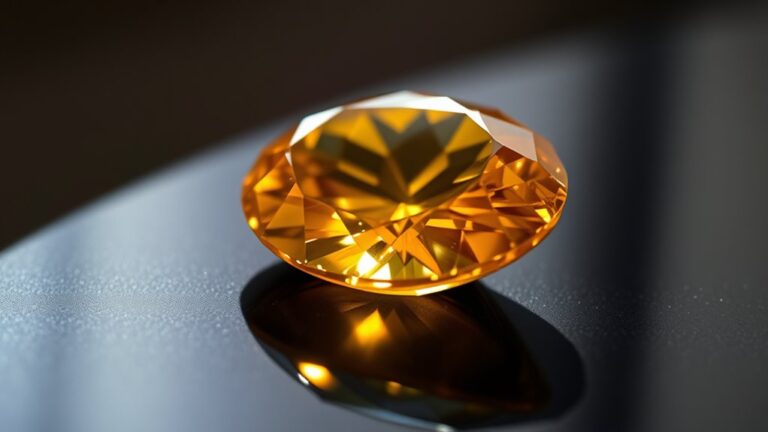
For example, nitrogen is a common impurity, giving diamonds a yellowish tint, while boron can produce a blue hue. Synthetic diamonds, grown in controlled environments, may also include specific impurities purposely added to mimic or improve certain colors.
Besides nitrogen and boron, hydrogen and nickel can occasionally be found as impurities. These trace elements don’t change the diamond’s fundamental carbon structure but influence its appearance and, sometimes, its value. Understanding common diamond impurities helps you appreciate why no two diamonds are exactly alike.
Elements Affecting Diamond Color
Trace elements like nitrogen and boron play a big role in shaping a diamond’s color, but other elements can also influence its appearance. When you look at a diamond, you’ll find that tiny amounts of elements like hydrogen, aluminum, or even nickel can subtly affect its hue.
These color influences occur because impurities change how light interacts within the diamond’s crystal lattice. Understanding these effects is vital in diamond grading since color impacts value and desirability. For example, nitrogen often causes yellow tones, while boron can produce blue shades.
While pure diamonds are colorless, these trace elements create the wide range of colors you see in natural diamonds. So, yes, diamonds can contain other elements, and they play a key role in determining a diamond’s unique look.
Why Understanding Diamond Chemistry Helps Identify Real Diamonds
Because diamond’s unique chemical structure gives it distinct physical properties, understanding its chemistry makes it easier to spot genuine diamonds. When you learn about diamond identification techniques, you’ll see how experts use chemical traits like hardness, refractive index, and light dispersion to verify authenticity.
Knowing these properties helps you distinguish natural diamonds from synthetic diamond differences, which often have subtle chemical or structural variations. For instance, synthetic diamonds might contain trace elements or growth patterns that natural diamonds lack.
Why Diamond Chemistry Matters for Science and Buyers
Understanding diamond chemistry doesn’t just help you spot real stones; it also impacts how scientists study these gems and how buyers make smart choices. When you grasp the chemical structure of diamonds, you understand why they’re so durable and how impurities affect their color and value.
This knowledge is essential for accurate diamond valuation, ensuring you don’t overpay or fall for fakes. Scientists use this chemistry to innovate synthetic diamond production, improving quality and lowering costs, which directly benefits you as a buyer.
Buyer education about diamond chemistry empowers you to ask the right questions and recognize quality beyond just sparkle. So, knowing the chemistry behind diamonds helps you make informed decisions, whether you’re investing in a precious stone or simply appreciating its unique properties.
Frequently Asked Questions
How Are Diamonds Formed Deep Within the Earth?
You form diamonds deep within the Earth when carbon structure undergoes intense heat and pressure. This environment causes carbon atoms to bond tightly, creating a crystal formation.
Over millions of years, these crystals grow and harden into the diamonds you know. You can think of it as nature’s way of arranging carbon atoms into a super-strong, sparkling lattice, buried far below the surface where conditions are just right.
What Is the Difference Between Natural and Synthetic Diamonds?
Natural and synthetic diamonds differ distinctly. You’ll find natural diamonds formed deep in Earth’s hold, boasting unique diamond characteristics shaped over millennia, which often boost their gemstone value.
Synthetic diamonds, however, are swiftly simulated in labs, sharing similar sparkle but sometimes lacking natural nuances. When you compare these, you’ll notice natural diamonds carry a rare, radiant reputation, while synthetic stones offer affordability and accessibility without fully capturing nature’s charm.
Can Diamonds Be Created in a Laboratory?
Yes, you can create diamonds in a laboratory through a process called diamond synthesis. Lab grown diamonds are made by replicating the high-pressure, high-temperature conditions found deep in the Earth or using chemical vapor deposition.
These methods allow you to produce real diamonds with the same physical and chemical properties as natural ones. This means you don’t have to rely solely on mining to get quality diamonds anymore.
How Do Diamonds Affect Industrial Applications?
You know what they say, “A diamond in the rough can shine the brightest.” In industrial uses, diamonds boost cutting efficiency like no other material.
When you use diamond tools, their abrasive properties speed up manufacturing processes while ensuring precision. Their exceptional thermal conductivity helps prevent overheating, making them ideal for tough jobs.
What Are the Environmental Impacts of Diamond Mining?
Diamond mining can greatly impact local communities by disrupting their livelihoods and causing displacement. You’ll also see ecological damage like deforestation and soil erosion.
However, some companies now invest in ecological restoration to repair the land after mining ends. If you care about sustainability, supporting responsible mining practices that prioritize community welfare and environmental recovery is essential for reducing these negative effects.
Conclusion
You might think diamonds are complex compounds, but they’re pure carbon, an element, not a mix. While compounds blend different atoms, diamonds showcase carbon’s unique atomic dance, creating unmatched hardness and sparkle.
This simple element transforms into something extraordinary, blurring lines between nature’s elegance and scientific wonder. Knowing this helps you spot real gems and appreciate the brilliant chemistry behind every diamond’s glow.
It’s simplicity and complexity perfectly intertwined, proving that diamond is an element with amazing properties.