
How Is a Diamond Formed?
If you’ve ever wondered how diamonds come to be, you’re not alone. Many people struggle to understand what makes these gems so rare and valuable. The journey from carbon deep underground to the sparkling stones we admire is truly fascinating.
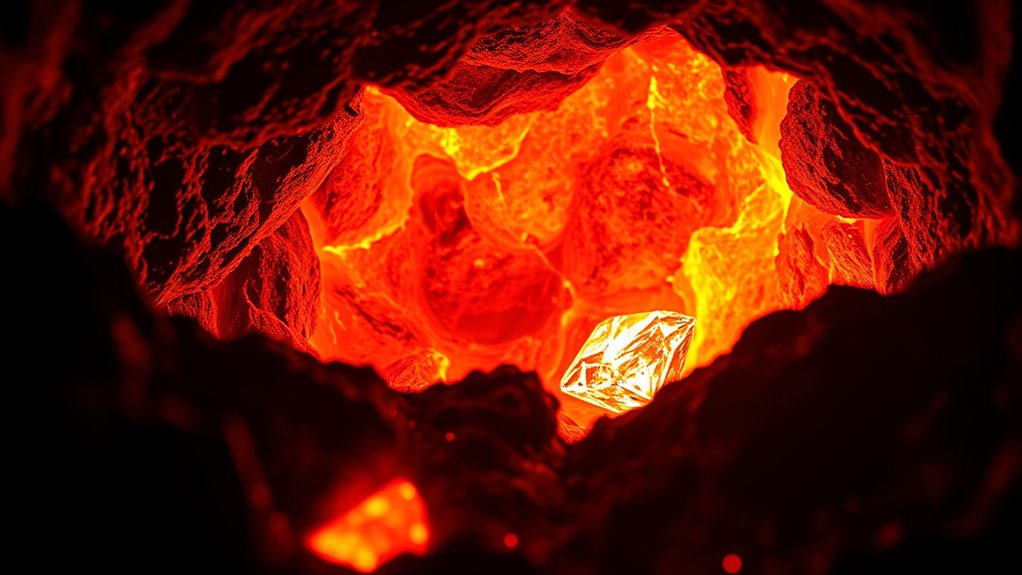
You form a diamond deep within the Earth’s mantle, where intense heat over 1,000 degrees Celsius and immense pressure squeeze carbon atoms tightly. This extreme environment rearranges the carbon into a strong crystal lattice over millions of years.
Volcanic eruptions then quickly transport these precious stones to the surface, preserving their unique brilliance.
Understanding this natural process helps explain why diamonds are so rare and valuable and there’s even more fascinating science behind how they reach us.
Key Takeaways
- Diamonds form deep in the Earth’s mantle, 90 to 150 miles below the surface, under extreme heat and pressure conditions.
- High temperatures (900 to 1,300°C) and intense pressure (45 to 60 kilobars) cause carbon atoms to bond into a crystal lattice.
- Carbon atoms reorganize into a strong, three-dimensional network, creating the unique structure of diamonds.
- Volcanic eruptions rapidly transport diamonds to the surface, which prevents them from turning into graphite.
- The entire diamond formation process takes millions to billions of years, starting from deep carbon sources under geological conditions.
What Makes Diamonds Unique and Valuable
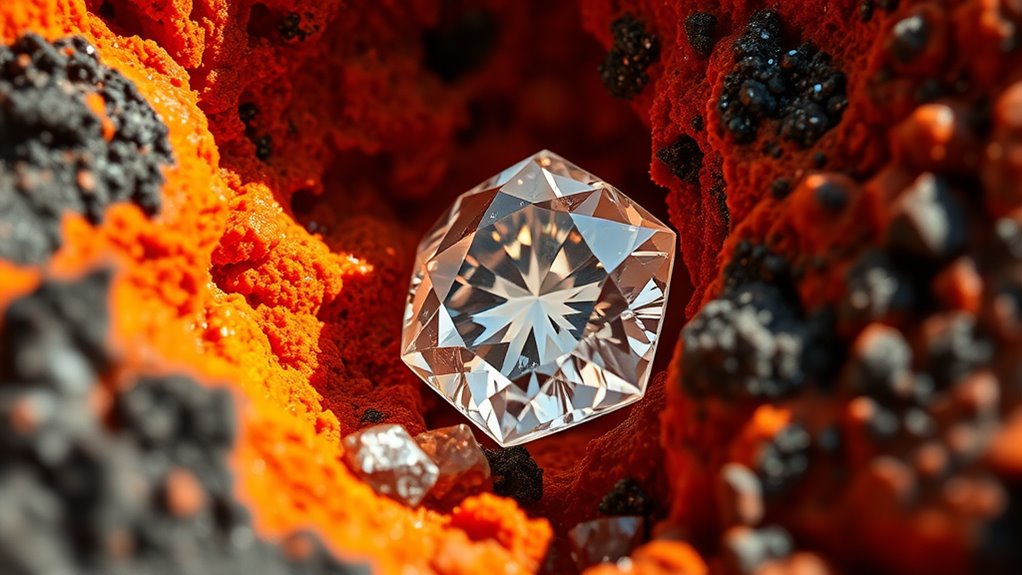
Diamonds stand out because of their unmatched brilliance and durability. When you look at a diamond, you’re seeing a gem formed through intense natural processes, making it rare and valuable.
This diamond rarity plays a huge role in its worth. Fewer diamonds exist compared to other gemstones, so they naturally attract more attention. You’ll notice that market demand constantly pushes diamond prices higher, especially for stones with exceptional clarity and color.
Because they’re so durable, diamonds also symbolize lasting beauty, which keeps buyers coming back. When you invest in or wear a diamond, you’re appreciating a gem whose unique physical properties and scarcity combine to make it one of the most sought-after jewels worldwide.
Where Do Diamonds Form Deep Inside the Earth?
Have you ever wondered where deep beneath the Earth’s surface these precious gems actually form? Diamonds develop in the Earth’s mantle, roughly 90 to 150 miles below you. This zone experiences intense mantle dynamics, where rock movement and pressure create unique conditions.
The mineral composition here is rich in carbon, essential for diamond formation. As carbon interacts with surrounding minerals, it sets the stage for diamonds to emerge. You won’t find diamonds just anywhere in the mantle; specific regions with the right balance of temperature, pressure, and composition are key.
Understanding this deep environment helps you appreciate how rare and precious diamonds truly are, born from the Earth’s powerful natural forces far beneath your feet.
How Do Heat and Pressure Transform Carbon Into Diamonds?
You’ll find that extreme heat and intense pressure work together deep underground to change carbon into diamonds. Basically, these forces squeeze and heat carbon atoms until they rearrange into a tight, crystal structure. So, let’s dive in and see how this transformation actually happens.
Extreme Heat Conditions
When carbon atoms get buried deep within the Earth’s mantle, intense heat and pressure work together to transform them. The high temperature in this environment, often exceeding 1,000 degrees Celsius, provides the energy needed to rearrange carbon sources like ancient plant and animal matter.
This extreme heat breaks down the original carbon structures, allowing the atoms to move and bond in new ways. You’ll find that without this sustained high temperature, carbon atoms wouldn’t have the mobility required to form the strong crystal lattice characteristic of diamonds.
Intense Pressure Effects
Although intense heat initiates the transformation, it’s the extreme pressure deep within the Earth’s mantle that forces carbon atoms to pack tightly together. You’ll find that pressure variations play an essential role, as only specific ranges create conditions suitable for diamond formation.
These pressures, often exceeding 45,000 times atmospheric pressure, alter mineral stability, allowing carbon to shift from graphite’s loose layers into the dense diamond structure. Without this intense pressure, carbon would remain in its more stable graphite form.
As you investigate these forces, you’ll see how the balance between heat and pressure shapes the environment where diamonds form. This intense pressure doesn’t just squeeze carbon; it stabilizes the minerals surrounding it, setting the stage for the next significant transformation step.
Carbon Atom Reorganization
Because heat and pressure work together deep within the Earth, carbon atoms rearrange from a loose, layered structure into a tightly bonded, three-dimensional network. You’ll see that this change happens because carbon bonding shifts dramatically under these extreme conditions.
Instead of forming weak layers, carbon atoms connect firmly in all directions, creating an incredibly strong molecular structure. This transformation is what gives diamonds their unique hardness and brilliance.
As you investigate this process, you’ll understand how the molecular structure shifts from graphite’s flat sheets to diamond’s rigid lattice. So, heat and pressure don’t just push and squeeze; they actively reorganize the carbon atoms, enabling a new, stable form.
This reorganization is essential for turning ordinary carbon into sparkling diamonds deep below the Earth’s surface.
How Long Does It Take for Diamonds to Form?
How long does it actually take for a diamond to form deep within the Earth? The formation timeline is quite extensive, typically millions to billions of years.
Diamond formation deep within the Earth spans an incredible timeline of millions to billions of years.
You see, diamonds originate from carbon sources buried deep under the Earth’s surface. These carbon atoms undergo intense pressure and heat, reorganizing their structure into a diamond crystal.
The process isn’t quick; it demands stable conditions over vast periods. You might find carbon from ancient organic material or mantle carbon, both contributing to diamond formation.
Understanding this timeline helps you appreciate the rarity and value of diamonds. So, while it’s tempting to think diamonds form instantly, remember they require deep time and specific carbon sources to develop their brilliance beneath the Earth’s crust.
Which Geological Conditions Create Diamonds?
When you consider the incredible journey carbon takes to become a diamond, the specific geological conditions that make this transformation possible become essential. Diamond formation requires intense heat, typically between 900 to 1,300 degrees Celsius, and immense pressure, ranging from 45 to 60 kilobars.
These conditions exist about 140 to 190 kilometers beneath Earth’s surface, deep within the mantle. The geological processes involved force carbon atoms to bond in a crystal lattice, creating the diamond’s unique structure.
Without this combination of high pressure and temperature, carbon would remain graphite or other forms. Understanding these geological processes helps you appreciate why diamonds are so rare and precious, formed only under such extreme and specific conditions deep within the Earth’s mantle.
How Do Diamonds Travel to the Surface?
The intense heat and pressure deep within the mantle create diamonds, but these precious stones don’t stay hidden forever. You’ll find that diamond migration happens as these gems travel through geological pathways, natural channels within the Earth’s crust.
These pathways act like tunnels, guiding diamonds upward from their birthplace. As you trace their journey, you’ll see that diamonds move along fractures and faults caused by tectonic forces.
This migration isn’t slow; it can be rapid enough to preserve the diamonds’ crystal structure. Understanding these geological pathways helps you grasp how diamonds leave the deep mantle and reach shallower layers closer to the surface, setting the stage for their eventual revelation.
Without this migration, diamonds would remain buried and inaccessible.
How Do Volcanic Eruptions Bring Diamonds to the Surface?
Because volcanic eruptions forcefully push material from deep within the Earth, they play an essential role in bringing diamonds closer to the surface. You can think of volcanic pathways as natural highways that rapidly transport diamonds embedded in molten rock.
The eruption dynamics, such as pressure, speed, and gas content, drive this swift ascent. This prevents diamonds from transforming into graphite. As magma ascends, it carries diamonds within kimberlite or lamproite pipes, the primary volcanic rocks linked to diamond deposits.
Without these powerful volcanic processes, diamonds would remain buried miles underground.
- Volcanic pathways provide direct routes for deep-origin diamonds
- Eruption dynamics guarantee rapid, high-pressure transport
- Magma composition preserves diamond integrity
- Kimberlite pipes serve as diamond-bearing conduits
This explosive journey is vital for diamonds to reach the surface intact.
How Do Scientists Find and Study Natural Diamonds?
You’ll notice that scientists use certain exploration techniques to find areas beneath the Earth’s surface that are rich in diamonds. Once they discover samples, they then use advanced analytical methods to study the diamonds’ properties and origins. This whole process helps us understand how natural diamonds form and where they come from.
Exploration Techniques
Although diamonds form deep within the Earth, scientists have developed clever techniques to locate and study them near the surface. You can use seismic surveys to send shock waves underground and map rock formations where diamonds might hide.
Magnetic mapping helps identify variations in Earth’s magnetic field, revealing kimberlite pipes, volcanic structures that often carry diamonds. You’ll also rely on soil sampling to detect tiny diamond fragments or indicator minerals.
Moreover, aerial surveys using drones or planes provide detailed images to guide ground exploration. These techniques work together to pinpoint promising sites efficiently, saving time and resources.
- Seismic surveys reveal underground structures
- Magnetic mapping detects kimberlite pipes
- Soil sampling finds diamond indicators
- Aerial surveys guide detailed ground work
Analytical Methods
Scientists use several advanced analytical methods to identify and study natural diamonds once they’re extracted. You’ll often start with spectroscopic analysis to examine the diamond’s chemical composition and isotopic ratios, which reveal its origin and formation conditions.
Imaging techniques like electron microscopy help you observe the diamond’s crystal structure and any inclusions in great detail. X-ray diffraction allows you to confirm the crystal lattice, ensuring it’s a genuine diamond.
To further differentiate diamonds from other minerals, you can measure thermal conductivity, as diamonds conduct heat exceptionally well. Fluorescence properties under ultraviolet light also provide clues about the diamond’s quality and type.
What Are Synthetic Diamonds and How Are They Made?
While natural diamonds form deep within the Earth over millions of years, synthetic diamonds are created in laboratories using advanced technology. These lab grown gems replicate the natural diamond’s structure through synthetic processes, making them nearly identical in appearance and properties.
You can trust that synthetic diamonds offer a more sustainable and cost-effective alternative.
Here are key points about synthetic diamond creation:
- High Pressure High Temperature (HPHT) mimics natural conditions to grow diamonds.
- Chemical Vapor Depposition (CVD) uses gas to deposit carbon atoms on a substrate.
- Lab grown diamonds can be customized for size and quality.
- Synthetic processes reduce environmental impact compared to mining.
Understanding these methods helps you appreciate the science behind lab grown diamonds and their growing popularity.
How Does Diamond Formation Affect Their Value?
Because the way a diamond forms directly influences its characteristics, it also plays an essential role in determining its value. When you understand diamond rarity, you see why naturally formed diamonds often command higher prices.
These diamonds develop under extreme pressure and temperature over millions of years, making each one unique. This rarity boosts their appeal and market demand. On the other hand, synthetic diamonds, while chemically identical, form faster and in controlled environments, which can affect their market demand differently.
As a buyer, knowing how formation impacts clarity, color, and size helps you make informed choices. Ultimately, the natural origin and rarity of a diamond raise its value, reflecting its extraordinary journey deep within the Earth.
Frequently Asked Questions
Can Diamonds Form From Elements Other Than Carbon?
No, diamonds can’t form from elements other than carbon because diamond formation specifically involves carbon atoms arranged in a crystal lattice.
While scientists investigate alternative materials like silicon or boron to create diamond-like structures, these aren’t true diamonds. If you want real diamonds, you need carbon.
What Tools Are Used to Cut and Polish Diamonds?
You might think cutting and polishing a diamond is all about brute force, but it’s actually delicate precision. You use specialized cutting techniques like laser cutting and sawing with diamond-coated blades to shape it carefully.
Then, polishing tools such as spinning wheels coated with diamond powder bring out its brilliance. This contrast between strength and finesse guarantees your diamond shines perfectly, revealing its true beauty through expert craftsmanship.
How Do Diamonds Influence Jewelry Fashion Trends?
Diamonds shape jewelry fashion trends because you’re drawn to their brilliant cuts that maximize sparkle and style. You’ll notice designers highlight these cuts to create eye-catching pieces that stand out.
Plus, with growing awareness, you care about ethical sourcing, pushing brands to offer responsibly mined diamonds. This blend of dazzling brilliance and ethical values keeps diamond jewelry fresh, relevant, and highly desirable in today’s fashion world.
Are Diamonds Used in Industrial Applications Beyond Jewelry?
Yes, you’ll find industrial diamonds widely used beyond jewelry. You’ll rely on them for cutting, grinding, and drilling because of their extreme hardness.
Synthetic diamonds, especially, play a big role in these applications since they’re more affordable and consistent than natural ones. So, whether you’re working with precision tools or heavy machinery, industrial diamonds help you achieve durability and efficiency in tough tasks.
What Cultural Meanings Do Diamonds Hold Worldwide?
You might think diamonds only symbolize wealth, but their diamond symbolism runs much deeper worldwide. They often represent love, strength, and purity across cultures.
In some traditions, diamonds hold spiritual power or protection. Their cultural significance varies, from engagement rings in the West to symbols of status in Asia.
Conclusion
Now that you know diamonds form under intense heat and pressure deep within the Earth over millions of years, you might wonder if all diamonds are natural treasures. Some believe synthetic diamonds lack value, but they’re nearly identical chemically and physically.
While natural diamonds carry unique geological stories, synthetic ones challenge traditional views of rarity and worth. So, understanding their origins helps you appreciate both types and rethink what truly makes a diamond priceless.
In the end, knowing how a diamond is formed deepens your appreciation for these remarkable gems.