How You Can Tell if a Diamond Is Real With Simple Steps
If you’ve ever bought or inherited a diamond, you know how tricky it can be to tell if it’s real or fake. You’re not alone—many people struggle with this because diamonds can look so similar to imitations. Understanding how to spot a genuine diamond can save you from costly mistakes and give you peace of mind.
You can tell if a diamond is real by checking its sparkle and sharp edges. Real diamonds show bright, colorful flashes and have precise cuts.
Try the water test: a real diamond sinks quickly, while fakes might float. Also, breathe on it; a real diamond clears fog fast.
Look for tiny imperfections under a magnifier, as flawless stones often aren’t genuine.
Keep exploring to uncover more simple tests that can confirm authenticity and spot common imitations.
Key Takeaways
- Real diamonds reflect bright, sharp flashes of white and colorful light, unlike the dull or cloudy sparkle you see in fakes.
- Drop the stone in water. Genuine diamonds sink quickly, while fakes may float or sink slowly.
- Breathe on the diamond to fog it. Real diamonds clear the fog almost instantly, while fakes hold onto it longer.
- Check the edges and facets for sharpness and precise cuts. Rounded or uneven edges usually mean it’s a fake.
- Use a loupe to look for tiny natural imperfections since flawless stones are often synthetic or imitation.
How to Spot a Real Diamond at First Glance
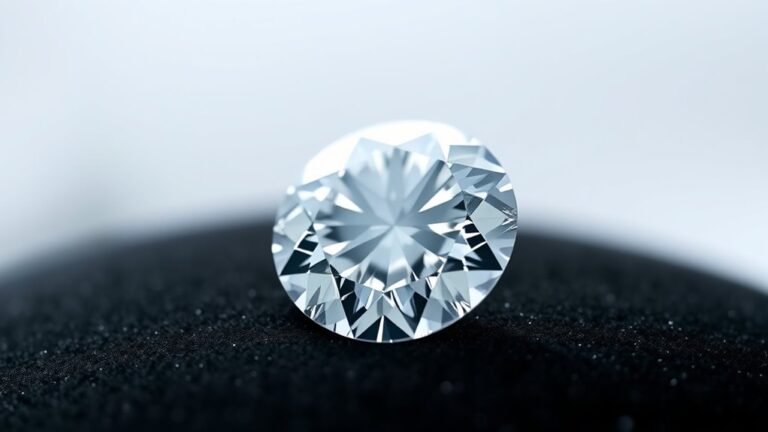
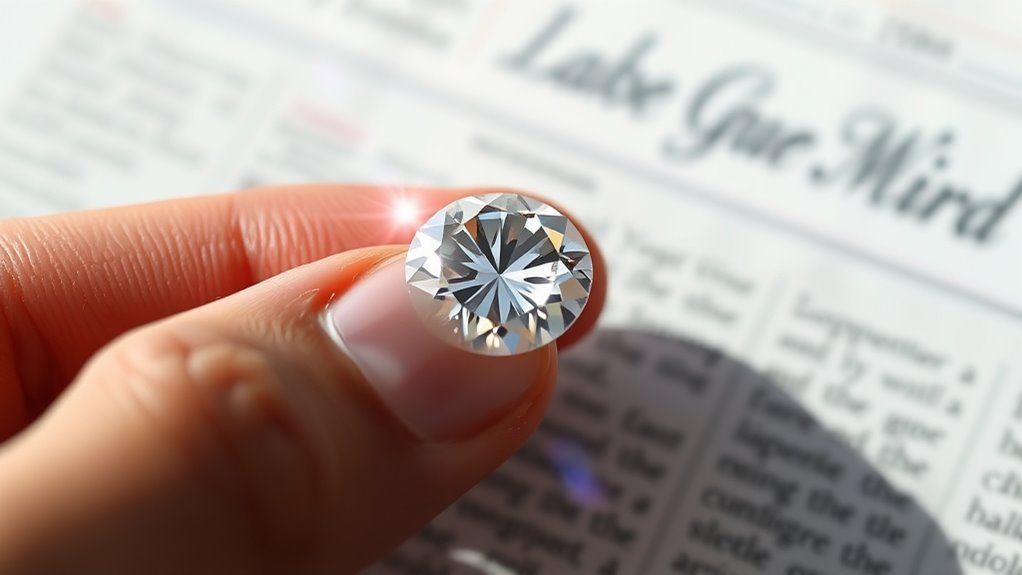
How can you quickly tell if a diamond is real just by looking? Focus on key diamond characteristics and visual cues that set genuine stones apart. A real diamond reflects light in a unique way. Notice its brightness and the way it sparks with colorful flashes, known as fire.
Look closely for sharp edges and precise facets. Fake diamonds often have rounded edges or blurry cuts. Also, pay attention to the clarity. Real diamonds usually have tiny imperfections, while fakes might appear flawless.
Another visual cue is how the diamond interacts with its surroundings. Real ones refract light so it’s hard to see through them clearly. By observing these diamond characteristics and visual cues, you can spot a real diamond at first glance with confidence.
Simple Water Test to Check Diamond Authenticity
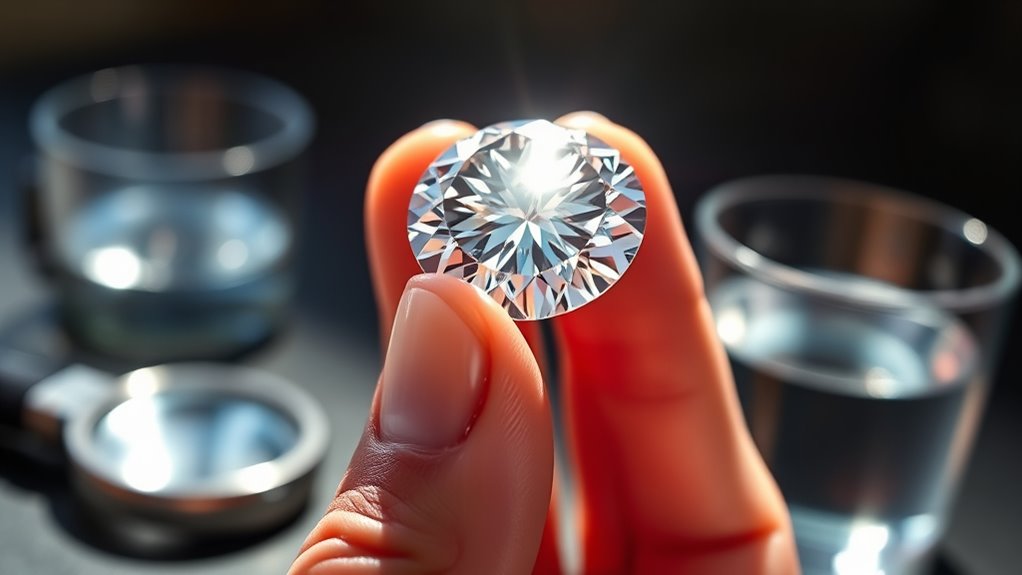
Wondering if there’s a quick and easy way to test your diamond’s authenticity at home? Try the simple water test. Fill a glass with water and gently drop your diamond into it.
Real diamonds have high density, so they’ll sink quickly. Fake diamonds or imitations often float or sink slowly.
Watch closely for bubble formation. If bubbles cling to the stone, it might be fake, as real diamonds repel water and don’t trap air bubbles.
Also, observe water clarity around the stone; a genuine diamond will cause water to remain clear and unclouded.
| Test Aspect | Real Diamond Result | Fake Diamond Result |
|---|---|---|
| Sinking Speed | Sinks quickly | Floats or sinks slowly |
| Bubble Formation | No bubbles cling | Bubbles cling to surface |
| Water Clarity | Water stays clear | Water becomes cloudy |
Using the Fog Test to Confirm a Real Diamond
After testing your diamond with water, another quick way to check its authenticity is the fog test. You simply breathe on the diamond to create a fog from your breath. Real diamonds disperse heat quickly, so the fog duration is very short. Here’s how to do it:
- Hold the diamond close to your mouth
- Take a deep breath and exhale steadily onto its surface
- Watch how long the fog stays on the diamond
- Check the breath clarity through the fog; real diamonds won’t obscure your view for long
If the fog clears almost immediately, your diamond is likely real. If it lingers for a few seconds, it might be a fake. This simple fog test relies on breath clarity and fog duration to quickly confirm authenticity.
How to Check a Diamond’s Sparkle and Brilliance
To check a diamond’s sparkle and brilliance, you want to watch how it reflects light from different angles. It’s pretty cool to see how the light plays off the surface.
Next, look for the fire—that’s the colorful flashes you see inside the diamond. And don’t forget about the scintillation, which is the sparkle that happens when you move the diamond around.
These little details really help you figure out if the diamond is the real deal or not. So, take your time and enjoy the show!
Observe Light Reflection
Light reflection reveals a diamond’s true brilliance and sparkle. When you observe how light interacts with a diamond, you get clues about its authenticity.
Real diamonds exhibit exceptional light dispersion, breaking white light into vibrant colors. To check, hold the stone under a bright light and watch for:
- Sharp, crisp flashes of light bouncing inside the gem
- Distinct separation of colors, showing strong light dispersion
- A brilliance comparison with nearby glass or cubic zirconia, which appear duller
- Bright reflections that move smoothly as you tilt the stone
If the diamond’s sparkle feels muted or the reflections look blurred, it might be fake. Real diamonds maximize light reflection, creating a lively, eye-catching glow you can’t easily replicate.
Examine Fire and Scintillation
Fire and scintillation give a diamond its enchanting sparkle and dynamic brilliance. When you examine these qualities, focus on how the diamond breaks light through light dispersion, creating flashes of vivid colors.
A real diamond produces strong color intensity, showing vibrant reds, blues, and greens as you move it under light. Scintillation refers to the sparkle effect you see when the diamond or light source shifts, causing bright flashes and dark areas.
Fake stones often lack this lively interplay of light and color, appearing dull or uniform. To check, hold the diamond under a direct light source and tilt it slowly. If you notice sharp, colorful flashes and varied sparkle patterns, the diamond’s fire and scintillation are genuine, indicating authenticity.
Testing Diamond Hardness With Everyday Items
You can test a diamond’s hardness using simple scratch tests with everyday items. For example, try gently scratching the stone with a metal object like a knife or even a piece of glass to see if it leaves a mark. Since diamonds are incredibly hard, they won’t get scratched easily. This can help you figure out if your stone is real or not.
Scratch Test Techniques
Although it’s not the most foolproof method, you can use simple scratch tests to check a diamond’s hardness with everyday items. Diamonds rank highest in scratch durability, so they resist scratch marks from most materials.
To try this, gently attempt to scratch the stone’s surface using:
- The edge of a metal key
- A piece of glass
- A ceramic plate corner
- A steel nail
If the stone shows no scratch marks after these tests, it likely has the hardness of a diamond. However, be cautious. Too much pressure can damage the setting or create false results.
Common Household Tools
Scratch tests can give you a quick idea about a stone’s hardness, but they’re just a starting point. You can use common household tools like a piece of glass or a steel file to test your diamond’s scratch resistance.
Gently try scratching the stone with these items. If it’s a real diamond, it won’t scratch easily because diamonds rank highest on the Mohs hardness scale. Remember, avoid applying too much pressure to prevent damage.
After testing, perform proper diamond cleaning to remove any residue and keep your gem sparkling. Regular diamond care not only maintains its shine but also helps you better notice subtle changes during tests.
Using everyday tools is a simple, accessible way to start verifying your diamond’s authenticity at home.
How to Use a Loupe to Find Diamond Flaws
When you examine a diamond under a loupe, you can spot tiny imperfections that reveal its authenticity. Use loupe magnification techniques by holding the loupe close to your eye and bringing the diamond near the opposite hand.
Focus on identifying inclusions, which are small internal flaws or foreign materials trapped inside the diamond. These inclusions appear as tiny spots, lines, or clouds. They help you distinguish a real diamond from a fake one.
Look for natural flaws like feathers or crystals inside the stone. Also, watch for small black or white specks that don’t reflect light and irregularities in the diamond’s structure.
Check for clear, sharp edges around inclusions rather than blurred or fuzzy ones. This detailed inspection confirms the diamond’s genuineness through its unique imperfections.
Reading a Diamond’s Reflections and Edges for Authenticity
You’ll want to take a good look at how light bounces around inside the diamond. Real diamonds tend to create sharp, bright flashes that really catch your eye. Also, don’t forget to check out the edges. Authentic diamonds usually have clean, well-defined lines—not those rounded or rough edges you might see in fakes. These little visual hints make it easier to spot a genuine stone quickly.
Analyzing Light Reflections
How can you tell if a diamond’s sparkle is genuine? Focus on how it handles light. A real diamond bends and refracts light distinctively, creating distinct sparkle patterns you can spot with a careful eye. When you hold the diamond under a light source, observe the reflections closely.
Look for these signs:
- Bright, sharp flashes of light (fire) in multiple colors
- Sparkle patterns that shift as you move the diamond
- Distinct light refraction causing a mix of white and colorful light
- No dull or cloudy areas within the stone’s surface
Fake diamonds often reflect light unevenly or produce muted sparkle. By analyzing these light reflections, you get a quick, simple way to assess a diamond’s authenticity without specialized tools.
Inspecting Diamond Edges
Three key details about a diamond’s edges can reveal its authenticity. When you inspect the edges, look closely for sharp, well-defined cuts. Real diamonds have precise edge symmetry, while fakes often appear rounded or uneven.
Also, check for the diamond clarity near the edges; genuine diamonds maintain consistent clarity without cloudiness or bubbles.
Use the table below to quickly compare:
| Edge Quality | Diamond Clarity | Authenticity Indicator |
|---|---|---|
| Sharp & Symmetrical | Clear & Flawless | Real Diamond |
| Rounded & Uneven | Cloudy or Bubbly | Fake or Imitation |
| Slight Imperfections | Slight Inclusions | Possibly Real (Needs Further Testing) |
How UV Light Helps Identify Real Diamonds
Anyone interested in verifying a diamond’s authenticity can use UV light as a helpful tool. Real diamonds often exhibit UV fluorescence, glowing blue under ultraviolet light, while synthetic diamonds may show little to no reaction.
When you shine UV light on your stone, watch for these signs:
- A subtle blue glow indicating natural diamond traits
- No glow, which might suggest synthetic or treated stones
- An inconsistent or patchy fluorescence pattern
- A strong green or yellow glow, uncommon in genuine diamonds
Keep in mind, not all real diamonds fluoresce, and some synthetic ones can mimic this effect. Still, UV light offers a quick, non-invasive way to help you tell if your diamond is genuine or possibly synthetic. It’s a handy step before moving on to more detailed tests.
When Should You Use Professional Diamond Testers?
Although basic tests like UV light can provide clues, you should turn to professional diamond testers when you need a definitive answer about your stone’s authenticity. These testers use advanced technology to perform precise authenticity verification, which simple home methods can’t match.
If you’re considering a significant purchase or want accurate diamond grading for resale or insurance, relying on a professional tester guarantees you’re making an informed decision. They can distinguish real diamonds from high-quality simulants that basic tests might miss.
Also, if the stone’s origin or certification is unclear, professional testing provides reliable proof of authenticity. Using these testers protects your investment and gives you confidence in your diamond’s true value.
When precision matters, professional diamond testers are your best choice.
Common Fake Diamonds and How to Tell Them Apart
How can you tell if a diamond is fake when many look so convincing? Understanding common fake diamond types helps you spot the difference quickly. Synthetic diamond differences often confuse buyers, but they’re lab-created with distinct properties.
Knowing common fake diamond types helps you quickly identify genuine stones despite convincing appearances.
Other fake diamond types include:
- Cubic zirconia: glassy sparkle, heavier weight
- Moissanite: more brilliance, rainbow flashes
- White sapphire: less sparkle, duller fire
- Glass: scratches easily, low hardness
Each fake diamond type mimics real diamonds but lacks certain qualities like hardness, brilliance, or thermal conductivity. By learning these key traits, you’ll confidently distinguish real diamonds from fakes and synthetic counterparts.
Keep this knowledge handy when evaluating stones to avoid costly mistakes and guarantee you get genuine value.
Frequently Asked Questions
What Is the History of Diamond Testing Methods?
You’ll find diamond lore dates back centuries, where people used simple tricks like fogging the stone or checking its sparkle. Over time, the testing evolution introduced tools like the loupe and thermal conductivity testers to identify real diamonds.
Today, you can use advanced devices that measure electrical conductivity or even laser inscriptions. Understanding this history helps you appreciate how diamond testing has become more accurate and accessible for everyone.
How Do Diamonds Form Naturally?
Diamonds form naturally deep within the Earth’s mantle under intense heat and pressure, usually about 90 miles below the surface. You’ll find that diamond formation takes millions to billions of years as carbon atoms bond tightly in a crystal structure.
These natural processes push diamonds upward through volcanic eruptions, bringing them closer to the surface where you can unearth them. Understanding diamond formation helps you appreciate their incredible natural journey.
What Are the Ethical Concerns Around Diamond Mining?
Ethical concerns around diamond mining hit you like a storm, shaking trust in the industry. You have to watch out for conflict diamonds, which fund violence and exploit communities.
Without ethical sourcing, miners often face poor working conditions and environmental harm. When you buy a diamond, make sure it’s certified to avoid supporting these issues.
Choosing responsibly helps protect people and the planet while still enjoying your sparkling gem.
How Should I Care for and Clean My Diamond Jewelry?
You should care for your diamond jewelry by regularly performing diamond cleaning to keep it sparkling. Use warm water, mild dish soap, and a soft toothbrush to gently scrub away dirt. Rinse thoroughly and dry with a soft cloth.
For jewelry maintenance, avoid harsh chemicals and store your pieces separately to prevent scratches. Get professional cleanings and inspections annually to guarantee your diamonds stay beautiful and secure.
What Certifications Authenticate Diamond Quality and Origin?
You know what they say: “Trust, but verify.” When you’re checking diamond quality and origin, rely on certifications from respected gemological laboratories like GIA or AGS.
These certification agencies use strict grading scales to assess cut, color, clarity, and carat. A diamond appraisal from a certified expert also confirms authenticity and value.
Always ask for official documentation to guarantee your diamond’s quality and ethical origin before buying or selling.
Conclusion
Think of spotting a real diamond like finding a rare star in the night sky. At first glance, it might just sparkle, but the true test reveals its brilliance.
Remember, even a simple fog test or water dip can separate that star from ordinary stones. Like a skilled astronomer uses tools to confirm a star’s identity, you can use these easy steps to verify your diamond truly shines.
Don’t hesitate to call in the pros when in doubt. These simple steps will help you tell if a diamond is real with confidence.