How to Test a Diamond at Home in 7 Simple Steps
If you’ve ever wondered whether that sparkling gem is a real diamond or just a convincing imitation, you’re not alone. Many people struggle with identifying genuine diamonds without professional tools or expertise.
It can feel overwhelming trying to figure out if your precious stone is the real deal, especially when you want to be sure before making a big investment or sentimental purchase.
You can test a diamond at home by checking its sparkle and clarity under strong light, then performing a fog test. Real diamonds clear fog quickly.
Next, drop it in water; genuine diamonds sink fast due to their density. Try scratching glass gently; a real diamond will leave a mark.
Use a magnifying loupe to spot inclusions and a thermal tester for heat conductivity. Combining these methods boosts accuracy, and there’s more to investigate for confidence in your gem.
Key Takeaways
- Hold the diamond under strong light to check for sharp sparkle and visible inclusions using a magnifier or loupe.
- Breathe on the diamond and watch how quickly the fog clears. Real diamonds clear fog almost instantly.
- Drop the diamond into a container of water. Genuine diamonds sink quickly because of their high density.
- Gently scratch a glass surface with the diamond. Authentic diamonds can leave a scratch due to their hardness.
- Use a thermal tester for quick authenticity checks, but combine it with other tests to avoid false positives from moissanite.
Assess Diamond Sparkle and Clarity to Spot Fakes
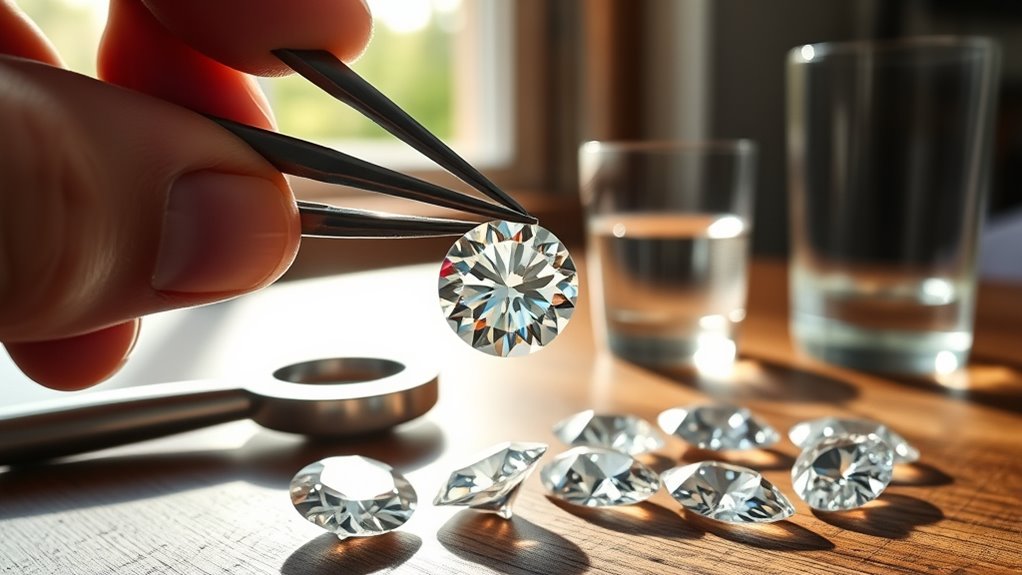
Although it might seem tricky at first, you can quickly assess a diamond’s sparkle and clarity to spot fakes. Real diamonds show exceptional diamond brilliance, reflecting light in a way that creates sharp, bright sparkle patterns.
Hold the diamond under a strong light source and observe how the light bounces off its facets. Genuine diamonds produce a dazzling array of white and colored flashes, while fake stones often look dull or display uneven sparkle patterns.
Next, examine the clarity by looking through the diamond with a magnifier or even your naked eye. Natural diamonds usually have tiny imperfections or inclusions, unlike synthetic stones that appear perfect.
Try the Fog Test to Check Diamond Breath Patterns
Once you’ve observed a diamond’s sparkle and clarity, you can move on to another quick home test: the fog test. Simply breathe on the stone, like you’re trying to fog up a mirror.
Pay close attention to how quickly the fog caused by your diamond breath disperses. Real diamonds have low moisture retention, so the fog should clear almost immediately, usually within a few seconds.
If the fog lingers for longer, it’s a sign the stone might be a fake or made from a material that holds moisture more than a genuine diamond. This test isn’t foolproof but gives you a quick indication of authenticity before moving on to other methods.
Use the Water Test to See If Your Diamond Sinks
Fill a clear container with water, then gently drop your stone in. Keep an eye on it to see if your diamond sinks quickly or floats. This simple observation can actually help you figure out whether your stone is a real diamond or not.
Preparing The Water Container
Before you start the water test, make sure you have a clear container that’s large enough to hold enough water for your diamond to fully submerge. Pick a container with sufficient size so the diamond won’t touch the bottom or sides, ensuring an accurate test.
Use clean, room-temperature water because extreme water temperature can affect the test’s reliability. Avoid hot or cold water, which might cause bubbles or distortions.
Fill the container slowly to prevent splashes or air bubbles that could interfere with your observation. Once filled, double-check that the water level allows the diamond to be completely submerged without crowding the container.
Proper preparation of the water container sets the stage for a successful water test to determine your diamond’s authenticity.
Observing Diamond’s Buoyancy
Although it might seem simple, closely watching how your diamond behaves in water can reveal a lot about its authenticity. To start, gently place your stone into the prepared water container.
Pay attention to its buoyancy measurement. Does it sink immediately or float? Diamonds have a high density compared to many imitations, so this density comparison is essential.
If your stone sinks quickly, it matches the expected behavior of a real diamond. On the other hand, if it lingers or floats, that difference in buoyancy might indicate it’s not genuine.
Make sure to observe without disturbing the water to get an accurate reading. This straightforward water test helps you evaluate your stone’s physical properties before moving on to interpreting the sinking results.
Interpreting Sinking Results
When your diamond sinks quickly in the water, it confirms the stone’s high density, a hallmark of genuine diamonds. You should pay close attention to sinking patterns during the test. Authentic diamonds tend to drop straight to the bottom without hesitation.
If your stone floats or sinks slowly, buoyancy factors might be influencing the result, suggesting it could be a fake or a different material with lower density. Keep in mind that impurities or air bubbles trapped under the stone can alter sinking behavior. So make certain your diamond is clean and dry before testing.
See If Your Diamond Can Scratch Glass Gently
One simple way to check if your diamond is real is to see if it can gently scratch a piece of glass. Diamonds rank highest on the hardness scale, so they should be able to leave a mark on glass, which is much softer. To test this:
- Find a clean, smooth glass surface like a window or glass cup.
- Hold your diamond firmly and gently try to scratch the glass at a shallow angle.
- Check the glass for any visible scratches without pressing too hard.
If your diamond leaves a glass scratch, it’s a good sign of genuine diamond hardness. Remember, don’t apply too much pressure to avoid damage or injury. This simple test helps you quickly gauge authenticity before moving to more detailed checks.
Inspect Your Diamond Under a Magnifying Loupe for Inclusions
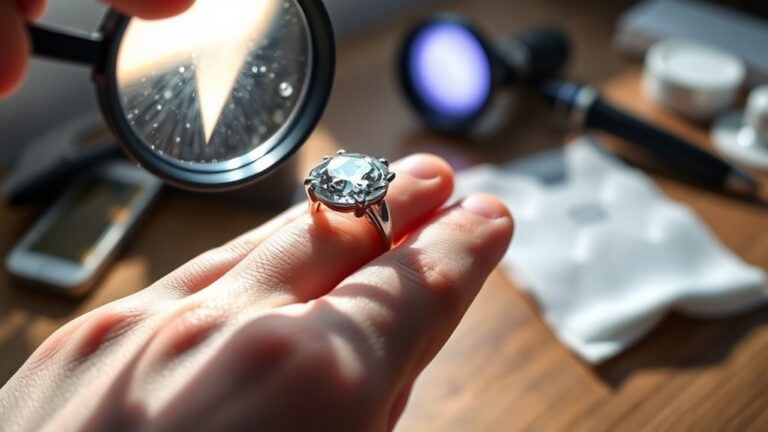
Grab a magnifying loupe and take a close look at your diamond’s interior. You’re looking for tiny internal flaws, called inclusions, which can help confirm if your stone is genuine. Using the loupe’s magnification lets you spot these details that are invisible to the naked eye.
Identifying Internal Inclusions
Although diamonds are prized for their clarity, most contain natural internal features called inclusions that can help you verify authenticity. By identifying these inclusion types, you get insight into the diamond’s clarity grades and whether it’s genuine.
When you inspect your diamond, look for:
- Small crystals or mineral deposits trapped inside the diamond. These are common inclusion types that affect clarity grades.
- Feather-like fractures, which look like tiny cracks but don’t always weaken the stone.
- Pinpoints or tiny white spots scattered within, often seen only under magnification.
Recognizing these natural imperfections distinguishes real diamonds from imitations, which usually lack such internal details. This step is essential when testing your diamond at home, giving you a clearer picture of its quality and authenticity.
Using Loupe Magnification
When you inspect your diamond closely, using a magnifying loupe can reveal details invisible to the naked eye. A jeweler’s loupe, usually 10x magnification, is the most common loupe type for diamond grading. This tool helps you spot internal inclusions and surface blemishes, which are essential for evaluating authenticity and quality.
Hold the loupe close to your eye and bring the diamond near until it’s in focus. Look for tiny imperfections like feathers, crystals, or clouds inside the stone. Natural diamonds typically have some inclusions, while synthetic or fake stones often lack these.
Check Diamond Fluorescence With UV Light
Since diamonds often exhibit unique fluorescence under UV light, you can use a UV lamp to help verify your stone’s authenticity. This test reveals how your diamond reacts, showing distinct fluorescence patterns based on its diamond color.
Here’s how to check fluorescence with UV light:
Here’s a simple method to check your diamond’s fluorescence using a UV light.
- Darken the room and shine the UV lamp directly on the diamond.
- Observe the stone’s glow; genuine diamonds usually emit a blue fluorescence, though other colors can appear depending on the diamond color.
- Compare the fluorescence patterns with known standards or reference images to spot inconsistencies.
Keep in mind, not all real diamonds fluoresce, but unnatural or inconsistent fluorescence patterns may indicate a fake. This simple UV test adds a reliable layer to your home diamond inspection toolkit.
Confirm Authenticity With a Thermal Tester
If you want a quick and effective way to verify your diamond’s authenticity, a thermal tester can help. This device measures the thermal conductivity of your stone since diamonds conduct heat much faster than most imitations. Simply place the tester’s tip on your diamond, and it will indicate whether the heat dissipates rapidly, confirming diamond authenticity.
Thermal testers are widely used by professionals because they offer accurate, immediate results. Keep in mind that some moissanites can mimic diamond thermal conductivity, so this test is most reliable when combined with other methods. Still, using a thermal tester at home is a practical step to confidently confirm if your gem is a real diamond or just a look-alike.
Frequently Asked Questions
Can I Test a Diamond Using Household Items Only?
Yes, you can test a diamond using household items and simple techniques. For example, try the fog test by breathing on the stone. Diamonds disperse heat quickly, so the fog should clear almost instantly.
Another way is the water test. Diamonds have high density and will sink in water. These methods won’t be 100% accurate but give you a quick, practical way to check your stone using everyday items.
How Reliable Are At-Home Diamond Tests Compared to Professional Ones?
How accurate can your at-home diamond test really be? While these DIY methods offer quick insights, their test accuracy often falls short compared to a professional evaluation.
Professionals use advanced tools and expertise that detect subtle details you might miss. So, if you want certainty about a diamond’s authenticity, relying solely on home tests isn’t enough.
Trusting a certified jeweler guarantees you get a precise and reliable assessment every time.
What Are Common Mistakes When Testing Diamonds at Home?
You often make common mistakes during visual inspection by confusing cubic zirconia or moissanite for diamonds. You might rely too much on one testing technique, like the fog test, which isn’t always accurate.
Another error is skipping proper lighting or magnification, making it hard to spot flaws or inclusions. Also, you could misinterpret hardness tests and damage the stone.
To avoid these, use multiple techniques and good tools for better results.
How Can I Differentiate Between Diamond and Moissanite at Home?
Imagine two stars dancing in your palm. One’s a diamond, the other moissanite. To tell them apart, watch their sparkle closely.
Moissanite flashes more rainbow colors under light, like a prism’s playful dance, while diamonds shine with a steady white brilliance. Also, check for doubled facets through a loupe. Moissanite often shows this visual difference.
Trust your eyes; they reveal the subtle truth between these shimmering twins.
Are There Any Safety Precautions for DIY Diamond Testing?
Yes, you should take safety precautions when testing diamonds at home. Always handle testing tools carefully to avoid injury or damage to your jewelry. Avoid using harsh chemicals that can harm the diamond clarity or setting.
Work in a well-lit, clean area to prevent losing small stones. If you’re unsure, don’t force any tests that could scratch or damage the gem. Staying cautious guarantees accurate results and protects your valuable pieces.
Conclusion
By following these simple steps, you’ll reveal the secret dance of light and fire that only a true diamond performs. Each sparkle, fog, and scratch tells a story of authenticity waiting to be disclosed.
Trust your hands and eyes; they’re your best allies in this treasure hunt. Like a detective uncovering a mystery, you’ll soon hold the genuine brilliance in your palm, shining brighter than any doubt.
Your journey to truth starts now, and by testing a diamond at home, you’ll gain the confidence to recognize real beauty whenever you see it.