How Big Is a 1 Carat Diamond Size Guide
Choosing the perfect diamond can feel overwhelming, especially when you’re trying to understand how size really translates to what you see. You’re not alone—many people struggle with figuring out how big a 1 carat diamond actually looks in real life. It’s more than just the number on the scale; the visual impact depends on several factors that can make a huge difference.
A 1 carat diamond usually measures about 6.4 to 6.5 millimeters in diameter, but its visible size depends on cut, shape, and setting. Shallower cuts and shapes like oval or marquise can make it appear larger, while deeper cuts may make it seem smaller despite the same weight.
Settings like halos can boost its presence too. Keep in mind, understanding depth, proportions, and shape can help you pick a diamond that looks just right.
Key Takeaways
- A 1 carat diamond weighs 200 milligrams, but its visible size depends on cut, shape, and proportions rather than weight alone.
- Diameter and depth influence a 1 carat diamond’s perceived size. Shallower cuts often appear larger than deeper cuts.
- Round diamonds typically look smaller at 1 carat because of deeper cuts, while shapes like oval or marquise usually appear larger visually.
- Halo settings and thinner bands enhance the diamond’s appearance, making the 1 carat diamond seem bigger on the finger.
- Using online size comparison charts and printable guides helps you accurately visualize and compare the actual size of 1 carat diamonds.
Understanding What 1 Carat Means in Diamond Size and Weight
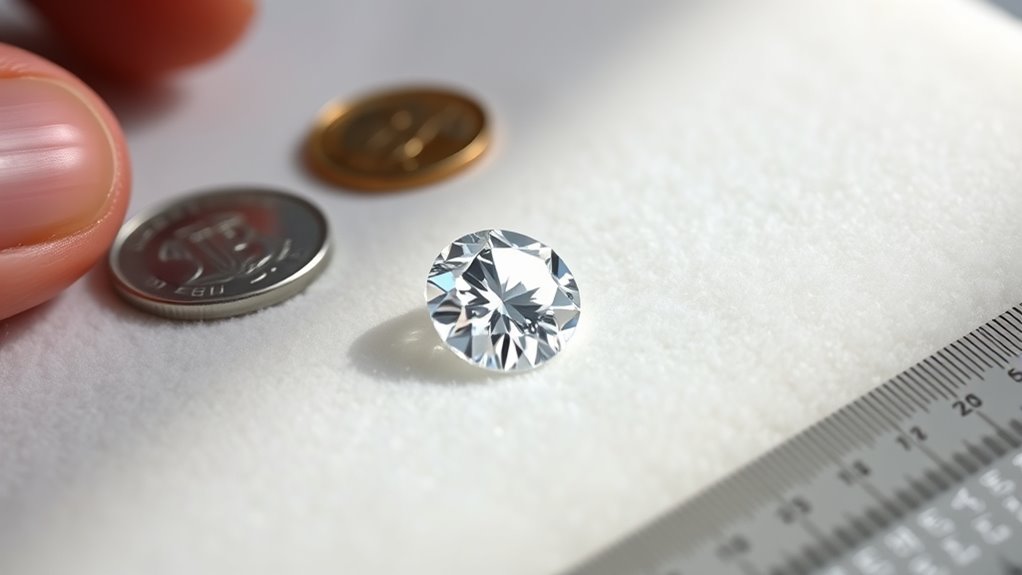
A carat is the standard unit used to measure a diamond’s weight, but it doesn’t directly tell you how big the diamond will look. When you pick a 1 carat diamond, you’re choosing a stone that weighs exactly 200 milligrams. However, its visible size can vary depending on factors like cut and proportions.
While diamond clarity affects the stone’s sparkle and brilliance, it doesn’t influence the carat weight. You’ll want to take into account diamond settings too, because some settings can make your diamond appear larger or smaller.
For example, a halo setting surrounds the diamond with smaller stones, boosting its overall appearance. Understanding these elements helps you make an informed choice beyond just the carat number, ensuring your diamond looks just right for you.
How Carat Weight Differs From Visible Size in 1 Carat Diamonds
You might think that all 1 carat diamonds look the same size, but that’s not always the case. The visible diameter—the size you actually see—can change quite a bit.
It all comes down to how deep the diamond is cut. Even if two diamonds weigh the same, the one that’s cut shallower will appear larger from above.
Knowing this little trick can really help you pick a diamond that looks bigger without having to pay for extra carat weight.
Carat Weight vs Diameter
Understanding how carat weight differs from diameter can help you better grasp what makes a 1 carat diamond appear larger or smaller. Carat weight measures a diamond’s mass, but it doesn’t directly indicate the stone’s visible size.
Diameter, the measurement across the widest part of the diamond, plays a key role in your size perception. Two diamonds can both weigh 1 carat but vary in diameter depending on their cut proportions.
For example, a diamond with excellent carat clarity and a well-cut shape often looks bigger because it maximizes diameter and brilliance. When shopping, don’t focus solely on carat weight; consider diameter and cut quality too, since these affect how large the diamond appears on your finger.
Depth Impact on Size
Although carat weight measures a diamond’s mass, it doesn’t tell the whole story about how large the stone looks on your finger. Depth plays an essential role in depth perception and visible size.
A 1 carat diamond cut too deep will appear smaller from the top view because more of its weight is hidden beneath the surface. Conversely, a shallower cut spreads the diamond’s mass over a wider area, making it look larger.
However, there’s a trade-off: an overly shallow cut can reduce diamond brilliance, causing it to lose sparkle. When choosing your 1 carat diamond, you want a balanced depth that maximizes both visible size and brilliance.
This way, your diamond looks big and shines brilliantly, truly reflecting its value.
How Cut and Proportions Affect the Perceived Size of 1 Carat Diamonds
Cut and proportions play a major role in how large a 1 carat diamond appears to the eye. The cut influence directly affects the sparkle effect and how light performance improves the diamond’s brilliance, making it seem larger or smaller.
Shape perception also changes based on proportions, creating an optical illusion that impacts visual weight. Your finger size, viewer distance, and setting style further modify how you perceive the diamond’s size. For example, a low setting height can make the stone appear bigger.
Consider these factors to understand size perception better:
- Cut quality’s impact on light reflection
- Shape’s role in optical illusions
- Setting style and height altering appearance
- Viewer distance and finger size affecting perceived scale
Typical Size of a 1 Carat Round Diamond: Diameter and Measurements
When you look at a 1 carat round diamond, its standard diameter usually falls around 6.4 to 6.5 millimeters. But here’s the thing—the weight of the diamond doesn’t always match up with how big it actually looks to the eye. So, understanding these measurements can really help you know what to expect, both in terms of size and sparkle.
Standard Diameter Dimensions
A typical 1 carat round diamond measures about 6.4 to 6.5 millimeters in diameter, making it easier for you to visualize its size. These standard measurements help maintain consistency across diamonds, so you know what to expect when comparing stones.
Understanding diameter is essential for accurate size perception, as slight variations can affect how large the diamond appears to your eye.
Keep in mind these key diameter dimensions:
- Diameter range: 6.4 to 6.5 mm for a 1 carat round diamond
- Depth percentage: usually 59% to 62% of diameter
- Table size: commonly 53% to 58% of diameter
- Girdle thickness: varies but impacts overall dimensions
These details influence the diamond’s face-up size and how it looks once set.
Weight Versus Visual Size
Weight alone doesn’t tell the full story of how large a 1 carat round diamond will appear. Your weight perception often differs from the actual diameter, affecting your visual impression.
Size expectations can shift based on the diamond’s shape influence; round cuts tend to maximize spread. Clarity effects also play a role. Higher clarity can make a diamond look brighter and larger.
The setting impact is vital. A thin band or bezel mounting style can improve the apparent size, while thicker settings might reduce it. Light performance dramatically affects brilliance, influencing how big the diamond seems from various viewer distances.
Don’t forget the profile view. A shallow cut might look larger face-up but thinner from the side. Understanding these factors helps you see beyond simple carat weight to the true visual size.
Comparing 1 Carat Diamonds by Shape and Dimensions
Different diamond shapes measure and appear larger or smaller even when they weigh exactly one carat. When you investigate a diamond shape comparison, you’ll notice how visual size perception varies notably based on the cut. For example, round diamonds tend to have a deeper cut, which can make them look smaller face-up compared to other shapes.
Diamond shapes can look larger or smaller face-up despite identical carat weight due to differences in cut depth.
Consider these key points:
- Round Cut: Classic, but often deeper, reducing face-up size.
- Princess Cut: Square shape with sharp corners, appears larger face-up.
- Oval Cut: Elongated, creates an illusion of greater length.
- Marquise Cut: Unique shape that maximizes surface area, enhancing visual size.
Visual Size Differences: 1 Carat Vs 0.75 and 1.25 Carat Diamonds
You’ll notice that a 1 carat diamond sits right between the more subtle 0.75 carat and the more striking 1.25 carat sizes. Each step up or down changes the visual impact more than you might expect. So, let’s take a closer look at how these differences actually affect what you see.
Size Comparison Overview
When comparing diamonds around one carat, subtle size differences can make a big visual impact. You might think 0.75, 1, and 1.25 carats look very similar, but your size perception changes depending on how each stone interacts with its diamond settings and lighting. Understanding these nuances helps you choose the perfect diamond that fits your style and budget.
Here’s a quick size comparison overview:
- A 0.75 carat diamond appears noticeably smaller but can look larger in certain settings.
- A 1 carat diamond balances size and brilliance, making it a popular choice.
- A 1.25 carat diamond offers a more substantial presence without overwhelming the finger.
- Diamond settings can amplify or diminish perceived size, affecting your overall impression.
This knowledge lets you make a confident, informed decision.
Visual Impact Differences
Three diamonds weighing 0.75, 1, and 1.25 carats might seem similar at a glance, but their visual impact varies more than you’d expect. Your visual perception plays a big role here.
A 1-carat diamond often creates a diamond illusion, appearing larger due to the clarity effect and the setting influence. Comparing sizes side-by-side highlights these subtle differences.
| Carat Weight | Visual Impact Factors |
|---|---|
| 0.75 | Subtle size, clarity effect |
| 1.00 | Balanced size, diamond illusion |
| 1.25 | Noticeably larger, setting influence |
When you consider size comparison, clarity effect can make a smaller diamond look nearly as brilliant as a larger one. The setting influence improves this, showing how much the environment around the stone can affect perceived size.
How to Compare 1 Carat Diamonds by Size and Appearance
Comparing 1 carat diamonds involves more than just checking their weight. You need to evaluate how size and appearance affect their overall look. When you compare diamonds, consider factors that influence how big and brilliant they appear to the eye:
Choosing the perfect 1 carat diamond means looking beyond weight to size and brilliance.
- Diamond clarity affects sparkle and how clean the stone looks up close.
- Shape influence impacts surface area; for example, round cuts often look larger than princess cuts.
- Light performance determines brilliance and fire, which improve visual perception.
- Setting style can either highlight or diminish the diamond’s perceived size.
Tips for Choosing a 1 Carat Diamond That Appears Larger
Although a 1 carat diamond has a fixed weight, you can make it look noticeably larger by choosing the right cut, shape, and setting. Opt for cuts like the oval, marquise, or pear, which create optical illusions that elongate the stone’s appearance.
A well-proportioned round brilliant cut also maximizes sparkle, making the diamond seem bigger. Surround your diamond with sparkling settings, such as a halo of smaller diamonds, to boost its presence and draw more light.
Avoid bulky metal settings that can overshadow the stone. Choosing a thinner band contrasts with the diamond, making it stand out more. By focusing on these factors, you’ll guarantee your 1 carat diamond looks as impressive as possible without increasing its actual size.
Using Size Guides and Tools to Buy a 1 Carat Diamond
When you’re ready to buy a 1 carat diamond, using size guides and tools can help you visualize exactly what you’re getting. These resources give you a clearer picture of the diamond’s actual dimensions, so you won’t be surprised when it arrives.
To make the most of size tools, follow these buying tips:
Use online size comparison charts to see how a 1 carat diamond measures against other carat weights. Try printable diamond size guides to compare stones side-by-side in person.
Investigate virtual try-on tools offered by retailers to imagine how the diamond looks on your hand. Check detailed measurements (diameter and height) listed in product descriptions for accuracy.
Why Depth and Proportions Make a Difference for 1 Carat Diamonds
Since a 1 carat diamond’s weight doesn’t tell the whole story, you need to pay close attention to its depth and proportions. Diamond proportions directly influence how light travels within the stone, affecting brilliance and how large the diamond appears.
Depth importance comes into play because if the diamond is too deep or too shallow, it can create a size illusion that makes the stone look smaller than its actual carat weight. When you prioritize cut quality, you guarantee the diamond’s facets are balanced, maximizing sparkle and enhancing visual perception.
Frequently Asked Questions
How Does Diamond Clarity Affect the Sparkle of a 1 Carat Diamond?
Diamond clarity directly impacts your 1 carat diamond’s sparkle because diamond inclusions can block or scatter light. When you choose higher clarity grades, fewer inclusions mean light passes through more freely, creating more brilliance and fire.
If your diamond has visible inclusions, it won’t sparkle as much. So, focusing on better clarity grades guarantees your diamond shines brightly, maximizing that dazzling effect you want.
What Is the Average Price Range for a 1 Carat Diamond?
You can expect the average price range for a 1 carat diamond to vary between $4,000 and $12,000. Diamond pricing trends show that factors like cut, color, and clarity heavily influence cost.
Because market demand for 1 carat diamonds is consistently high, prices remain competitive but can fluctuate. If you keep an eye on these trends, you’ll find a beautiful diamond that fits your budget and style perfectly.
How Do Diamond Certifications Impact 1 Carat Diamond Value?
Diamond certifications directly impact your 1 carat diamond’s value by verifying its quality through diamond grading. When you choose diamonds with reputable certification types like GIA or AGS, you’re assured the diamond’s cut, color, clarity, and carat weight are accurately assessed.
This transparency boosts your confidence and often increases resale value. Without proper certification, your diamond’s worth might be undervalued or questioned, so don’t skip this essential step.
Can a 1 Carat Diamond Be Resized or Reshaped?
Yes, you can resize or reshape a 1 carat diamond, but options are limited. Resizing usually involves adjusting the setting rather than the diamond itself, which helps preserve its durability.
Reshaping techniques like cutting or polishing are possible but can reduce the carat weight and value. It’s best to focus on setting adjustments to improve appearance without compromising the diamond’s integrity.
Always consult a professional jeweler to explore safe resizing options.
What Jewelry Settings Best Showcase a 1 Carat Diamond?
You’ll want to choose prong settings or solitaire options to really let your 1 carat diamond shine on its own. If you prefer extra sparkle, halo designs add a brilliant frame, making your diamond look larger.
Bezel settings offer sleek protection while vintage styles provide unique charm. Don’t overlook side stones; they elevate brilliance and depth.
Each setting highlights your diamond differently, so pick what matches your style and lifestyle best.
Conclusion
Choosing a 1 carat diamond is like picking the perfect key to a hidden treasure chest. It’s not just about the weight but how it fits and shines. You’ll want to look beyond numbers and focus on cut, depth, and shape, unveiling brilliance that catches every eye.
With the right knowledge and tools, you hold the power to reveal a gem that’s distinctly dazzling. This turns a simple stone into your own radiant story. Understanding the true size and beauty of a 1 carat diamond helps you make the best choice for your sparkle.