What Is a Diamond Made Of?
If you’ve ever wondered what makes diamonds so special, you’re not alone. Many people struggle to understand why these sparkling gems are so valuable and unique.
Whether you’re shopping for the perfect ring or just curious about their composition, knowing what a diamond is made of can help you appreciate its beauty even more.
A diamond is made entirely of carbon atoms tightly bonded in a strong, three-dimensional crystal lattice. This unique tetrahedral arrangement gives diamonds unmatched hardness and brilliance, setting them apart from other carbon forms like graphite.
Natural diamonds form deep within the Earth under intense heat and pressure over millions of years, while synthetic ones are created in labs.
The purity and trace elements in diamonds influence their color and value.
Keep exploring to understand why this composition matters so much.
Key Takeaways
- Diamonds are made entirely of carbon atoms arranged in a strong, three-dimensional tetrahedral lattice. Each carbon atom bonds tightly with four others, creating an extremely hard and durable crystal structure.
- The uniform crystal lattice gives diamonds their characteristic shape and exceptional hardness on the Mohs scale.
- Natural diamonds form under high pressure and temperature deep within the Earth over millions of years.
- Synthetic diamonds replicate this structure in labs, using pure carbon and controlled conditions to match natural diamond properties.
What Are Diamonds Made Of At The Atomic Level?
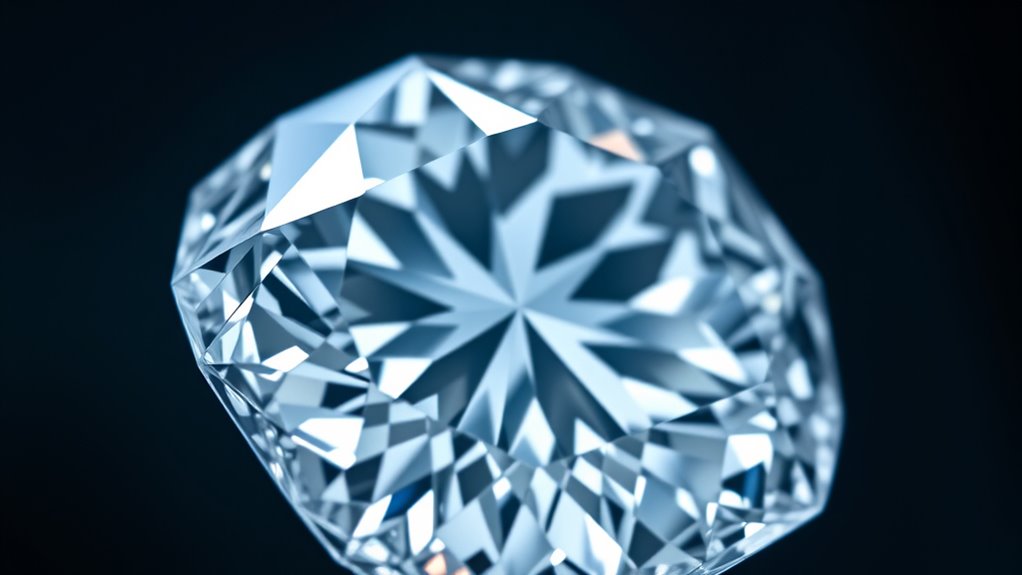
At the atomic level, diamonds are made entirely of carbon atoms arranged in a unique crystal structure. You’ll find that each carbon atom forms strong atomic bonding with four other carbon atoms, creating a rigid, three-dimensional molecular structure.
This bonding makes diamonds incredibly hard and gives them their remarkable properties. Unlike other forms of carbon, like graphite, where atoms bond in layers, diamond’s atomic bonding is uniform and extensive throughout the molecular structure.
When you examine a diamond, you’re fundamentally looking at a vast network of carbon atoms connected by these strong bonds. This precise arrangement at the atomic level is what sets diamonds apart, making them both beautiful and durable in their natural form.
How Carbon Atoms Create A Diamond’s Crystal Structure
The way carbon atoms connect in a diamond goes beyond just strong bonds. They arrange themselves into a very specific pattern called a crystal structure. This crystal lattice is what gives diamonds their unique properties.
When you look closely, carbon bonding in diamonds forms a rigid three-dimensional network. Here’s how it works:
- Each carbon atom bonds to four others in a tetrahedral shape.
- These bonds create a repeating pattern extending in all directions.
- The uniform crystal lattice guarantees consistent strength throughout the diamond.
- This precise arrangement locks atoms in place, making the structure stable.
Understanding this organized crystal lattice helps you see why diamonds have such a remarkable structure. Carbon bonding isn’t random; it’s a carefully ordered system creating the diamond’s iconic shape.
Why Diamond’s Crystal Structure Makes It So Hard
Because each carbon atom in a diamond is tightly bonded to four others in a strong tetrahedral network, you get an incredibly tough material. This arrangement forms a rigid crystal lattice that distributes force evenly when pressure is applied.
You’ll notice that diamond hardness comes from this interconnected structure, which resists deformation and prevents atoms from sliding past one another. Unlike softer materials, where bonds can break or shift easily, the diamond’s crystal lattice locks everything in place.
When you try to scratch or dent a diamond, you’re actually challenging thousands of strong covalent bonds all at once. This is why diamonds rank highest on the Mohs scale of hardness and are so valued not just for their beauty but also for their unmatched durability.
How Diamonds Differ From Other Forms Of Carbon
Although diamonds, graphite, and charcoal are all made entirely of carbon atoms, their properties differ drastically because of the way those atoms bond and arrange themselves. These variations create distinct carbon allotropes, including diamond allotropes known for their unique hardness and brilliance.
You can see the differences clearly when you compare:
- Atomic bonding: diamonds have strong tetrahedral bonds, while graphite has layered planar bonds.
- Crystal structure: diamonds form a rigid 3D lattice; graphite forms stacked sheets.
- Physical properties: diamonds are hard and transparent; graphite is soft and opaque.
- Electrical conductivity: diamonds don’t conduct electricity; graphite does.
Understanding these factors helps you appreciate how diamond allotropes stand out among other carbon allotropes in both structure and function.
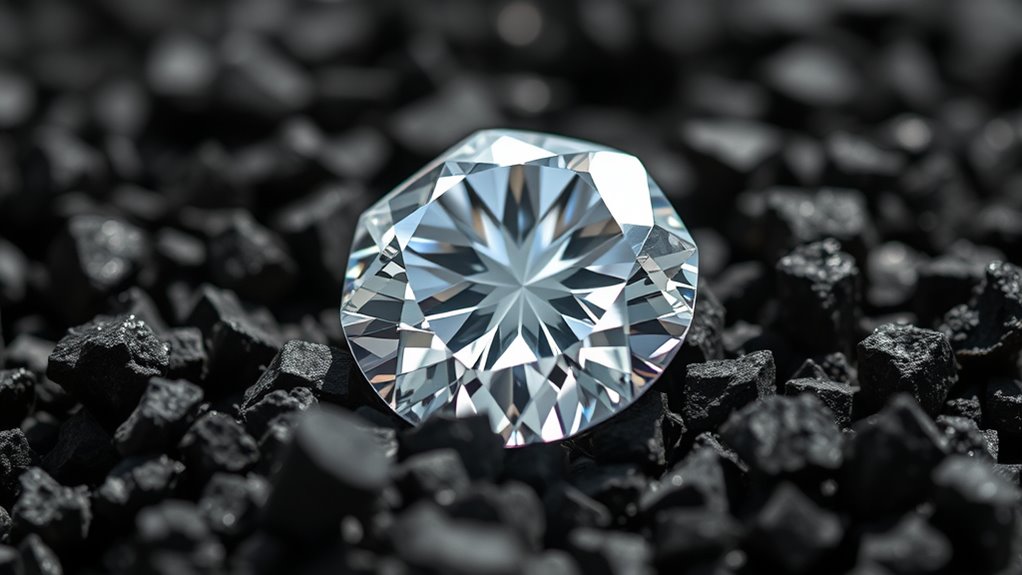
Where Natural Diamonds Form Deep Inside The Earth
When you think about where natural diamonds come from, you might not realize they form more than 90 miles beneath the Earth’s surface. Diamond formation requires extreme geological conditions, like high pressure and temperatures around 1,300 to 1,600 degrees Fahrenheit. These conditions exist only deep within the Earth’s mantle.
Here, carbon atoms bond tightly in a crystal structure, creating diamonds over millions of years. These diamonds eventually travel to the surface through volcanic eruptions, carried by magma that cools into kimberlite pipes.
Understanding these unique geological conditions helps you appreciate how rare and valuable natural diamonds really are. Without this deep-earth environment, the beautiful gemstones you see wouldn’t exist. So, the next time you admire a diamond, remember it started its journey far beneath your feet.
How Synthetic Diamonds Are Made And What’s Inside Them
If you’ve ever wondered how synthetic diamonds come to life, you’ll find their creation quite fascinating. Unlike natural diamonds formed deep in the Earth, synthetic diamonds are made using controlled synthetic processes in a lab. These processes use specific carbon sources to replicate the conditions needed for diamond growth.
Here’s how it works:
- Select pure carbon sources, often gases like methane.
- Apply high pressure and high temperature (HPHT) or use chemical vapor deposition (CVD) techniques.
- Carbon atoms bond tightly in a crystal lattice, forming the diamond structure.
- Carefully control the environment to guarantee clarity and purity.
Inside synthetic diamonds, the carbon atoms arrange similarly to natural diamonds, making them virtually the same in composition and quality.
What Causes The Sparkle And Brilliance Of Diamonds?
Because diamonds have a unique crystal structure and a high refractive index, they bend and reflect light in remarkable ways. When light enters a diamond, it slows down and changes direction due to light refraction, bouncing internally before exiting. This process creates the dazzling sparkle you see.
Sparkle factors include the diamond’s cut, clarity, and the way its facets interact with light. A well-cut diamond maximizes light refraction, producing intense brilliance and fire. If the cut is off, light escapes, dulling the sparkle.
You’ll notice that a diamond’s sparkle depends not just on its material but on how expertly it’s shaped to manipulate light. So, understanding these sparkle factors helps you appreciate why diamonds shine so brilliantly.
How Impurities Affect A Diamond’s Color And Quality
Although diamonds are often praised for their clarity, tiny impurities can greatly impact their color and overall quality. When you’re evaluating a diamond, these impurities influence both color grading and clarity factors, which are critical in determining its value.
You should consider the type of impurity, such as nitrogen or boron, which can tint the diamond yellow or blue. The concentration of impurities affects how intense the color appears.
Also, think about the location of impurities, as inclusions near the surface can reduce clarity. Finally, impurities interfere with light, altering the diamond’s brilliance.
Why Diamond Composition Is Key For Jewelry And Industry
Understanding how impurities affect a diamond’s color and clarity helps you appreciate why its composition matters so much in both jewelry and industrial applications. For jewelry, pure carbon diamonds with minimal impurities offer unmatched brilliance and value.
In industrial applications, specific compositions improve hardness and thermal conductivity. This makes diamonds ideal for cutting, grinding, and heat dissipation.
| Composition Aspect | Jewelry Significance | Industrial Applications |
|---|---|---|
| Carbon Purity | High brilliance and value | Maximum hardness |
| Nitrogen Levels | Affects color (yellow tint) | Can alter durability |
| Boron Presence | Rare blue diamonds | Improves electrical conductivity |
| Inclusions | Lower clarity reduces appeal | May not impact performance |
| Structural Integrity | Guarantees durability | Critical for tool longevity |
How Knowing Diamond Composition Helps You Choose Gems
How can you be sure you’re picking the perfect diamond? Understanding diamond composition plays an essential role in your gem selection by revealing the qualities that affect diamond value. Knowing what makes a diamond unique helps you make informed choices and avoid costly mistakes.
Here’s how diamond composition helps:
- Identifies purity levels, influencing brilliance and clarity.
- Highlights the presence of trace elements affecting color.
- Guides you on durability based on structural makeup.
- Assists in distinguishing natural diamonds from synthetic ones.
Frequently Asked Questions
How Are Diamonds Ethically Sourced?
You guarantee diamonds are ethically sourced by choosing sellers who follow strict ethical sourcing practices and provide diamond certification from reputable organizations. These certifications verify the diamond’s origin, confirming it wasn’t mined under exploitative conditions or funding conflict.
What Is the Environmental Impact of Diamond Mining?
You’ll find that diamond mining often leads to habitat destruction, disrupting ecosystems and wildlife. However, if you choose diamonds from companies committed to sustainable mining, you can help reduce these environmental impacts.
Sustainable mining practices aim to minimize land degradation, conserve water, and rehabilitate mining sites. By supporting ethical brands, you encourage better environmental stewardship and help protect the planet while still enjoying beautiful diamonds.
Can Diamonds Be Recycled or Reused?
Imagine holding a sparkling gem that’s already lived a life of beauty. You can absolutely recycle or reuse diamonds.
Through diamond repurposing, you breathe new life into secondhand jewels, transforming them into fresh, stunning pieces. You don’t just save a gem; you honor its journey and reduce environmental impact.
How Do Diamonds Compare to Other Gemstones in Value?
You’ll find diamond pricing generally higher than many other gemstones because diamonds combine exceptional hardness with brilliant sparkle. Their gemstone rarity also plays a big role; high-quality diamonds are rarer and more sought after, which drives up their value.
While some colored gemstones can rival diamonds in price, diamonds usually maintain strong market demand and liquidity. This makes them a consistently valuable choice compared to other gemstones.
What Are Common Treatments to Enhance Diamond Appearance?
Think of a diamond as a blank canvas waiting for an artist’s touch. When you seek color amplification, you’re adding vibrant hues to brighten its story. Clarity improvement acts like an eraser, removing flaws that cloud its brilliance.
Common treatments you’ll find include laser drilling to clear inclusions and high-temperature annealing to elevate color. These techniques help your diamond shine with unmatched beauty, revealing its true potential.
Conclusion
You might think diamonds are just pretty stones, but at their core, they’re incredibly complex carbon structures forged deep within the Earth. Their atomic arrangement makes them both stunningly brilliant and extraordinarily tough, qualities that contrast with the softness of other carbon forms like graphite.
Understanding what diamonds are made of not only helps you appreciate their beauty but also empowers you to choose gems with confidence. Whether for jewelry or industrial use, knowing what a diamond is made of makes all the difference.