How to Identify Gemstones Step by Step
If you’ve ever tried to identify gemstones and felt overwhelmed by all the details, you’re not alone. Many people struggle with distinguishing real gems from imitations or understanding what makes each stone unique. It can be confusing, but with the right guidance, you can gain confidence and enjoy the process.
To identify gemstones step by step, start by examining their color, noting hue, tone, and saturation carefully. Use a 10x loupe to inspect clarity and look for inclusions or optical effects like asterism.
Test hardness with the Mohs scale and consider specific gravity for density clues. Check for synthetic signs such as curved growth lines or unusual color zoning.
Get familiar with common gem families and practice observing stones in various light. Keep going, and you’ll uncover deeper tips for mastery.
Key Takeaways
- Examine the gemstone’s color, hue, tone, and saturation under different lighting. This helps you assess its visual properties accurately.
- Use a 10x loupe to inspect surface features, inclusions, and optical effects like asterism or chatoyancy.
- Test hardness with scratch tests using reference materials on the Mohs scale. This narrows down the gemstone type.
- Measure specific gravity by comparing the stone’s weight in air and water. This helps distinguish similar-looking gems.
- Look for synthetic indicators such as curved growth patterns, gas bubbles, or unusual color zoning. Use magnification and UV light to spot these.
Essential Gemstone Properties to Check
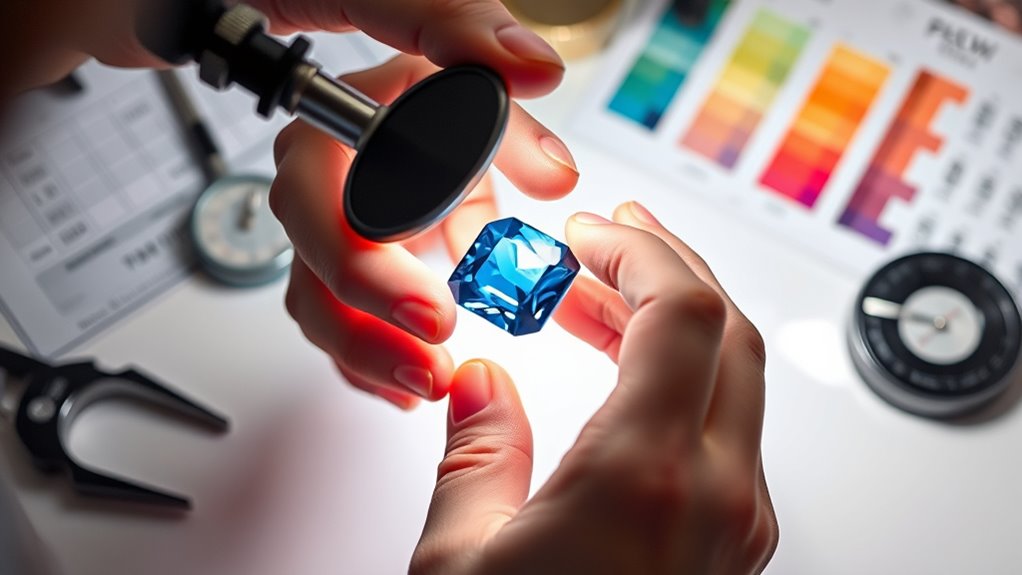
To accurately identify a gemstone, you need to focus on a few essential properties. First, observe its color saturation, which is the intensity and purity of the hue. High color saturation often indicates a valuable gemstone, but don’t rely on this alone.
Next, consider the gemstone rarity. Some gems are naturally rare, and that affects their value and identification. You’ll also want to check hardness by gently testing how resistant the stone is to scratches. This helps distinguish between similar-looking stones.
Transparency and brilliance are other key aspects. A genuine gemstone often has a distinct sparkle and clarity. By carefully examining these properties, you’ll build a solid foundation for identifying gemstones accurately without jumping to judgments.
How to Examine Gemstone Color and Hue
Color and hue play a major role in identifying gemstones, building directly on the properties you’ve already considered. When you examine a gemstone, focus on color terminology to describe its shade accurately.
Hue variations can indicate different mineral compositions or treatments, so pay close attention to subtle shifts in tone and saturation.
Use this table to guide your observations:
| Color Term | Description |
|---|---|
| Hue | Basic color (e.g., red, blue) |
| Tone | Lightness or darkness of color |
| Saturation | Intensity or purity of color |
| Hue Variations | Slight changes within a hue |
Spotting Clarity and Inclusions to Identify Gemstones
A gemstone’s clarity reveals much about its origin and value, making it essential for identification. When you spot clarity and inclusions, you’re looking for natural flaws or internal features within the stone.
Different inclusion types, such as crystals, feathers, or needles, help you determine whether a gemstone is natural or synthetic. Clarity grading assesses how visible these inclusions are under normal viewing conditions, affecting the gemstone’s overall quality.
While higher clarity typically means higher value, some gemstones naturally contain certain inclusions that act as fingerprints for identification. By understanding both inclusion types and clarity grading, you gain insight into the gemstone’s authenticity and origin, allowing you to confidently distinguish one stone from another.
How to Use a Loupe and Tools for Close Inspection
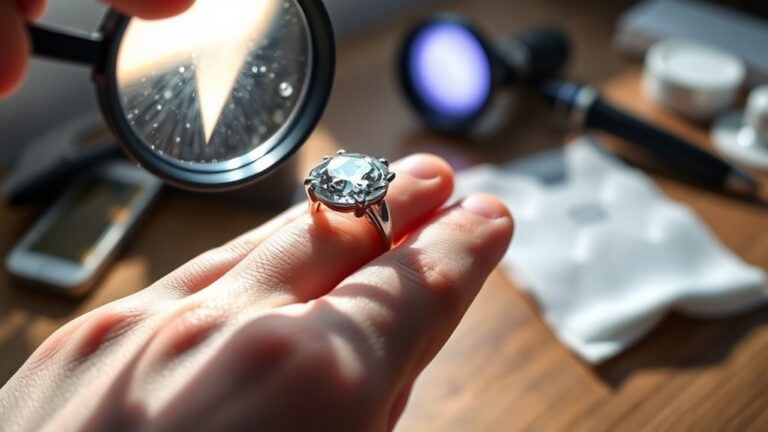
To get a closer look at your gemstones, you’ll want the right loupe—usually one with 10x magnification works best. Just hold the loupe close to your eye and bring the gem near the lens. This way, you can clearly inspect its features. It really helps you spot tiny details like inclusions and surface marks, which are key for identification.
Choosing The Right Loupe
How do you guarantee every detail of a gemstone stands out clearly? Choosing the right loupe is essential. You’ll want to evaluate loupe types and magnification levels carefully.
A 10x magnification loupe is standard, offering a clear view without distortion. Higher magnifications can reveal finer details but may require steadier hands.
Here’s a quick guide to help you pick:
| Loupe Type | Feelings Evoked |
|---|---|
| 10x Magnification | Confidence & Clarity |
| 15x Magnification | Excitement & Precision |
| Triplet Loupe | Trust & Accuracy |
| Single Lens Loupe | Simplicity & Ease |
Pick a loupe that feels comfortable and suits your inspection style. This guarantees you get sharp, accurate views every time.
Inspecting Gemstone Features
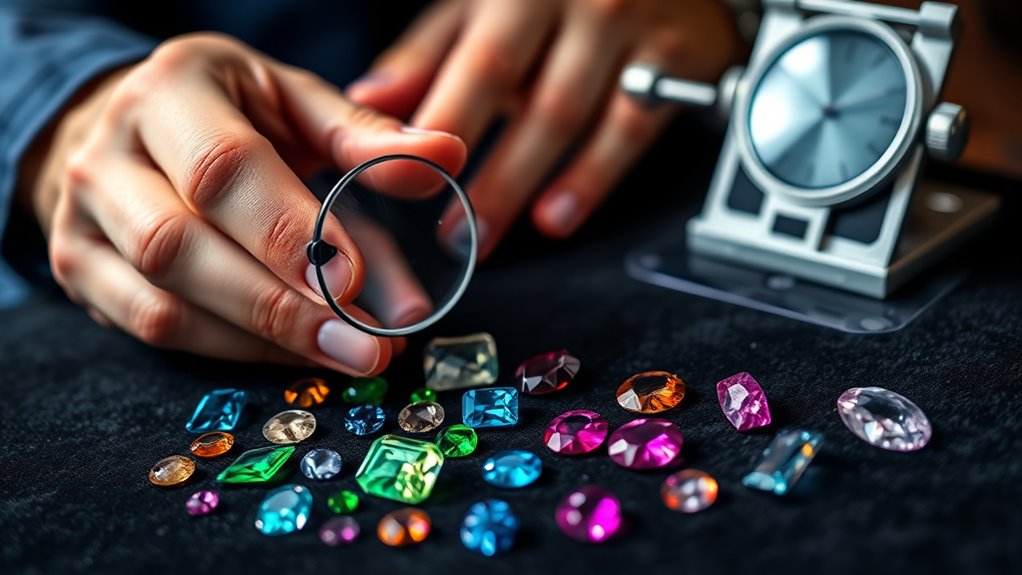
Start by holding your loupe close to your eye and bringing the gemstone slowly into focus. Pay close attention to the color saturation, as vivid, evenly distributed hues often indicate quality.
Use the loupe to examine the stone’s surface and internal features, looking for inclusions or imperfections. Notice any optical effects, like asterism or chatoyancy, which can help identify specific gems.
Rotate the stone under different light angles to observe how these effects change. Don’t forget to use additional tools like a light source or microscope if needed, as they improve your ability to see subtle details.
Testing Gemstone Hardness With the Mohs Scale
Although gemstone identification involves many factors, testing hardness provides a quick and reliable way to narrow down your options. Hardness testing uses the Mohs scale, which ranks minerals from 1 (softest) to 10 (hardest).
By scratching your gemstone with materials of known hardness, you can estimate its position on the scale. This helps eliminate possibilities and guides you toward the correct identification.
| Mohs Hardness | Common Minerals | Scratch Test Tool |
|---|---|---|
| 2 | Gypsum | Fingernail |
| 5 | Apatite | Copper coin |
| 7 | Quartz | Steel knife |
| 9 | Corundum (Ruby) | Hardened steel file |
| 10 | Diamond | Diamond-tipped tool |
Use this method carefully to avoid damaging your gemstone.
How to Check a Gemstone’s Specific Gravity
Testing hardness with the Mohs scale gives you a solid starting point, but to narrow down your gemstone further, you’ll want to measure its specific gravity. This involves comparing the gemstone’s weight in air to its weight in water.
Using specific gravity techniques, you can determine the density of your stone, which helps distinguish between similar-looking gems. You’ll need density measurement tools like a precise scale and a container of water to perform this test accurately.
First, weigh the gemstone dry, then suspend it in water and record the submerged weight. Dividing the dry weight by the loss of weight in water gives you the specific gravity. This method is simple yet effective for identifying many gemstones by their unique density values.
How to Measure Refractive Index and Sparkle
To measure a gemstone’s refractive index, you’ll need some specific tools, like a refractometer, which gives you precise readings. It’s pretty straightforward once you get the hang of using the device.
Next, you’ll want to check out the sparkle. This means observing how light plays with the stone when you look at it from different angles. It’s kind of like watching a little light show happening inside the gem.
Tools For Refractive Index
Several essential tools help you measure a gemstone’s refractive index, which directly influences its sparkle and brilliance. The most common device is the refractometer, designed specifically for gemstone testing. It uses precise measurement techniques to determine how light bends as it passes through the stone.
You simply place a drop of contact liquid on the refractometer’s glass surface, then set the gemstone on top. By looking through the eyepiece, you can read the refractive index on the scale, which helps identify the stone.
Other tools include immersion cells and spectrometers, which also assist in refractive index measurement techniques but are less common for field use. Mastering these tools sharpens your ability to distinguish gemstones accurately.
Measuring Sparkle Effectively
How can you accurately measure a gemstone’s sparkle alongside its refractive index? Start by using a refractometer to determine the refractive index, which reveals how light bends within the gem.
For sparkle measurement, observe the gem under a strong light source, noting how light reflection creates flashes and brilliance. You can improve this by gently rotating the stone, watching how the sparkle changes with different angles.
Using a loupe or microscope helps you see these reflections clearly. Remember, sparkle depends on both the gem’s cut and its refractive index, so combining these observations gives you a fuller picture.
Interpreting Results Accurately
Accurately interpreting the refractive index and sparkle measurements requires careful attention to detail and context. When you measure these properties, keep in mind that gemstone grading depends on comparing your results against known standards.
Small variations can indicate different minerals or treatments. Use precise identification techniques to avoid misreading values. Calibrate your refractometer regularly and assess sparkle in consistent lighting.
Also, consider the stone’s cut and clarity, as they influence how light interacts with the gemstone. If your refractive index falls within a specific range and the sparkle matches known patterns, you can confidently classify the gemstone.
Combining these measured results with visual inspection improves your accuracy and helps you distinguish between similar stones effectively.
How to Spot Synthetic and Treated Gemstones
Although synthetic and treated gemstones can look very similar to natural ones, you’ll quickly learn to spot key differences that reveal their true nature. When identifying synthetics, pay close attention to inclusions and growth patterns under magnification. Synthetic gems often display curved striae or gas bubbles, unlike natural stones.
Recognizing treatments requires a keen eye for color zoning or unusual surface features caused by improvements like heating or irradiation. Using tools like a loupe or microscope helps you detect these subtle clues. Also, a gem’s response to UV light or specific filters can indicate treatment.
Common Gemstone Types and Families Explained
Understanding the main gemstone types and families gives you a solid foundation for identifying and appreciating gems. Gemstone families group minerals with similar chemical compositions and crystal structures, helping you recognize common traits.
For example, the corundum family includes sapphires and rubies, while the beryl family covers emeralds and aquamarines. Classification systems categorize gemstones by factors like hardness, refractive index, and specific gravity, guiding you in distinguishing one gem from another.
By familiarizing yourself with these families and classification methods, you can quickly narrow down possibilities during identification. This knowledge also helps you appreciate the diversity within gemstone types and understand why certain gems share similar qualities or appearances.
Mastering these basics makes your gemstone identification more precise and enjoyable.
Tips to Practice and Improve Gemstone Identification Skills
You can really sharpen your gemstone identification skills by regularly observing different stones and paying close attention to their unique characteristics. It helps to have some reference materials handy, like guides and charts, so you can compare what you see and confirm your findings. Also, joining gemstone communities is a great idea. Not only will you connect with experts, but you’ll also get valuable feedback that can boost your learning even more.
Regular Observation Exercises
When you regularly observe gemstones, you’ll sharpen your ability to spot subtle differences in color, clarity, and cut. Consistent practice using effective observation techniques is key to improving your identification skills.
Keep detailed gemstone journals to record your findings, helping you track patterns and progress over time.
Try these exercises to improve your observation skills:
- Examine a variety of gemstones under different lighting conditions, noting changes in appearance.
- Sketch or photograph stones, focusing on unique features like inclusions or facet arrangements.
- Compare similar-looking gems side by side, writing detailed notes in your gemstone journals.
Utilize Reference Materials
A reliable set of reference materials can dramatically boost your gemstone identification skills. Start by gathering well-regarded gemstone guides that cover a variety of stones and their properties. These guides often provide detailed descriptions, photos, and tips to help you spot key features.
Alongside guides, use reference charts that compare characteristics like hardness, refractive index, and specific gravity. These charts make it easier to narrow down possibilities quickly.
When you come across an unfamiliar stone, consult these materials to verify your observations and avoid mistakes. Regularly updating your collection of gemstone guides and reference charts guarantees you stay informed about new findings and techniques.
Join Gemstone Communities
Although gemstone identification can be a solitary pursuit, joining gemstone communities offers invaluable opportunities to practice and hone your skills. Connecting with others exposes you to diverse expertise and practical experiences that online resources alone can’t provide.
Here’s how you can get involved:
- Participate in gemstone forums and discussion groups on social media to ask questions, share findings, and learn from experts worldwide.
- Attend local meetups, community events, and gemstone workshops where you can handle stones firsthand and gain practical insights.
- Join expert webinars and virtual sessions to deepen your knowledge with up-to-date techniques and trends in gemstone identification.
Engaging with these communities will enhance your learning curve and keep you motivated on your gemstone journey.
Frequently Asked Questions
Where Can I Buy Affordable Gemstone Testing Tools?
You can buy affordable gemstone kits and testing tools online at sites like Amazon, Etsy, and eBay, where prices and options vary. Specialty stores for jewelers and hobbyists also offer gemstone kits with reliable testing methods.
Don’t forget to check reviews to verify quality. Local gem and mineral shows often have vendors selling affordable tools too. By comparing different sources, you’ll find testing kits that fit your budget and help you identify gemstones confidently.
How Do I Care for and Clean Different Gemstones?
You should tailor gemstone maintenance to each stone’s hardness and sensitivity. Use gentle cleaning techniques like warm soapy water and a soft brush for most gems. But avoid harsh chemicals and ultrasonic cleaners on softer or porous stones like opal or turquoise.
Always dry your gemstones thoroughly and store them separately to prevent scratches. Regularly check settings to keep your gems secure. This way, they stay beautiful and last longer with proper care.
What Are the Best Books or Resources for Gemstone Identification?
For fantastic foundations in gemstone properties and identification techniques, you’ll find “Gemstones of the World” by Walter Schumann superbly straightforward. You can also count on “The Book of Stones” by Robert Simmons for soulful insights.
Don’t overlook online options like GIA’s website; they offer detailed guides and interactive tools. These resources will sharpen your skills and help you confidently classify and care for your sparkling stones.
Can Gemstone Identification Help Determine a Stone’s Value?
Yes, gemstone identification plays an essential role in value assessment. When you accurately identify a stone’s type, clarity, cut, and carat weight, you can better understand its true worth.
You’ll also factor in market demand, which fluctuates based on trends and rarity. By combining these elements, you’ll make informed decisions about pricing or investment, ensuring you don’t undervalue or overpay for a gemstone.
Are There Any Legal Restrictions on Buying or Selling Gemstones?
You want transparency, you want fairness, and you want trust. Yes, you do face gemstone regulations when buying or selling stones.
Many countries enforce rules to guarantee ethical sourcing, preventing conflict diamonds or illegally mined gems from entering the market. So, you must verify origin, demand proper certifications, and stay aware of local laws.
Conclusion
Identifying gemstones is like revealing a treasure chest; you need the right keys: color, clarity, hardness, and sparkle. By mastering these steps and using proper tools, you’ll sharpen your eye and avoid costly mistakes.
Remember, every gem has its story, and with practice, you’ll learn to read it like a pro. Keep exploring and stay curious. Soon, gemstone identification will feel as natural as breathing.