
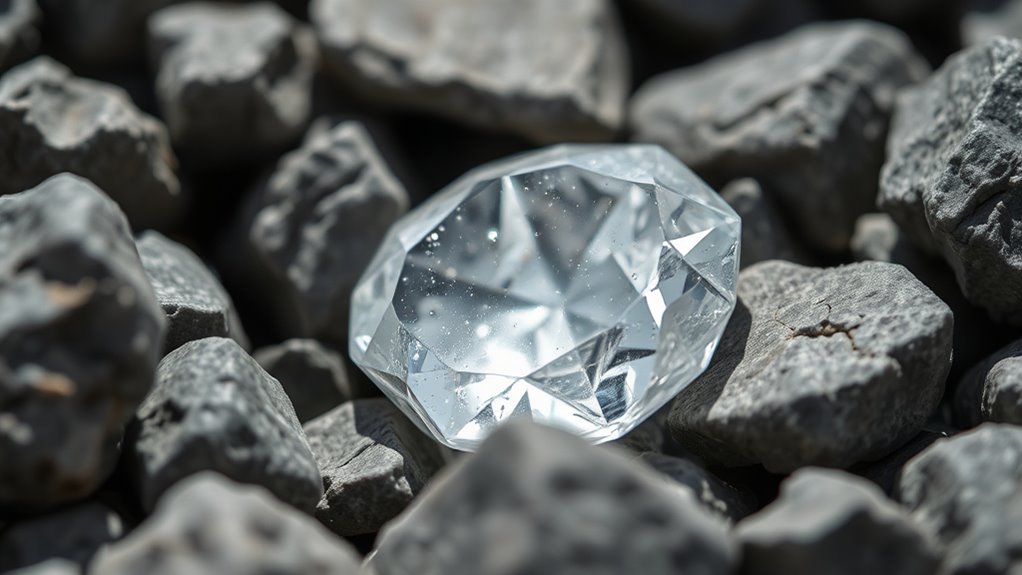
What Makes a Diamond a Rock?
Finding the perfect gemstone can feel overwhelming, especially when you want something truly unique and valuable. You’re not alone—many people struggle to understand what makes certain stones stand out.
That’s why knowing what makes a diamond a rock can help you appreciate its beauty and worth even more.
You can call a diamond a rock because it’s a natural, solid mineral formed deep within Earth’s mantle under extreme heat and pressure. It’s made entirely of carbon atoms arranged in a strong crystal lattice, giving it unmatched hardness and brilliance.
Diamonds grow slowly over millions of years and are brought to the surface by volcanic activity.
If you keep exploring, you’ll uncover the fascinating formation process and what sets them apart from other rocks.
Key Takeaways
- Diamonds are naturally occurring solid minerals formed deep within the Earth’s mantle.
- They consist entirely of carbon atoms arranged in a crystal lattice, classifying them as rocks.
- Their formation involves geological processes like intense heat, pressure, and volcanic activity.
- Diamonds have a rigid crystal structure with strong covalent bonds, characteristic of mineral rocks.
- As a pure carbon allotrope with defined physical properties, diamonds meet the criteria of natural rocks.
What Makes a Diamond a Rock?
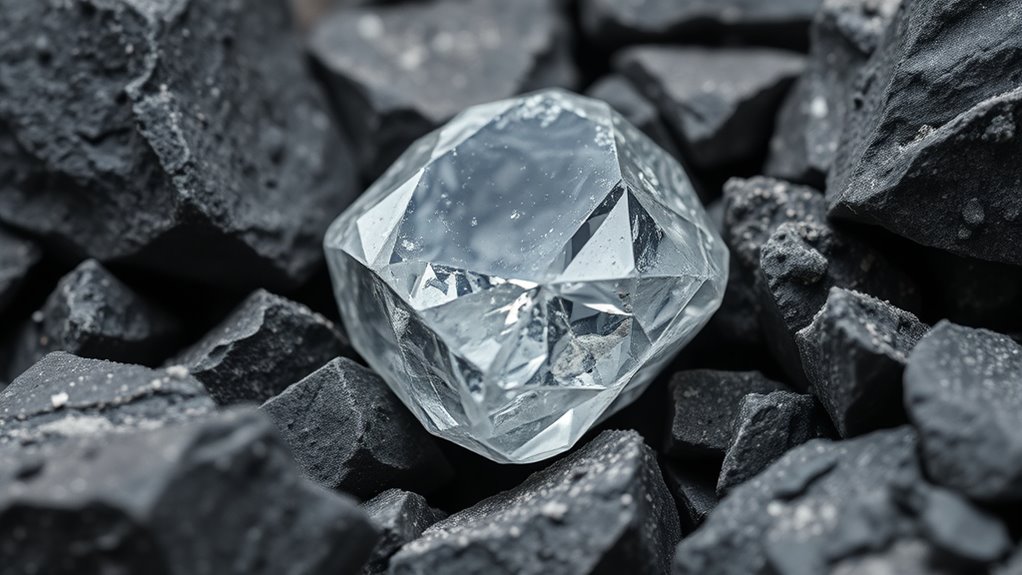
A diamond qualifies as a rock because it’s a naturally occurring solid composed of minerals. When you think about diamond symbolism, you likely associate it with strength, purity, and eternal love, qualities rooted in its rock status.
Unlike synthetic gems, diamonds form naturally under Earth’s surface, making them true rocks. You’ll find these minerals prized not only for their beauty but also for their unmatched hardness, which fuels various industrial applications.
In cutting, grinding, and drilling, you rely on diamonds for efficiency and durability. So, whether you’re admiring a diamond’s sparkle or using it in heavy-duty tools, you’re engaging with a rock that’s both symbolic and practical.
This dual nature makes diamonds exceptionally valuable in many aspects of life.
How Natural Diamonds Form Underground
Although diamonds may seem timeless, they actually form deep within the Earth’s mantle under intense heat and pressure. You might wonder how these precious stones make their way to the surface.
Natural diamonds are brought up through volcanic eruptions, carried by magma that cools into kimberlite pipes. These pipes are prime sites for diamond mining. When miners extract them, they uncover diamonds that have spent millions of years crystallizing far beneath the Earth’s crust.
Understanding this process adds depth to the diamond symbolism you often hear about, like strength, endurance, and rarity. So, the next time you see a sparkling diamond, remember it’s not just a beautiful gem but a rock forged by powerful underground forces, shaped over eons before reaching your hands.
Geological Processes Behind Diamond Formation
You’ll want to understand where the carbon that forms diamonds originally comes from and how it changes deep underground. So, think about the extreme pressure conditions that transform this carbon within mantle rocks. These processes are really key to turning simple elements into precious gems.
Carbon Source Origins
Since diamonds form deep within the Earth’s mantle, understanding their carbon source origins requires exploring the geological processes that transport carbon to these extreme depths. You’ll find that diamond sources rely heavily on carbon cycling through Earth’s layers. Carbon reaches the mantle via subduction, where oceanic plates carrying organic material descend.
Once there, carbon transforms and crystallizes into diamonds under specific conditions.
Key aspects of carbon source origins include:
- Subduction zones delivering surface carbon deep into the mantle
- Recycling of carbonates and organic material through Earth’s carbon cycles
- Mantle reservoirs storing carbon that eventually forms diamonds
Extreme Pressure Conditions
When carbon descends deep into the Earth’s mantle, it encounters extreme pressure conditions that trigger its transformation into diamonds. You’ll find that different pressure types—lithostatic and deviatoric—play vital roles at various geological depths.
Lithostatic pressure is the force exerted uniformly in all directions due to the weight of overlying rocks. It increases steadily as you go deeper. Deviatoric pressure, on the other hand, involves uneven forces that cause stress and deformation in the carbon’s crystal structure.
At depths of roughly 140 to 190 kilometers, these combined pressures reach the threshold needed to rearrange carbon atoms into a diamond’s rigid lattice. Without such intense pressure types acting at specific geological depths, carbon wouldn’t crystallize into the hardest known natural material, diamond.
Mantle Rock Transformations
Although the intense pressures deep within the Earth are essential, it’s the transformations of mantle rocks that set the stage for diamond formation. You need to understand how mantle dynamics drive rock metamorphism, changing mineral structures under extreme conditions. These changes create the perfect environment for carbon atoms to bond into diamond crystals.
Key processes include:
High-temperature recrystallization: Alters the mantle’s mineral makeup, preparing carbon for diamond growth.
Phase shifts: Shift minerals to denser forms, increasing pressure and aiding diamond stability.
Fluid interactions: Introduce carbon-rich fluids that facilitate diamond formation during rock metamorphism.
The Crystal Structure That Makes Diamonds Unique
Because diamonds owe their unmatched hardness and brilliance to their internal arrangement, understanding their crystal structure is key. When you look closely, a diamond’s crystal lattice is a tightly bonded network of carbon atoms arranged in a cubic pattern.
This diamond symmetry creates a rigid 3D framework, giving diamonds their strength and unique optical properties. The atoms connect in a way that resists scratching and bending, making diamonds incredibly durable.
Here’s a quick overview to help you visualize this structure:
| Feature | Description |
|---|---|
| Crystal Lattice | Cubic (face-centered cubic) |
| Atomic Bonding | Strong covalent bonds |
| Diamond Symmetry | High symmetry in atomic arrangement |
| Resulting Traits | Exceptional hardness and brilliance |
This structure is what sets diamonds apart from other rocks.
The Mineral Composition of Diamonds
You might not realize it, but diamonds are made entirely of carbon atoms. These atoms are arranged in a very specific way, which is pretty fascinating. This unique crystalline formation is what gives diamonds their incredible strength and brilliance. So, let’s dive in and see how this mineral composition actually shapes what you see in a diamond.
Carbon Structure Explained
The unique carbon structure of diamonds sets them apart from other minerals and defines their extraordinary properties. You’ll find that diamonds are a prime example of carbon allotropy, where carbon atoms bond in different arrangements, creating distinct materials called diamond allotropes. In diamonds, carbon atoms form a rigid three-dimensional lattice, making them incredibly hard and brilliant.
Here’s what you should know about their carbon structure:
- Carbon atoms bond tetrahedrally, creating a strong, stable network
- This arrangement results in unmatched hardness and high refractive index
- Diamond allotropes differ from other forms like graphite, where atoms bond differently
Understanding this carbon structure helps you appreciate why diamonds stand out among minerals and why their composition makes them unique.
Crystalline Formation Process
Although diamonds form deep within the Earth under intense pressure and heat, their crystalline structure emerges through a precise mineral composition. You’ll find that the key to a diamond’s strength and brilliance lies in its crystalline lattice, a highly ordered arrangement of carbon atoms.
Each carbon atom bonds to four others through strong atomic bonding, creating a rigid three-dimensional network. This atomic bonding within the crystalline lattice gives diamonds their unparalleled hardness and unique optical properties.
When you look closer, you realize that this mineral composition isn’t random; it’s a carefully balanced structure that forms only under specific conditions. Understanding this crystalline formation process helps you appreciate why diamonds stand out among other rocks and minerals.
How Geologists Classify Diamonds
Understanding how geologists classify diamonds reveals the complex criteria that set these gems apart from other minerals. When you investigate diamond classification, you’ll see it hinges on specific gemological properties, including crystal structure, hardness, and optical traits. Geologists don’t just admire their sparkle; they analyze characteristics to confirm a diamond’s identity and quality.
Geologists classify diamonds by analyzing crystal structure, hardness, and optical properties to confirm their identity and quality.
Here are key factors geologists use for diamond classification:
- Crystal Structure: Diamonds have a unique cubic lattice that defines their form.
- Hardness: Scoring a 10 on the Mohs scale, diamonds are the hardest natural substance.
- Optical Properties: Their ability to refract light, causing brilliance and fire, is distinctive.
How Diamonds Differ From Other Rocks
You might think all rocks are pretty similar, but diamonds are actually quite different when it comes to their composition and crystal structure. See, unlike most rocks, diamonds form way down deep inside the Earth where the heat and pressure are incredibly intense. This extreme environment gives diamonds their unique physical properties. So, let’s take a closer look at what really makes diamonds stand out from the rest.
Composition and Structure
Diamonds stand apart from other rocks because of their unique composition and atomic structure. Unlike most rocks made from various minerals, diamonds are pure carbon arranged in a crystal lattice that gives them unmatched hardness and brilliance. This structure directly influences diamond clarity and gem quality, making them highly valued in jewelry.
Here’s what sets diamonds apart:
- Pure Carbon Composition: Diamonds consist entirely of carbon atoms, unlike other rocks with mixed minerals.
- Crystal Lattice Structure: Carbon atoms form a tight, repeating pattern that creates incredible strength.
- Clarity and Gem Quality: The atomic arrangement minimizes flaws, enhancing transparency and sparkle.
Understanding this composition helps you appreciate why diamonds aren’t just any rock, they’re a remarkable natural marvel.
Formation Process
Although many rocks form near the Earth’s surface, diamonds originate deep within the mantle under extreme heat and pressure. This unique environment forces carbon atoms to crystallize into a dense, strong lattice that sets diamonds apart from other rocks.
When you think about diamond mining, you’re tapping into volcanic pipes that transported these precious crystals from mantle to surface. Unlike most rocks, diamonds require millions of years to form, making natural diamonds rare and valuable.
However, you should also know synthetic diamonds are created in labs using high pressure and temperature, mimicking natural conditions but in a much shorter time. Understanding this formation process helps you appreciate why diamonds aren’t just ordinary rocks; they’re the result of extraordinary geological forces.
Physical Properties
While other rocks may look similar at first glance, a diamond’s physical properties set it apart in remarkable ways. You’ll notice its exceptional hardness, which ranks highest on the Mohs scale, making it incredibly resistant to scratching. This hardness not only explains diamond rarity but also drives its widespread industrial uses, from cutting tools to precision instruments.
Furthermore, diamonds have a unique crystal structure that gives them unmatched brilliance and sparkle, unlike any other rock. Their thermal conductivity is another standout feature, allowing diamonds to dissipate heat efficiently.
- Hardness: the hardest natural material
- Crystal structure: tightly bonded carbon atoms for brilliance
- Thermal conductivity: excellent heat dissipation for industrial uses
These traits make diamonds truly distinct among rocks.
Why Natural and Lab-Grown Diamonds Differ
Because natural and lab-grown diamonds form through different processes, you can expect distinct differences between them. Natural diamonds develop over millions of years deep within the Earth, while lab-grown diamonds are created in controlled environments within weeks. This difference affects their diamond value and how you might view synthetic alternatives.
| Aspect | Natural Diamonds |
|---|---|
| Formation Time | Millions of years |
| Origin | Earth’s mantle |
| Market Value | Generally higher |
| Aspect | Lab-Grown Diamonds |
| Formation Time | Weeks |
| Origin | Lab (high pressure/temperature) |
| Market Value | Typically lower |
Understanding these differences helps you appreciate why natural diamonds often command premium prices compared to synthetic alternatives.
Diamonds’ Role in Earth’s Mantle and Crust
Natural and lab-grown diamonds have distinct origins, but both connect to the Earth’s geology in meaningful ways. When you investigate diamonds’ role in Earth’s mantle and crust, you see how mantle dynamics create the extreme pressure and temperature conditions necessary for diamond formation.
These gems then travel through crust interactions, making their way closer to the surface. Understanding this process reveals their geological significance beyond beauty or value. Diamond mining taps into this journey, extracting diamonds formed deep within the Earth’s mantle.
- Mantle dynamics generate pressure essential for diamond creation
- Crust interactions transport diamonds toward the Earth’s surface
- Geological significance highlights Earth’s internal processes and diamond mining
You get a clearer picture of how diamonds truly are a bridge between deep Earth and surface geology.
Why Diamonds Fascinate as Rocks and Jewels
Although diamonds form deep within the Earth, their allure extends far beyond geology, enchanting you as both remarkable rocks and dazzling jewels. You see, their brilliance captures light in a way few stones can, making them irresistible.
Beyond their physical beauty, diamond symbolism runs deep, representing strength, purity, and eternal love. This symbolism has raised diamonds to cultural significance worldwide, especially in engagement traditions and luxury fashion.
Diamond symbolism embodies strength, purity, and eternal love, shaping cultural significance in engagements and luxury fashion worldwide.
When you wear or admire a diamond, you connect with centuries of meaning and human emotion. Their rarity and enduring sparkle make them timeless treasures, not just minerals.
Understanding this dual role helps you appreciate why diamonds fascinate you as geological marvels and powerful cultural icons.
Frequently Asked Questions
How Are Diamonds Cut and Polished for Jewelry?
When you get a diamond ready for jewelry, diamond cutting is the first step. You’ll carefully shape the rough stone using precise cuts to maximize its brilliance.
After cutting, polishing techniques come into play, smoothing the facets and enhancing sparkle. You’ll use specialized tools to polish each surface perfectly, ensuring the diamond reflects light beautifully.
This process transforms a raw stone into a dazzling gem ready to wear.
What Is the Average Price of a Diamond per Carat?
Think of diamond pricing trends like a dance, with each step influenced by carat weight factors. On average, diamonds cost between $2,500 and $16,000 per carat, but prices can jump dramatically with size and quality.
You’ll notice smaller diamonds are more affordable, while rare, larger ones command sky-high prices. So when buying, you’ll want to contemplate how carat weight and current market trends shape the price tag you’ll see.
Can Diamonds Be Synthetic Without Lab Equipment?
You can’t create diamonds with synthetic origins without lab equipment because natural processes take millions of years deep underground under extreme pressure and heat. Labs mimic these conditions using high-tech machines like HPHT or CVD reactors, which you won’t find at home.
How Do Diamonds Affect the Economy Globally?
You’d think shiny rocks wouldn’t move the world’s economy, but the diamond trade proves otherwise. Diamonds drive huge economic impact through market demand for luxury goods and investment value.
You rely on a complex supply chain that spans continents, creating jobs and wealth. Ironically, these tiny gems can influence global markets more than many industries you’d expect.
What Are the Ethical Concerns in Diamond Mining?
You need to watch out for conflict diamonds, which fund violence and human rights abuses. The environmental impact from mining practices can be severe, causing deforestation and pollution.
When you buy diamonds, choosing fair trade options helps support ethical sourcing and better working conditions for miners. By being mindful, you can avoid fueling harmful practices and encourage companies to adopt more responsible mining standards.
Conclusion
Now that you know the incredible journey diamonds take deep within the Earth, you might wonder what truly makes a diamond a rock? It’s not just their sparkle or value, but the powerful geological forces and unique crystal structure that shape them over millions of years.
The next time you see a diamond, remember: beneath its beauty lies a story of Earth’s fiery mantle, waiting to be uncovered. And that story about what makes a diamond a rock? It’s far from over.